Generative Engine Optimization (GEO) & AI Search
Generative Engine Optimization: How to Get Cited by AI Search

Being cited inside an AI answer is a different mechanism from ranking a page: the engine retrieves passages, then synthesises them, and it prefers sources that explain a topic clearly across several connected pages. That is why isolated blog posts lose to sites with a structured topic tree, and why the fix is editorial architecture plus a steady publishing rhythm, rather than a one-off optimisation pass.
A marketing lead opens a report and sees the same thing every quarter: three keywords on page one, decent impressions, flat clicks. Then someone in the sales meeting says a prospect asked an assistant for a shortlist and the company was not on it. The two facts sit next to each other and look contradictory. They are not. Ranking and being cited are two separate selections, run by two different processes, and a company can pass the first while failing the second.
Generative Engine Optimization, usually shortened to GEO, is the work of making a business quotable by systems that answer instead of listing. That includes google ai search surfaces such as AI Overviews and AI Mode, assistants like ChatGPT when they browse, and answer engines like Perplexity that show their sources next to every claim. The word has become a buzzword fast, and most of what circulates about it is either recycled SEO advice or speculation about secret ranking factors.
This guide takes the practical route. It explains what actually happens between a question and a generated answer, why a page can rank well and still never be retrieved, what makes a source look worth quoting to a synthesis model, and how to build the content structure that keeps earning citations. It also maps the sub-questions that follow — penalties, review, tooling, trust — so you know where each one gets answered in depth.
Contents
- Citation and ranking are two different selections
- Why page-one companies still miss AI Overviews
- How google ai search decides which sources to quote
- The structure that makes a site quotable
- Writing pages an engine can actually quote
- Quality, review and the AI-content question
- Choosing tools without inheriting their problems
- A practical sequence for the next ninety days
- Frequently asked questions
- Where this leaves you
Citation and ranking are two different selections
Classic search returns a list. The system orders documents by relevance and authority, and the user picks. Your job was to be high in that list, and a single strong page could do it.
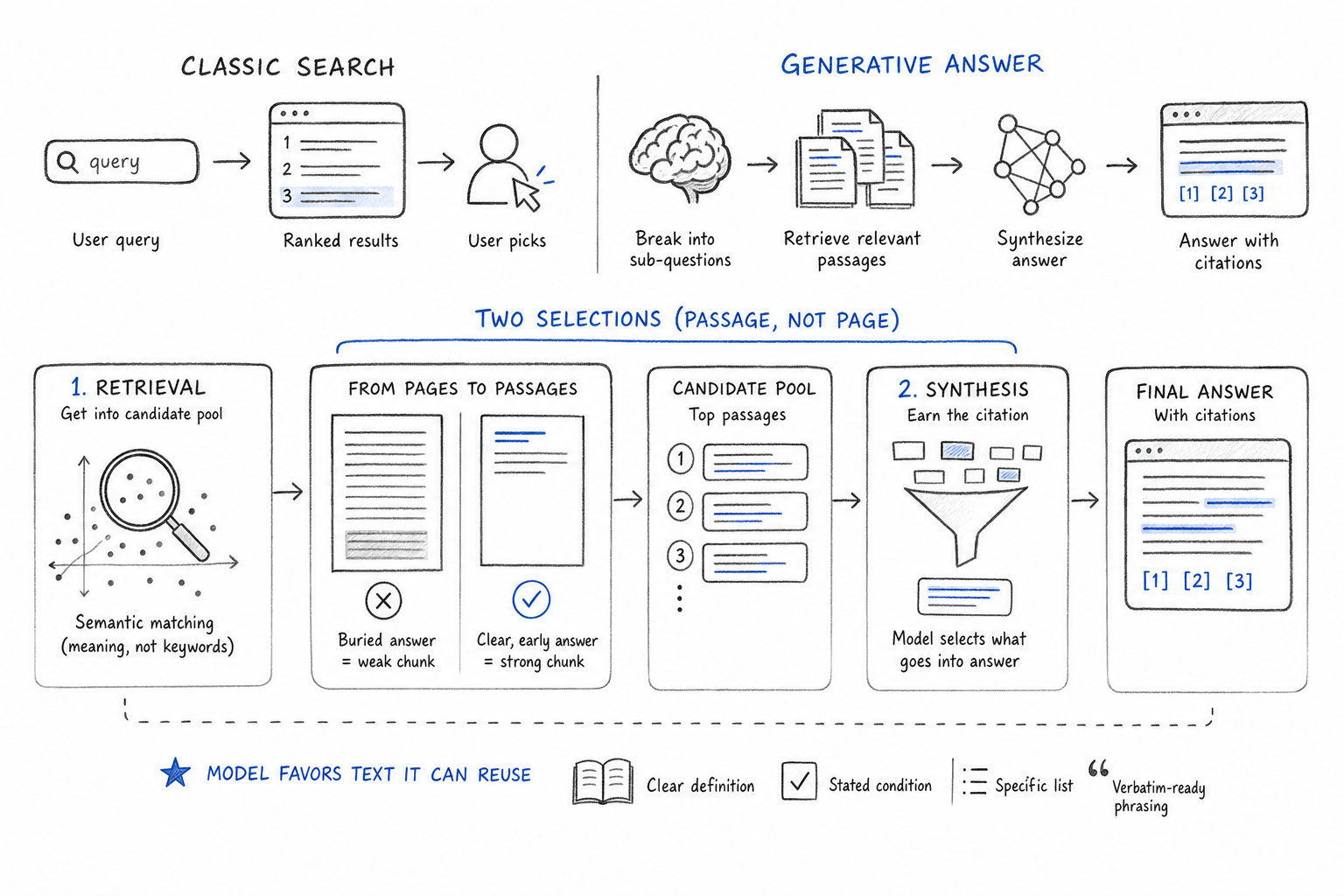
A generative answer works differently. The engine breaks the question into sub-questions, retrieves passages that look like they answer each one, then writes a single response that merges them, attaching citations to the sources it leaned on. The unit of selection is a passage, not a page, and the decision is made twice: once when the retriever picks candidate chunks, once when the model decides which of those chunks actually made it into the sentences it wrote.
Retrieval: getting into the candidate pool
Retrieval is semantic. The system is not matching your exact keyword string; it is matching meaning, usually against a vector of the question and vectors of indexed passages. A page that buries its answer in the eighth paragraph, after four paragraphs of context-setting, produces weak chunks. A page that answers the question in the first two sentences under a heading that matches the question produces a strong one.
This is the part most teams underestimate. You can hold position three and still never enter the candidate pool for the question that matters, because the passage that would have answered it does not exist as a self-contained block of text anywhere on your site.
Synthesis: earning the citation itself
Once passages are retrieved, the model writes. It favours text it can reuse almost verbatim: a clear definition, a stated condition, a number with its source of truth visible. Vague prose gets summarised away and loses its attribution. Specific prose gets quoted and keeps it.
There is a second filter here that has nothing to do with your page. When several sources say the same thing, the engine tends to cite the one that looks most established on that topic — the one with more pages covering it, more internal connections between them, more signals that this is a domain the site actually owns. A lone excellent article competes against a site with twenty articles on the theme, and usually loses.
The takeaway: optimise passages for retrieval and topic coverage for synthesis. Those are two jobs, and doing only one explains most disappointing results.
Why page-one companies still miss AI Overviews
This is the question that brings most people to GEO in the first place, so it deserves a direct answer before anything else.
The first reason is structural. AI Overviews expand the original question into several narrower ones, and cite whichever source answers each narrow one best. Your page may rank for the broad head term while saying nothing usable about the three sub-questions the engine actually decomposed it into. Ranking for the parent question does not imply coverage of its children.
The second is formatting. Pages written as continuous argument, with the conclusion at the end, give retrievers nothing to grab. Pages that state the answer, then explain it, hand the engine a ready-made citation. The same information, reorganised, changes the outcome.
The third is topical thinness. A site with one strong article on a subject and nothing around it reads as an outlier. A site with a pillar, a dozen supporting articles and links tying them together reads as a source. We go into the diagnostic detail of this gap in our guide to what happens to your SEO when you stop posting, which covers what decay looks like from the engine’s side.
The fourth is freshness. Answer engines lean toward recently updated material for anything time-sensitive, and a page last touched two years ago is a weaker candidate than an equivalent page updated this quarter — even if the older page ranks higher in the blue links.
If you want one action from this section: take your top five commercial queries, write down the five sub-questions each one implies, and check whether you have a page that answers each sub-question inside its first hundred words. Most teams find gaps immediately.
How google ai search decides which sources to quote
Different surfaces behave differently, and treating them as one target produces muddled work. Three families matter.
Google AI Overviews and AI Mode
These sit on top of the existing index. Being crawlable and indexed remains the entry ticket: if the classic index cannot see the page, the generative layer cannot cite it. From there the system runs its own retrieval over indexed content, decomposes the query, and assembles an answer with links to a handful of sources.
Practically, this means your technical foundations still matter and now matter differently. Clean heading hierarchy, descriptive titles, structured data and accurate alt text help the engine understand what each block of a page is about. Our guide to technical on-page SEO in 2026 covers those mechanics in the depth they deserve.
Assistants that browse the open web
When an assistant searches before answering, it typically issues a small number of queries to a search backend, reads the top results, and writes from what it finds. The chain has a bottleneck: whatever the backend returns is the entire universe the model sees. Conventional organic visibility feeds this pipeline directly, which is why GEO complements search work rather than replacing it.
The difference appears in what gets quoted from the retrieved page. Long pages with clear sectioning fare better than short pages, because the model can find the relevant slice. We break down that behaviour in our explainer on where ChatGPT search takes its sources from.
Answer engines that show sources by design
Perplexity and similar products make citation part of the interface: every claim carries a numbered source the user can click. That changes incentives. A source is quoted when it states something the model can attribute cleanly — a definition, a threshold, a procedure — and skipped when it only gestures at the idea.
These engines also tend to cite several sources per answer, which means the competition is not for one slot but for inclusion in a set of four or five. That is a far more winnable game than fighting for position one, and it is the reason mid-sized companies can appear next to much larger brands. The mechanics are detailed in our piece on how Perplexity picks and cites its sources.
Across all three families the pattern is the same: clarity at the passage level, breadth at the site level. Optimise the sentence the engine could paste, and the network of pages that makes your site look like the authority on the theme.
The structure that makes a site quotable
Here is the part GEO discussions usually skip, because it is architecture rather than a trick.
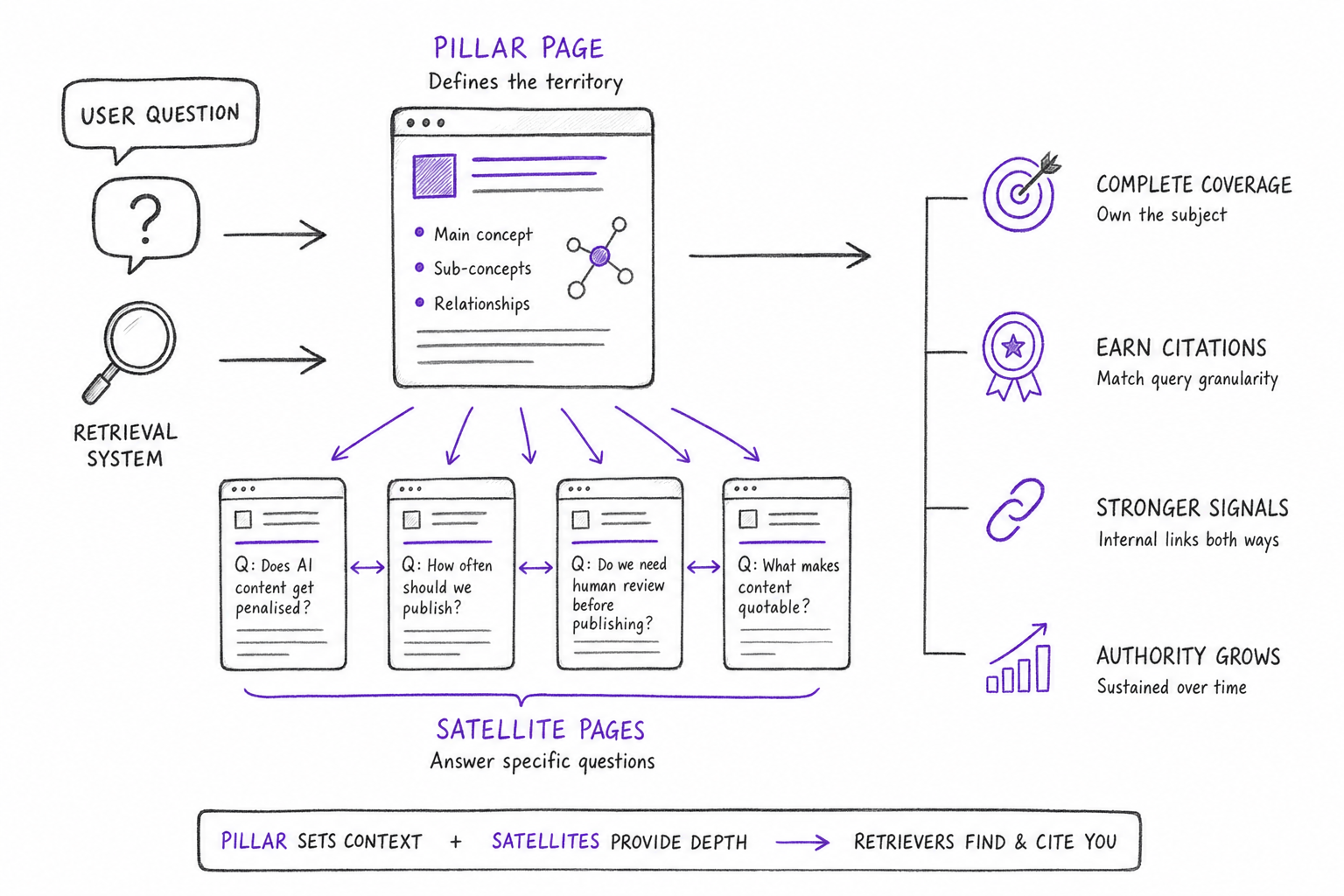
A topic tree is a set of pages organised around one theme: a pillar that covers the theme broadly, supporting articles that each answer one specific question inside it, and internal links connecting the whole set in both directions. It is the single most reliable way to signal that a site owns a subject, and it maps almost exactly onto how retrieval works.
Why the pillar matters
The pillar is the page that defines the territory. It gives the engine a document where the main concept is stated plainly, the sub-concepts are named, and the relationships between them are explicit. When a retriever needs a general answer, the pillar supplies it. When it needs a specific one, the pillar’s links point to the page that has it.
A pillar without satellites is just a long article. Its authority claim is unsupported, and it competes on prose quality alone against sites that can demonstrate coverage.
Why satellites do the citation work
Most real questions are narrow. “Does AI content get penalised”, “how often should we publish”, “do we need human review before publishing” — these are the questions people type, and each one deserves a page that answers it in its opening lines. Satellites are where citations are actually won, because they match the granularity of real queries.
The volume logic follows from this. If a theme contains forty legitimate questions and you publish one article a week, coverage takes most of a year and the tree is incomplete the whole time. At three a week the same tree closes in about three months and starts compounding. Three articles a week is the working floor for a blog that intends to own a topic, up to one a day on broad themes; anything measured in articles per month is a beginner’s cadence, not a benchmark. Consistency matters more than intensity: three a week sustained for a year beats fifteen in launch month followed by silence. Our analysis of how many blog posts per month a small business actually needs works through the arithmetic.
Why internal links are the connective tissue
Links between pillar and satellites do three things at once: they distribute authority, they tell crawlers which pages belong together, and they give retrieval systems a graph of related passages to move through. A blog of unconnected posts, however good each one is, gives none of those signals.
The practical rule is bidirectional linking with descriptive anchors: the pillar points down to each satellite using the question the satellite answers, and every satellite points back up. Our guide to pillar and supporting page internal linking sets out how to plan those connections before writing, and the broader method is laid out in our explainer on topic clusters and pillar pages.
This is exactly the mechanism RankGrove automates: it plans the tree, writes the pillar and the satellites, links them to each other and to the pages that sell, and keeps publishing on schedule. You can see the full process on the how it works page.
Writing pages an engine can actually quote
Structure gets you into the pool. Writing decides whether you get quoted.
Answer first, context second
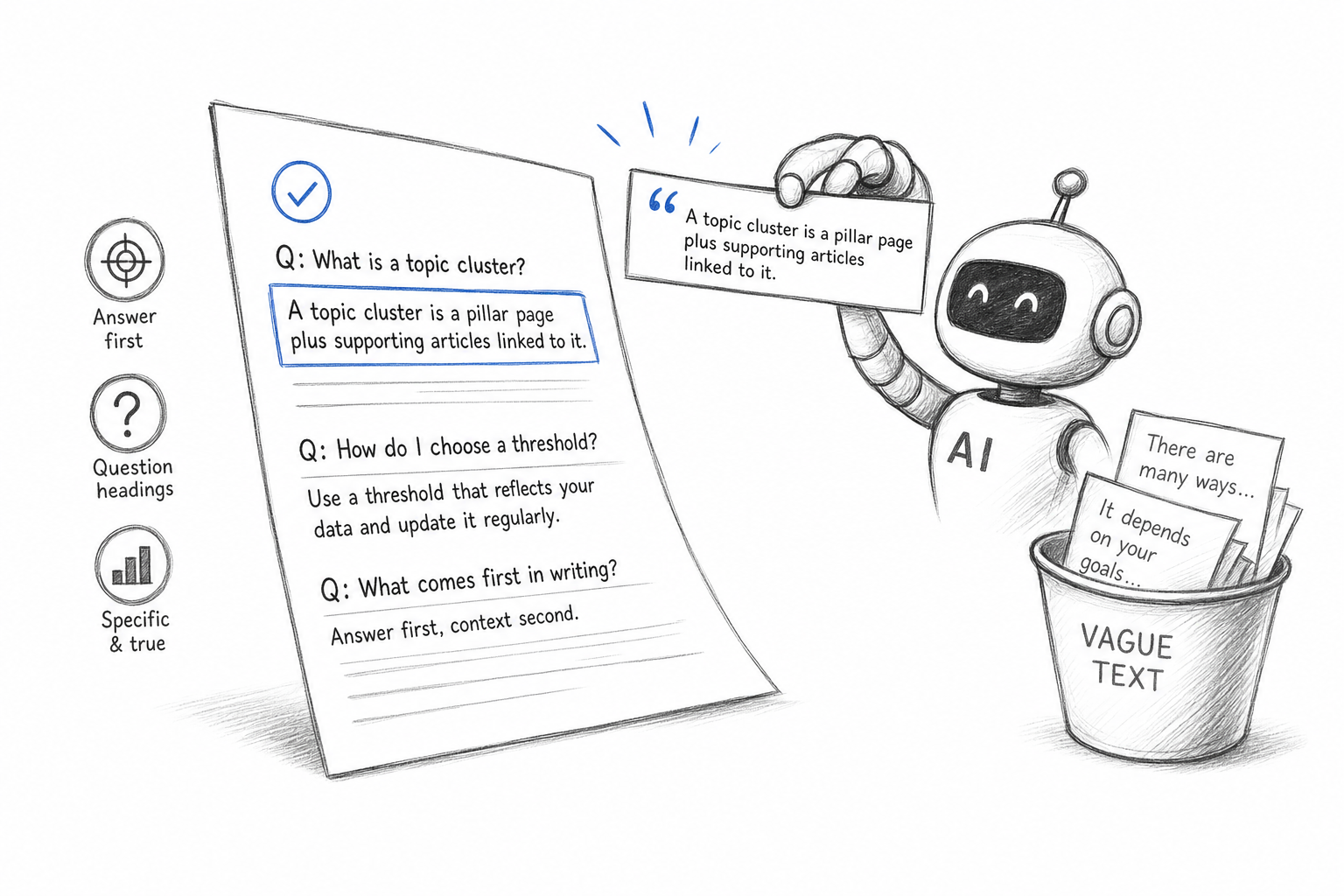
Every page should state its answer within the first two or three sentences, in a self-contained form that survives being lifted out of the page. “A topic cluster is a pillar page plus supporting articles linked to it” works as a standalone sentence. “There are many ways to think about clusters, and it depends on your goals” does not.
The same rule applies under every heading. Treat each section as if it might be read alone, because for retrieval purposes it will be.
Headings that match real questions
Generic headings like “Overview” or “Key concepts” carry no semantic signal. Headings phrased as the question a person would type — the same wording, not a cleverer version — give retrievers an exact match between query and section. This single change often moves pages into candidate pools they never reached before.
Specificity over hedging
Models reuse text that commits to something. A stated threshold, a named condition, a described sequence — these get quoted. Adjective-heavy prose that avoids claims gets compressed into a generic sentence with no attribution.
Specificity has a hard limit: it has to be true. Inventing statistics to sound authoritative is the fastest way to lose the trust you are trying to build, and readers in this audience spot fabricated numbers immediately. Where you have real figures — your own pricing, a public regulatory date, a calculation you show your working for — use them. Where you do not, describe the mechanism qualitatively and move on.
Sounding like a company, not a content mill
Content produced with AI assistance fails when it reads as interchangeable: no point of view, no named trade-offs, no opinions that could be disagreed with. The fix is editorial, not technical. Feed the system your positions, your pricing, your objections from real sales calls, and require that each article take a stance. We cover this in detail in our guide to making AI-assisted content read as trustworthy rather than generic, which also covers what sustains quality past the first few months.
Practical takeaway: rewrite the first paragraph of your five most important pages so each one answers its own title in the opening sentence. It is an afternoon of work and the cheapest GEO improvement available.
Quality, review and the AI-content question
Two objections come up in every conversation about publishing at GEO-relevant volume, and both deserve straight answers.
Does AI-assisted content get penalised
The operative standard is usefulness, not the method of production. Search systems target content that exists only to game rankings and adds nothing for a reader — and that description fits plenty of human-written pages. A well-researched, well-structured, accurate article does not become harmful because software drafted it, and a thin, derivative one does not become good because a person typed it.
Where the real risk sits is in what volume without oversight produces: repetition, factual drift, claims nobody checked. That is a process problem with a process fix. Our guide to E-E-A-T and whether AI-generated content gets penalised goes through the signals that actually matter and how to demonstrate experience on pages a machine helped write.
Is human review required before publishing
Yes, and for two independent reasons. Editorially, someone has to confirm the article says what the company believes, prices what the company charges, and does not contradict a page published last month. Nothing automated does that reliably.
Legally, the frame in Europe is transparency: content generated with AI assistance should be identifiable as such, in plain text and in machine-readable form, with a record of who approved what. Treating that as a disclosure to hide is the wrong instinct — stating it openly reads as confidence, and the record protects you. The workflow question is unpacked in our guide to human review before publishing AI content, which covers approval flows and safe auto-publishing.
The working model in 2026 is a system that researches, writes, illustrates and schedules, with a person who reads and approves. That combination is what makes three-a-week sustainable without turning quality into a coin flip.
Choosing tools without inheriting their problems
Most teams reach GEO through a tool decision, so the evaluation criteria matter.
What to evaluate
The first question is whether the tool plans or only produces. A generator that writes a good article from a prompt still leaves you the hard part: deciding which forty articles to write, in what order, and how they link. Planning is the scarce capability, and it is what separates a blog that accumulates authority from a pile of posts.
The second is whether it publishes. Tools that stop at a draft push the bottleneck downstream to whoever pastes into the CMS, which is exactly where weekly cadences die. The third is whether it links — internally, automatically, including to the pages that sell. The fourth is compliance: where data is processed, what the platform does with your inputs, and whether it produces the transparency markers European rules expect. We set out the full evaluation grid in our comparison of AI SEO tools for ranking in AI answers.
Compliance as a selection criterion
For a company publishing under European rules, a tool that produces excellent text but no transparency trail creates work rather than removing it. The features to look for are machine-readable marking of AI-assisted content, a visible transparency note, an approval log tied to a named person, and clear data-processing terms. Our overview of AI-assisted writing tools chosen with GDPR and AI Act in mind walks through what to check before signing.
The table below condenses the evaluation into the questions worth asking a vendor before a trial.
| Criterion | What to ask | Why it matters for GEO |
|---|---|---|
| Planning | Does it design a topic tree, or wait for my prompts? | Coverage, not single articles, earns citations |
| Cadence | Can it sustain three or more publications a week? | Gaps stall topical authority |
| Internal linking | Are links created automatically, both ways? | Links signal which pages belong together |
| Publishing | Does it post to the CMS, or hand me a draft? | Manual steps are where schedules break |
| Transparency | Plain-text and machine-readable AI marking? | Required posture in Europe, and a trust signal |
| Approval | Is there a tracked human review step? | Protects accuracy and creates a record |
Run those six questions against any candidate and most shortlists shorten themselves within a day.
A practical sequence for the next ninety days
Start with the inventory. List the questions your customers actually ask, in their words, pulled from sales calls, support tickets and the search console. Group them into two or three themes. Each theme becomes a tree: one pillar, plus a satellite for every question worth its own page. Our guide to keyword research that finds what customers really search covers how to do this without drowning in volume metrics.
Then fix the pages you already have. Rewrite openings so each one answers its own title immediately. Replace generic headings with the questions people type. Add the internal links that connect related pages, and make sure every one of them carries a descriptive anchor.
Then publish, at three a week minimum, without gaps, closing the tree question by question. Track the right things: which pages get cited in generated answers, whether branded queries rise, and whether the pages that sell receive traffic from assistant referrals. Those move slower than rankings and mean more.
Finally, keep the review step. One person reading before publication is the difference between a system that builds authority and one that accumulates liability.
Frequently asked questions
What is Generative Engine Optimization (GEO)?
GEO is the practice of making a website’s content likely to be retrieved and cited inside AI-generated answers, on surfaces such as Google AI Overviews, browsing assistants and answer engines. It focuses on passage-level clarity, question-shaped headings and topical coverage across linked pages, rather than on ranking a single URL in a list of blue links.
Does GEO replace traditional SEO?
No. Most generative answers are built from indexed or search-retrieved content, so crawlability, indexing and conventional relevance remain the entry ticket. GEO adds a layer on top: structuring passages so a model can lift them cleanly, and covering a theme across enough connected pages that the site reads as an authority rather than a one-off result.
Why does my site rank on page one but never appear in AI Overviews?
Usually because the answer engine decomposed the query into narrower sub-questions your page never addresses, or because the answer is buried mid-page instead of stated upfront. Thin topical coverage and stale publication dates also weigh against you. Audit the sub-questions behind your top queries and make sure a page answers each one in its opening lines.
Is AI-generated content penalised by search engines?
The standard applied is usefulness, not production method. Content that exists only to manipulate rankings is targeted regardless of who or what wrote it, while accurate, well-structured, genuinely helpful material is not disadvantaged because software drafted it. The practical risk of high-volume publishing is unchecked repetition and factual drift, which a human review step resolves.
How often should we publish to build AI search visibility?
At least three articles a week, and up to one a day on broad themes, held without gaps. Coverage is what earns citations, and a theme containing dozens of real questions closes in months at three a week versus most of a year at one. Consistency beats bursts: a sustained rhythm outperforms a launch spike followed by silence.
Do we have to disclose that content was written with AI?
In Europe the expectation is transparency: content produced with AI assistance should be identifiable in plain text and in machine-readable form, with a record of who approved it. Treat it as a trust signal rather than a liability. A visible note plus structured marking and a tracked approval step covers the requirement and reassures readers.
How do we measure whether GEO is working?
Track citation appearances in generated answers for your priority questions, growth in branded and navigational searches, and referral traffic from assistant and answer-engine sources to commercial pages. These signals move more slowly than keyword positions and are harder to read week to week, so evaluate them over quarters rather than days.
Where this leaves you
The shift worth internalising is that generative engines select passages and trust sites. A single excellent article can supply a passage; only a connected set of pages, kept current, makes a site look like the source worth quoting — which is why GEO ends up being an editorial architecture problem rather than an optimisation trick.
If you want the underlying research on how these systems retrieve and cite, and how topic trees map onto that behaviour, explore our research on AI search and citation and then decide which of your themes deserves the first tree.
This article was produced with the help of artificial intelligence and reviewed by our editorial team before publication.
Start today
A blog like this, on your site
This article was written and published by RankGrove, with the method you read about on the site. Try it free on your WordPress: the first article lands in your drafts within ten minutes.
Start free trial