FAQ
Frequently asked questions
Answers to the questions businesses ask us most often, including those about the AI Act, Google and content ownership.
Are the articles written with artificial intelligence?
Yes, and we say so openly: it is the reason a well-kept blog becomes sustainable. The difference lies in the system around the writing: a topic tree, quality checks, original images and, above all, your approval. Every article starts as a draft on your WordPress: you decide what goes online, for as long as you like, until you choose to automate publishing.
What does the AI Act require for AI-generated content?
The AI Act (EU Regulation 2024/1689) is the European law on artificial intelligence, and its transparency obligations apply from 2026. For text content the relevant point is Article 50: anyone using AI to generate text published to inform the public on matters of public interest must disclose it, unless the content goes through human review and someone takes editorial responsibility for it.
With RankGrove you are covered on both routes. If you wish, you review and approve every draft before publication: editorial responsibility stays with you and is documented, which is exactly the case covered by the exception. If instead you choose automatic publishing, perfectly legitimate, we help you set up a transparency statement about the use of AI on the blog, so the requirement is covered and readers know how the content is produced.
This information describes how the product is built and does not replace legal advice on your specific case.
My blog is in several languages: can RankGrove write in all of them?
Yes, with an editorial line per language. RankGrove writes natively in twenty-two European languages: the English blog of an Italian company has its own keywords, its own topics and its own calendar, designed for people reading in English, written directly rather than translated from Italian.
On your WordPress you need Polylang (the free version is enough) with the blog languages already created. Then on RankGrove you create one project per language, with the same site address and the same plugin key: every article is created in the language of its project and in the categories of that language, and each project keeps its own content. The plugin handles this on its own, from version 1.5.9. With Polylang left out, a WordPress site has a single language and keeps one project per site.
Do I have to tell readers that the content is made with AI?
The choice, and the responsibility for compliance in your case, is yours: every company has a different sector, audience and level of caution. RankGrove gives you the tools to do it in one click, if and when you decide to: a transparency note at the end of articles, in the blog's language, switched on when the project is created and adjustable from the settings with one toggle.
Two things we do for you by design: the machine-readable technical marking of generated content (the machine-readable format required by the AI Act, the same one Google asks for on AI images) and the tracking of approvals: every human review stays documented, so if one day you need to demonstrate your editorial control, you already have the proof.
Does disclosing the use of AI hurt rankings on Google or in AI answers?
No. Google states that it does not penalise content based on how it is produced, and the transparency note has no effect on rankings. The technical marking of AI images is in fact a standard Google asks for. What does get penalised is something else: mass production of poor content to manipulate results, the opposite of the RankGrove method, which works on structure, quality and consistency. The same goes for AI answer engines: they cite content for usefulness and authority.
An agency produces content for me with AI: am I fine with the AI Act?
It depends, and it is worth asking them in writing. Responsibility for the content published on your site lies with whoever publishes it: you. If the people who produce it for you leave out machine-readable marking, traceability of reviews and a clear line on transparency, the risk stays with you, not the supplier: it lands on your domain.
The questions to ask any automated content provider (they apply to us too): is the content marked as required by Article 50? Are human reviews documented? Who takes editorial responsibility? RankGrove was built with these answers built in: it is the difference between having content produced and having content produced that you can stand behind.
How long does it take to see results?
Months, not days. We say it plainly because it is the truth of the trade: organic visibility is built over time. Google and the AI systems have to discover the content, assess it and come to trust it. The first signals, indexing and first impressions, arrive within weeks; the results that matter (traffic, citations, enquiries) mature in 3-6 months and keep growing from there, because every article also works for the ones before it.
That is why method matters more than haste: anyone planting a wood measures it in years, not after a week. Be wary of anyone promising organic results in days.
How often should I publish?
As often as your topic requires, with consistency. As a rule of thumb: at least 3 well-made articles a week to hold a niche; broad, competitive sectors pay off with 5 or more; on the widest topics daily publishing is what pays best. RankGrove goes up to one article a day per site, and always keeps fresh topics ready in the reserve.
During setup you choose your publishing days and you can change them whenever you like. And one choice we made for you: RankGrove publishes at most one article a day per site, because consistency beats volume.
If people stop at the AI answer, is SEO still worth it?
It is, but the entry point has changed. More and more often, people looking for a supplier ask ChatGPT, Gemini or Perplexity, or read Google's AI Overview, and stop there: the old results page gets fewer clicks. The game has moved inside the answer, and AI systems build their answers from the content they find authoritative: clear, structured, up to date, on domains that own their topic.
This is the work RankGrove calls GEO: using the blog to build the authority that AI systems recognise and cite. Whoever is in the answer meets the customer; a well-kept blog is the most effective way a company has to be there today.
Does Google penalise content written with AI?
No: Google states that it judges content on quality and usefulness, whatever the method used to produce it. What gets penalised is poor, mass-produced content made purely to rank. That is exactly the difference between an article generator and a system: structure, originality, accurate data, real industry experience. It is why RankGrove works on the topic tree and on quality checks, rather than on volume. The sources page carries Google's official position, with a link to the original document.
But isn't AI-written content full of mistakes?
It's the most widespread myth, and it comes from a real experience: asking a generic chatbot for an article, with no context and no checks, produces vague and sometimes invented text. But that is the naive use of the tool, not the craft.
RankGrove works differently: every article starts from the description of your company (written and approved by you), inside a plan that defines its theme and purpose, with sources cited and automatic checks before delivery on structure, links and consistency. And today's models are a long way from the 2023 folklore that shaped the myth.
That said, every system, human or artificial, can slip: which is exactly why articles arrive as drafts for you to approve. The last word is yours, always. It's the combination that works: the machine handles the volume and the technique, you guarantee the truth of your trade.
What about the GDPR? Where is my data kept?
RankGrove is an Italian project built for European businesses: the GDPR is a design requirement, part of the product from day one. Published content lives on your WordPress and stays yours; the information you entrust to us for writing (company description, audience, preferences) is used solely to generate your content. The full privacy notice is on the Privacy page, with the DPA for those who need it.
What exactly does the WordPress plugin do? Is it safe?
The plugin does one thing: it receives articles and uploads them as drafts (or publishes them, if you decide so). The connection uses a signed key and never asks for your site passwords, and every request is verified cryptographically. You can revoke the key at any time from the plugin panel, and the connection stops instantly.
Can I review articles before they go live?
Yes, and that's the default behaviour: every article arrives as a draft on your WordPress. You open it, tweak it if you like, publish it with one click. Automatic publishing is an option you switch on once you trust it, and you can switch back whenever you want.
Does the content remain my property?
Yes. Articles are published on your site, inside your WordPress, and they are yours. If one day you stop using RankGrove, the blog you have built stays at home with you and keeps working for your visibility.
How is this different from writing articles with ChatGPT?
A generic AI writes good text; building visibility is another craft: it takes a plan with a structure (topic tree, pillar articles, categories), coherent internal links, verified SEO technique, original images, and the discipline of publishing consistently. RankGrove does all of this as a system: the comparison table shows the differences point by point.
How much of my time does it take?
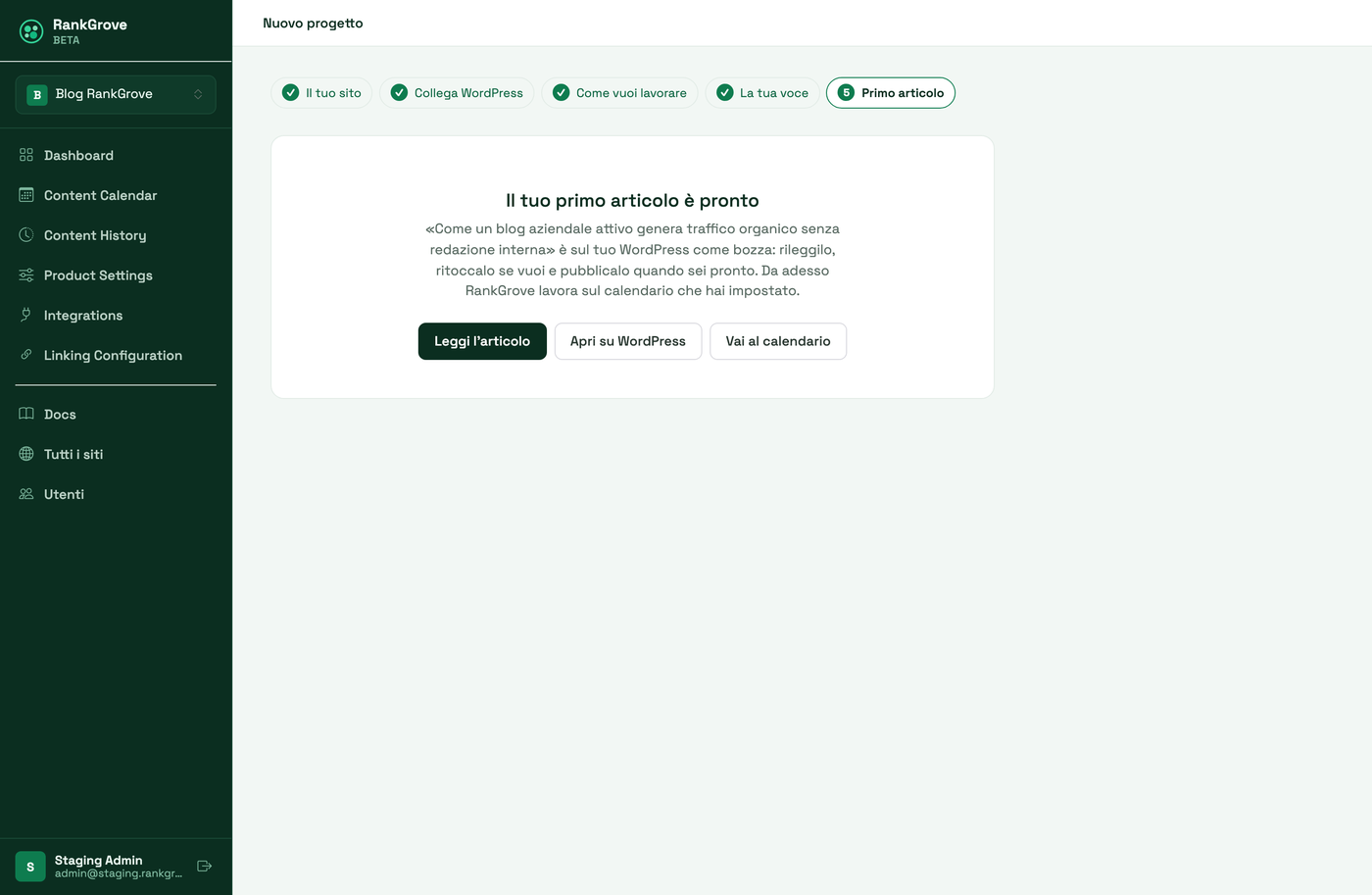
Ten minutes to get started: the guided setup ends with your first article already in draft on your site. After that, the time it takes to read and approve articles on the days you have chosen: minutes, not hours. Everything else (research, writing, images, layout, publishing) is RankGrove's work.
Does it only work with WordPress?
Yes, WordPress only: we prefer to do one thing and do it well, and it is by far the most widely used CMS among businesses.
Which languages does it publish in?
In 22 European languages: Italian, English, Spanish, French, German, Portuguese, Dutch, Polish, Czech, Slovak, Hungarian, Romanian, Bulgarian, Greek, Croatian, Slovenian, Swedish, Danish, Finnish, Estonian, Latvian and Lithuanian.
The language is chosen project by project and applies to everything: keywords are researched with the search volumes of that country, the article is written in that language from the start, and the table of contents and the transparency note arrive translated. An Italian company opening a blog in Spanish gets it in Spanish, while staying in Italy.
Can I have blogs in different languages?
Yes: one project per language, each with its own topic tree, its own calendar and its own WordPress site, all from the same account. From the second active project the price drops by €15 a month, and from the fifth by €30. See pricing →
Start today
Your first article, ten minutes from now
Try it free on your own site: connect WordPress, tell us about your company, and the first article lands in drafts while you finish your coffee.