Organic visibility for businesses
Get found on Google. Get cited by AI.
Your customers now ask a search engine or an artificial intelligence. RankGrove builds the content that puts you in those answers, and publishes it straight to your WordPress, up to one article a day.
The means is a well-tended blog that grows on a thought-out structure. The goal is a single one: when people search for what you do, they find you.
The problem
“Latest post: March 2024”
It happens to almost every company blog: they start with enthusiasm, then the real work eats up the time. And a blog that has stopped still says something: visitors read it as neglect, and search engines and AI read it as a company that has run out of things to say.
Meanwhile, AI still has to recommend someone to whoever asks. It picks those who publish, who own the topics, who answer the questions, and if that is your competitors, it recommends them. Instead of you.
A living blog is the simplest signal that your company is alive. RankGrove keeps it alive for you.
Start free trial See howThe method
A grove that grows together, article after article.
This is where RankGrove differs from article generators: every piece is born inside a topic tree: pillar articles that own the big themes, supporting articles that answer specific questions, internal links that hold it all together. It is the structure search engines reward and the one AI draws on.
Blog topic tree
The map of your industry's topics, built before a single word is written.
Pillar articles
The reference guides that own the most important searches.
Managed categories
The blog stays tidy and readable, for people and for crawlers.
Automatic internal links
Every article points to its neighbours and pushes the pages that sell.
Where it takes you
Written for people. Optimised for search engines. Ready for AI.
SEO has changed: until yesterday the work was about the click on Google, today more and more people ask ChatGPT, Gemini or Perplexity and stop at the answer, and on Google itself the AI Overview answers before the results: when the AI answer appears, clicks through to websites are halved (the sources, with the numbers). You win the customer inside that answer: that is why authority has to be built on AI platforms as well as on search engines. And the blog is today the most effective way to do it: fresh, structured content on your own domain, exactly the material those answers draw on when they decide who to cite.
People: getting read
Content made with AI that people are happy to read: your company's tone of voice, concrete examples, sentences that sound like they were written by someone who does the job. Because visibility counts for little if the page then bores whoever lands on it.
SEO: getting found
Heading structure, meta, structured data, keywords with clear intent, original images with alt text: every article comes out technically sound, and you can leave the checking to us.
GEO: getting cited
AI cites content that is clear, structured and authoritative. RankGrove writes it that way by default: TL;DR up top, table of contents, FAQ at the end with JSON-LD markup: that is the difference between being there and being picked up in the answer.
22 European languages, one per project
Your blog speaks the language your buyers speak: pick the language when you create the project and everything follows it, keywords researched with that country's volumes, the article written in that language, index and transparency note translated. An Italian company opening a blog in Spanish gets it in Spanish, while staying in Italy. Selling in three countries? Three projects, from the same account. Available languages →
AI Act compliant, by design
From 2026, AI-generated content follows European transparency rules, and RankGrove was born in Europe with those rules built into the product: machine-readable marking of content, approvals tracked and documentable, a transparency note whenever you want one. Tools born elsewhere are still catching up with the AI Act; here it is included in the price. Ask any AI content tool how it handles the AI Act. Then ask us. This holds true even when an agency produces the content for you: responsibility sits with whoever publishes, which means you. Everything about the AI Act, explained simply →
How it works
From zero to a blog that works, in three moves
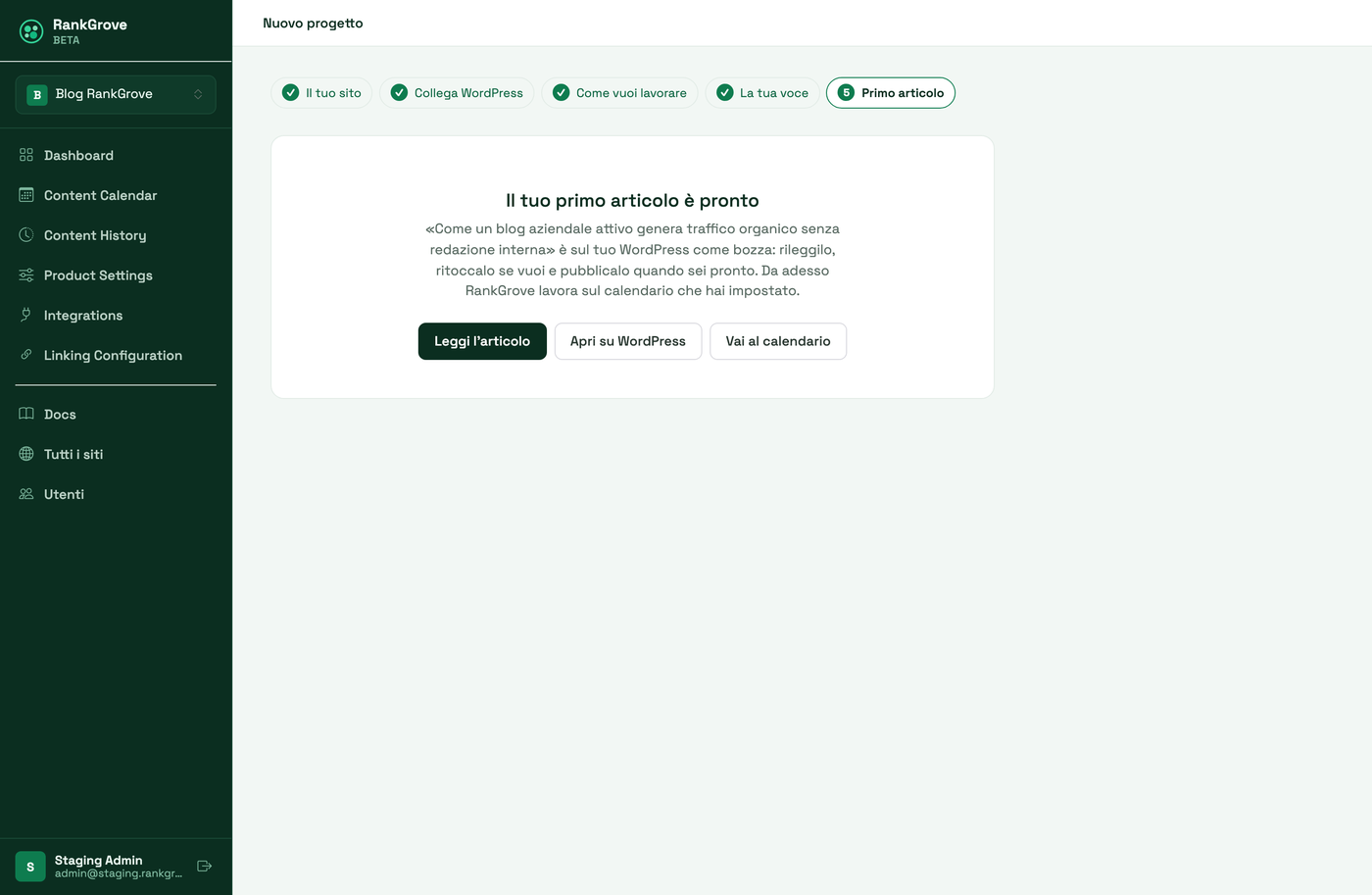
A wizard takes you to your first article. In ten minutes.
You connect WordPress with a key (2 minutes), describe your company using the draft RankGrove generates from your site (5 minutes), and you get five ready-made titles: choose one, or write your own, and the writing begins. Tips and copyable examples at every field.

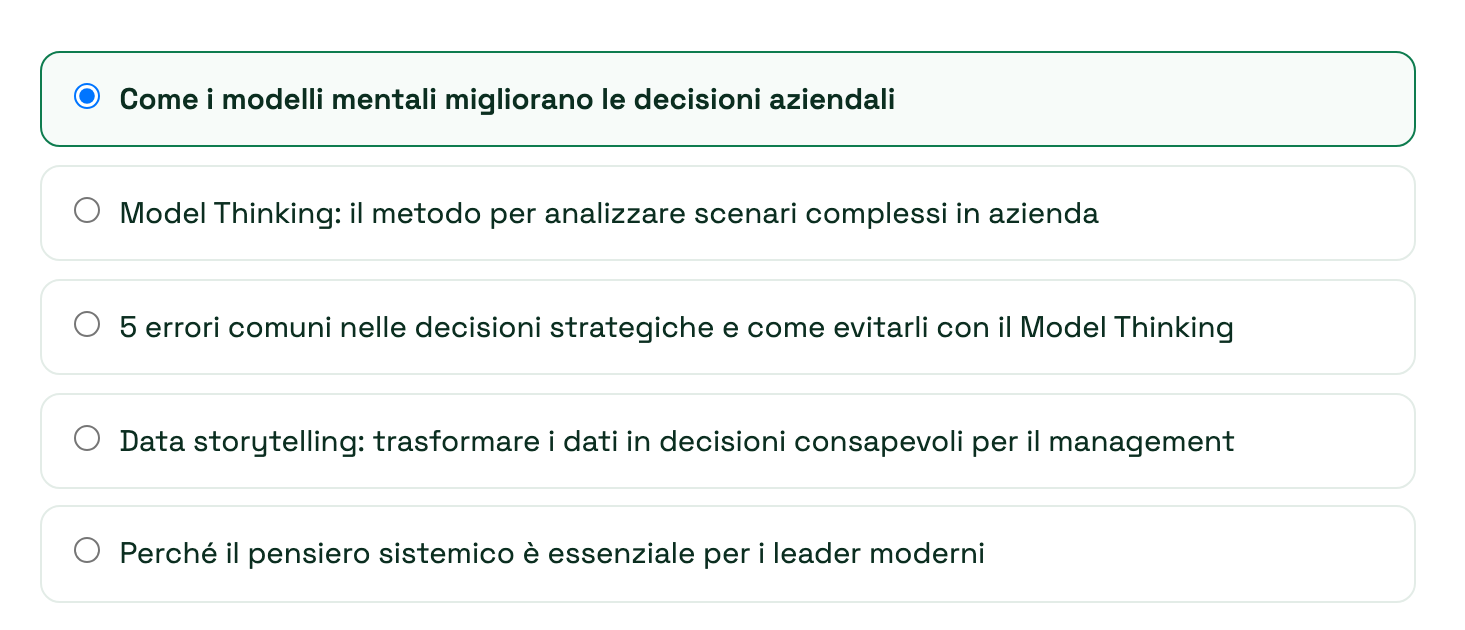
Ten minutes later, it is a draft on your WordPress
While you finish the setup, the article writes itself: text in your voice, original images, technical SEO verified. You open it on your WordPress, tweak it if you like, publish it with one click. The final word is always yours.
Start free trial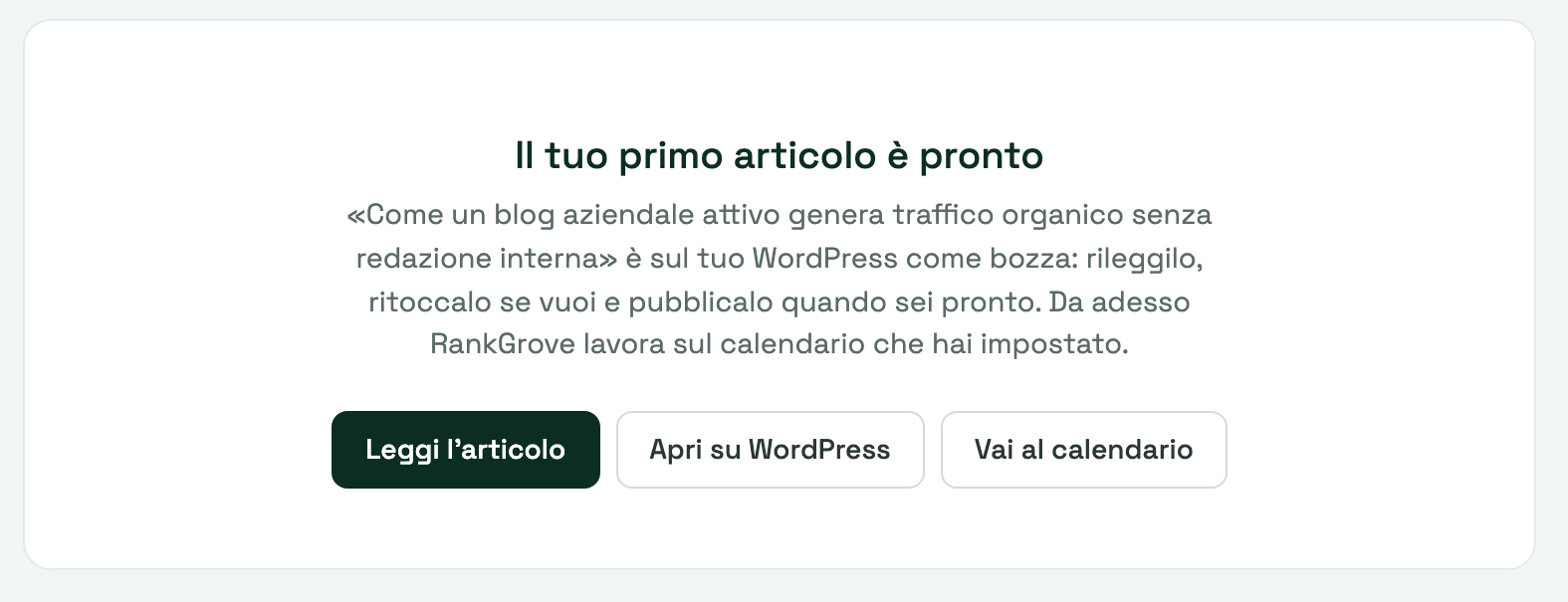
Then the calendar fills itself. Up to one article a day.
On the days you choose, articles are written ahead of time and go live on the scheduled date, all by themselves. And if you want to keep the final word, every article waits for you as a draft: one click and it is out. That is extra freedom, the work is done by RankGrove either way.
Start free trial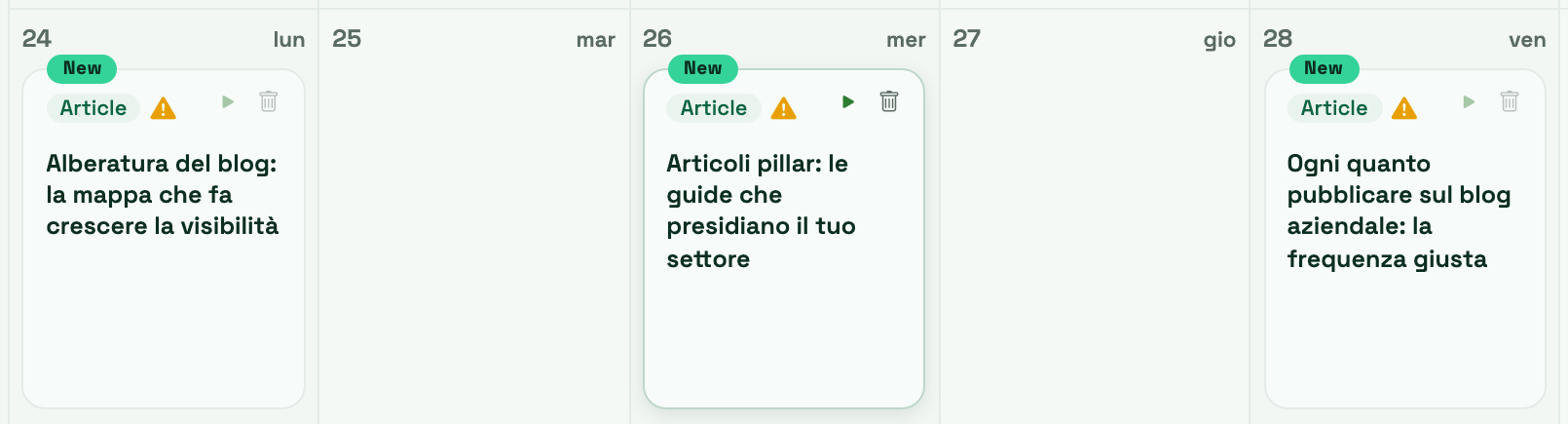
Real screenshots of the product, exactly as it is today.
Born in Italy. RankGrove is designed and developed in Italy by consultants who work on SEO and data for real businesses every day, and for anyone who wants it there is the supervised version, with the editorial plan curated by people. About →
The proof
The RankGrove blog is written by RankGrove
Topic tree, pillar articles, scheduled publishing: on our blog we use exactly the product you see here. Read it and judge the quality with your own eyes.
Open the blogStart today
Your first article, ten minutes from now
Try it free on your own site: connect WordPress, describe your company, and the first article lands as a draft while you finish your coffee.
Looking after blogs for several clients?
One account for the agency, one site for each client, and the price drops with every extra project: −15 €/month from the second, −30 € from the fifth.