SEO Content Structure & Topic Clusters
Topic Clusters and Pillar Pages: How to Structure an SEO Blog

A blog made of unconnected posts gives search engines and AI assistants no reason to treat you as a source on anything. The topic-cluster model fixes that: one pillar page owns the theme, supporting articles answer the specific questions around it, and internal links tie them together and point at the pages that sell. This article explains how the structure works, why it beats generating isolated articles one at a time, and what to build first.
Most company blogs fail in the same quiet way. Someone commits to publishing, the calendar gets filled, and after a year there are forty or sixty articles online. Traffic is flat. The pages that do get impressions are the wrong ones. Nobody links to anything. And when a prospect asks an AI assistant a question squarely inside your area of expertise, the answer cites three other companies.
The instinct is to blame the writing, or the volume, or the algorithm. The actual problem is usually structural. Those forty articles are forty separate objects. Each one was chosen on its own, written on its own, published on its own. None of them tells a search engine what this site is about, because none of them is connected to the others. There is no center of gravity.
An seo optimization strategy that works starts from architecture rather than from output. You decide which themes you intend to own, you build one comprehensive page per theme, you surround it with articles that answer the narrower questions people actually type, and you link them so authority flows in both directions and out toward the pages that generate revenue. That shape has a name: the topic cluster.
This article explains what a pillar page is, what supporting articles do, how internal linking distributes authority, and why building a planned structure outperforms producing one-off pieces indefinitely. It also maps the sub-themes a complete cluster needs so you can see where the work actually goes.
Contents
- Why publishing consistently stopped being enough
- What a pillar page actually is, and what it is not doing
- What supporting articles do that the pillar cannot
- How internal links move authority through the cluster
- Why a planned tree beats generating articles one at a time
- The subtopics a cluster needs to cover
- Building your first cluster without stalling
- Frequently asked questions
- The structure is the strategy
Why publishing consistently stopped being enough
Publishing regularly used to be close to sufficient. A steady stream of decent pages on relevant terms would accumulate rankings over time because most competitors were not publishing at all. That advantage is gone. The cost of producing a competent article has collapsed, and the volume of competent articles has exploded. Competence is now the floor, not the differentiator.
What separates sites that rank from sites that do not is topical authority: the accumulated evidence that a domain covers a subject thoroughly rather than touching it once. Search engines infer this from coverage breadth, from how internal pages reference each other, from whether the site answers the follow-up questions a real reader would have after the first article. A site with one article on a theme looks like a site that had one idea. A site with a pillar and twelve supporting pieces looks like a site that works in that field.
The same logic now governs AI-generated answers. Large language models assembling a response pull from sources that appear authoritative and well-structured on the specific question being asked. When your coverage is a single thin page, there is nothing to pull. When it is a connected body of work with clear headings, direct definitions and explicit answers to sub-questions, there is a lot to pull, and your brand name travels with it. Generative engine optimization is mostly a structure problem wearing a new name.
There is a second failure mode worth naming, because it compounds the first. Blogs stop. The founder gets busy, the marketing lead changes role, the agency contract ends. The archive sits there ageing, and the decay is not neutral — it is visible to both visitors and crawlers. We covered that dynamic separately in what happens to rankings when a blog stops publishing, and the short version is that an abandoned archive loses ground faster than an empty one, because competitors keep moving.
The practical takeaway: before you commission another article, ask which theme it belongs to and what it connects to. If you cannot answer, the article will be an orphan, and orphans do not rank.
What a pillar page actually is, and what it is not doing
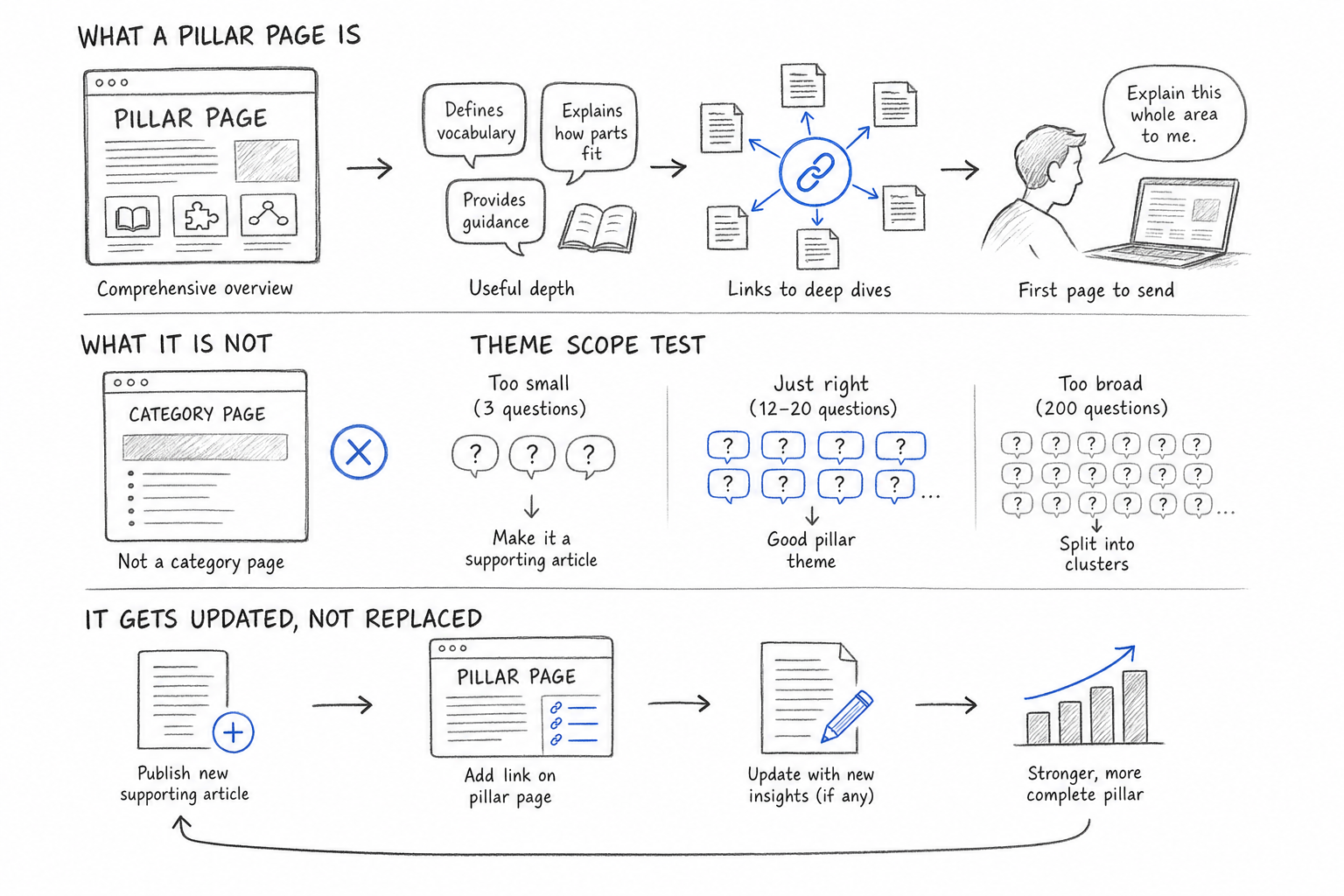
A pillar page is the single comprehensive page that owns a broad theme on your site. It covers the whole subject at a useful depth, defines the vocabulary, explains how the parts fit together, and links out to the narrower articles that treat each part in detail. It is the page you would send someone who said “explain this whole area to me.”
Two things go wrong when people build their first one.
It is broad, but it is still specific
A pillar is not a category landing page with a paragraph of introduction and a list of links. It has to be readable on its own — someone who lands on it from search and never clicks anything should leave understanding the subject. That means real explanation, real definitions, real judgment calls.
At the same time, the theme has to be narrow enough that a company can plausibly own it. “Marketing” is not a theme, it is an industry. “How manufacturers structure a technical blog for distributor discovery” is a theme. The test is whether you can imagine twelve to twenty distinct questions underneath it that each deserve their own page. If you can only think of three, the theme is too small and should be a supporting article under something larger. If you can think of two hundred, it is too broad and needs splitting into several clusters.
It gets updated, not replaced
The pillar is the most durable asset in the cluster. Supporting articles come and go as questions change; the pillar accumulates. Every time you publish a new supporting piece, the pillar gains a link and, if the piece introduced a genuinely new angle, a sentence or two acknowledging it. Over two or three years this page becomes long, dense and heavily interlinked — which is exactly the profile of a page that ranks for competitive head terms.
Practically, treat the pillar as a living document with an owner. If nobody is responsible for it, it will be written once and abandoned, and the cluster will lose its center.
What supporting articles do that the pillar cannot
Supporting articles — sometimes called satellites or cluster content — each answer one specific question that a real person types into a search box or an AI assistant. They are narrower than the pillar by design, and that narrowness is the source of their value.
A pillar covering blog structure cannot rank for “how do I find which keywords my customers actually search” and “do I really need internal links between my posts” and “how do I set up a blog in five European languages” simultaneously. Those are different intents with different competitors. Each needs its own page, its own title, its own direct answer in the first two paragraphs.
Three characteristics separate a genuine supporting article from a piece of filler.
It answers a question someone actually asked
The question comes from evidence — search data, sales calls, support tickets, the things prospects ask in demos — rather than from a brainstorm. A supporting article on a question nobody asks will be perfectly written and permanently invisible.
It stays in its lane
The temptation is to re-explain the whole subject before getting to the point, because it feels more complete. It makes every article in the cluster look like a slightly worse version of the pillar, and it means several of your own pages compete for the same query. Say what the reader needs on this question, link to the pillar for context, and stop.
It links back, and sideways
Every supporting article links to the pillar with an anchor that describes the theme. Where it genuinely helps, it links to sibling articles too. This is not decoration — it is the mechanism that makes the cluster legible as a cluster rather than as a folder of files.
The takeaway: judge a supporting article by whether it fully resolves one question, not by whether it covers the subject. Coverage is the pillar’s job.
How internal links move authority through the cluster
Internal linking is the part most teams skip, and it is the part that converts a pile of articles into a structure. The mechanics are worth understanding rather than delegating to a plugin.
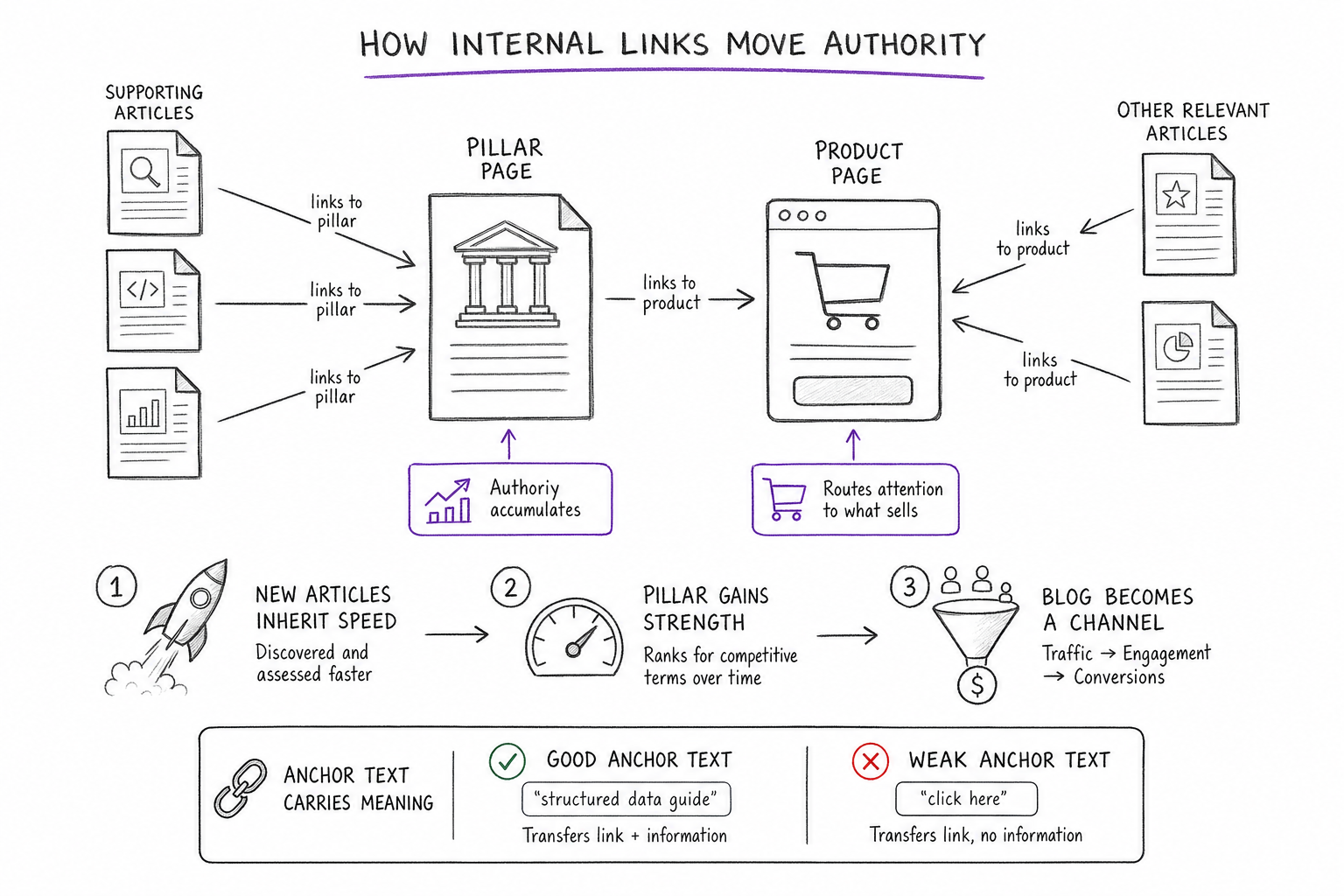
When one page on your site links to another, it passes a share of its own accumulated standing along with a signal about what the destination page is about — carried mostly by the anchor text. Do this systematically inside a theme and three things happen.
First, the pillar accumulates. It receives a link from every supporting article in the cluster, so as the cluster grows, the pillar’s internal link profile grows with it. That is why pillars tend to start ranking for competitive terms months after the supporting pieces do.
Second, new articles inherit. A brand-new supporting page that is linked from an established pillar gets discovered and assessed faster than an isolated post nobody points at. Publishing into an existing structure is materially different from publishing into a void.
Third — and this is the part that matters commercially — the cluster routes attention toward the pages that sell. A reader arriving on a supporting article about, say, structured data is three clicks from nothing unless you put the path there. Pillar links to product page, supporting articles link to pillar, relevant articles link directly to the product page where the intent justifies it. The blog stops being a traffic report and starts being a channel.
Anchor text carries the meaning
“Click here” and “read more” transfer a link but no information. An anchor that describes the destination — the theme, the question, the outcome — tells search engines and readers what they will get. Write anchors as if the link text had to work with the surrounding sentence removed.
Links have to be maintained, not just placed
Clusters grow. An article published in month three should be linked from the article published in month fourteen if they are related, which means somebody has to revisit older pieces and add the connection. Done manually, this is the task that silently gets dropped first. Done automatically, it is the difference between a structure that compounds and one that fossilizes at the size it reached when the team got busy.
The practical move: before publishing anything, decide which existing pages will link to it and which pages it will link to. If the answer is “none,” you are about to create an orphan.
Why a planned tree beats generating articles one at a time
There is a meaningful difference between producing content and building an asset, and it shows up in how the work is planned.
Generating articles one at a time means each piece is chosen in isolation. The keyword looks good, the brief gets written, the article ships. Repeat weekly. After a year you have a set of individually reasonable pages with no relationship to each other, frequent overlap between two or three of them, and no page positioned to rank for the head term that actually describes your business. The tools that stop at “here is a draft on this keyword” produce exactly this outcome, at speed.
Planning the tree first inverts the sequence. You choose the themes you intend to own — usually two to five, matched to what you sell. For each theme you define the pillar. Under each pillar you map the questions that deserve their own page, grouped and prioritized. Only then do you start writing, and every article you publish lands in a slot that was designed for it.
The differences compound in four ways worth spelling out.
Cannibalization disappears. When the map is drawn in advance, no two articles target the same intent, because the overlap is visible before anyone writes. Without a map, you discover the duplication months later when two of your own pages are splitting impressions for the same query.
Coverage becomes visible. A planned cluster shows you what is missing. You can look at the tree and see that you have nothing on multilingual setup, or nothing on measurement, and schedule it. Without the tree you only notice gaps when a prospect mentions them.
Internal linking is automatic rather than aspirational. If the structure is defined, every new article already knows its parent and its siblings. The links get placed at publication, not in a cleanup sprint that never happens.
Publishing cadence stops being arbitrary. A tree implies a queue: this many supporting articles, at this rhythm, to complete this cluster. That converts the perennial “how often should we post” question into a finite plan. We looked at that question directly in how many posts a month a small business actually needs, and the honest answer depends far more on cluster size than on any universal number.
Here is the difference stated plainly.
| Approach | What you get after a year | Where it breaks |
|---|---|---|
| One article at a time | A set of unrelated pages | No head-term ranking, overlapping posts, no internal links |
| Planned topic tree | Two to five owned themes | Requires upfront mapping before writing starts |
| Pillar only, no satellites | One strong page | Nothing ranks for specific long-tail questions |
| Satellites only, no pillar | Scattered long-tail traffic | No authority page, no route to the product |
The takeaway: the upfront mapping is a few days of thinking that determines whether the next hundred articles compound or accumulate. Do it before the first brief.
The subtopics a cluster needs to cover
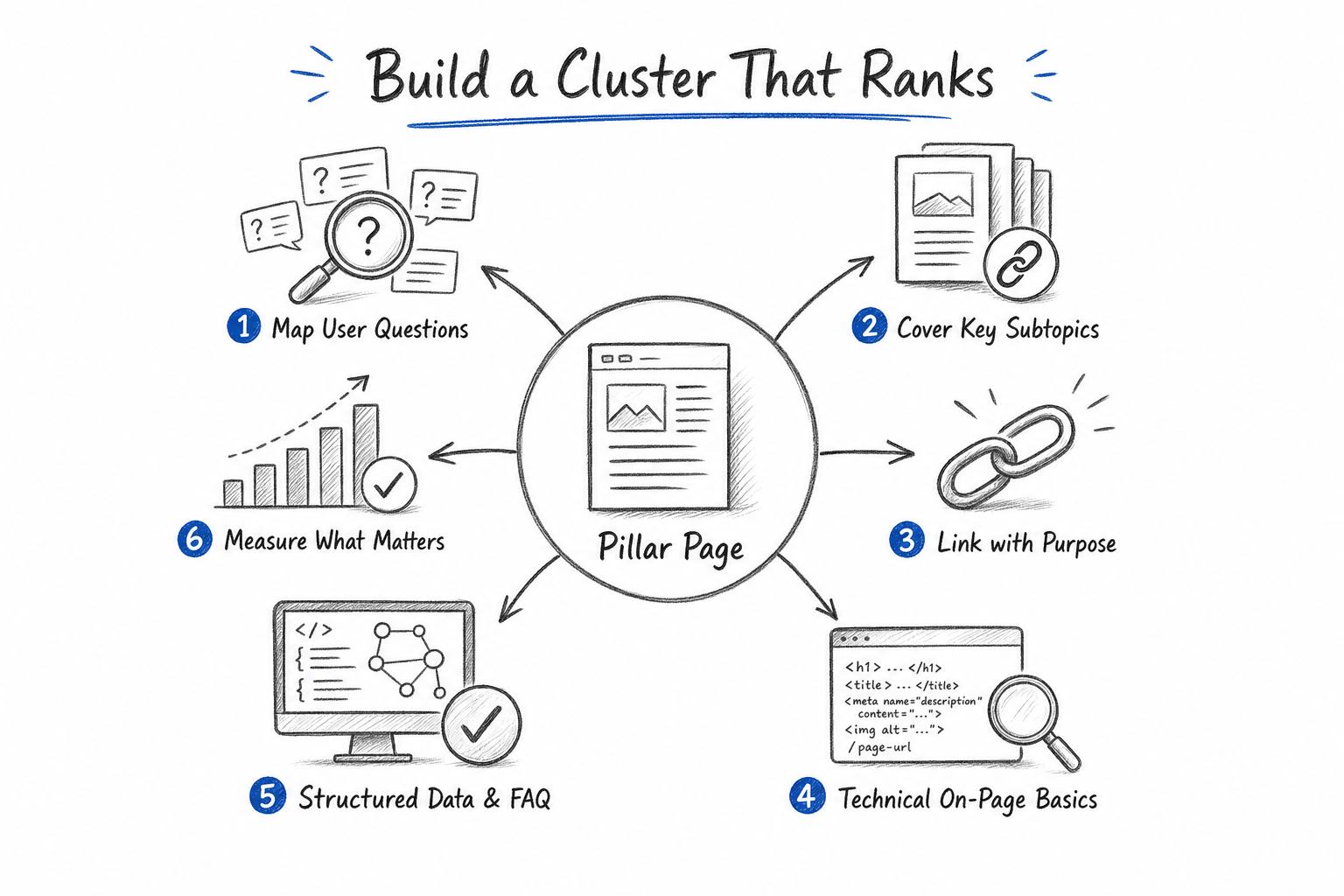
A pillar earns its links by pointing to work that goes deeper than it can. Five sub-themes come up in essentially every content-structure cluster, and each deserves its own article rather than a paragraph here.
Finding what customers actually search
Keyword research for a cluster is different from keyword research for a single post. You are not looking for one term with good volume; you are looking for the family of questions around a theme and how they relate to each other, so you can tell which one is the pillar and which are satellites. The output is a map with intent labelled, not a spreadsheet sorted by volume.
Whether the internal links are genuinely necessary
It is a fair question, and the honest answer has nuance. Links between pillar and satellites matter more in competitive themes and on younger domains, and the benefit depends heavily on anchor quality and placement rather than on link count. A dedicated article can examine what actually changes when the links are there versus absent, which is more useful than repeating the doctrine.
Technical on-page work: headings, meta, alt text
The heading hierarchy, the title and meta description, the image alt text and the URL are the mechanical layer that tells a crawler what a page contains. None of it saves weak content, and all of it makes strong content legible. It is also the layer most commonly half-done — headings used for visual size rather than structure, meta descriptions auto-truncated, alt text left empty.
Structured data and FAQ markup for AI visibility
Structured data is machine-readable annotation that describes what a page contains in a format assistants and search engines parse directly. FAQ markup in particular maps question-answer pairs explicitly, which is exactly the shape a generative answer wants to consume. The implementation details are involved enough to need their own treatment.
Multilingual setup for European markets
Running a blog across several European languages is a structural decision, not a translation task. Each language needs its own cluster logic, its own keyword map — because people in different markets phrase the same problem differently — and its own internal linking. Treating language versions as copies of one another is the fastest way to build four archives that each underperform.
Those five threads are where most of the ongoing work lives. The pillar’s job is to make clear why each one matters; the satellites’ job is to resolve them.
Building your first cluster without stalling
Knowing the model and having one is not the same thing. The gap is usually a sequencing problem, so here is a sequence that works.
Pick the theme from what you sell, not from what ranks
Start at the commercial end. Which product or service do you most want inbound demand for? What broad question does a buyer have before they are ready to evaluate it? That question, phrased as a theme, is your first pillar. Choosing themes by search volume alone produces traffic you cannot convert.
Map twelve to twenty questions before writing anything
Pull from search data, from sales conversations, from the questions that come up in onboarding. Group them. Discard the ones that are the same question in different words. What remains is your satellite queue, and its length tells you how many months the cluster will take at your publishing rhythm.
Publish the pillar early, then improve it
A common stall is waiting until the pillar is perfect. Publish a solid version, then let it grow as satellites come online and give you new material to reference. The page needs time in the index anyway.
Place every link at publication
Each satellite links to the pillar. The pillar gains a link to each satellite. Related satellites link to each other. Relevant pages link to the product page. Do this as part of publishing, because the retroactive cleanup pass is the one that never gets scheduled.
Decide who owns the structure after month three
This is where most programmes quietly end. The plan survives as long as the person who made it is paying attention. Whether you assign a permanent owner or automate the maintenance, the decision has to be made deliberately. We wrote about the longer arc of this problem in a blog strategy that survives its second year, and about the operational side in what to check before connecting auto-publishing to WordPress.
One more consideration belongs here, because it now sits on the same desk. If part or all of the content is AI-assisted, the transparency obligations that apply in Europe are a publishing requirement, not an afterthought: content marked as machine-generated where required, approvals tracked, transparency notes where they belong. Building that into the workflow from the start costs almost nothing. Retrofitting it across an archive of two hundred pages does not.
Frequently asked questions
How many supporting articles does a pillar page need?
Enough to cover the distinct questions under the theme, which in practice usually means somewhere between eight and twenty. The number matters less than the completeness: a cluster with ten articles that resolve every real sub-question outperforms one with thirty pieces that overlap. Map the questions first, then count.
How long should a pillar page be?
Long enough to explain the whole theme usefully, which typically lands in the two to four thousand word range. Length is a consequence of coverage, not a target. A pillar that hits three thousand words by repeating itself ranks worse than one that covers the subject in two thousand and links out cleanly for the details.
Can I convert my existing blog into topic clusters?
Yes, and it is usually faster than starting over. Group existing posts by theme, identify which ones already function as near-pillars, merge or redirect the duplicates, then write the missing pillar and add internal links. Most archives contain three or four latent clusters plus a set of orphans worth consolidating.
Does the pillar page have to be a blog post?
It can be a blog post, a guide page or a resource hub — the format matters less than the function. What it needs is a stable URL, comprehensive coverage, links out to the supporting articles and links in from them. Many companies put the pillar in the blog for editorial flexibility and link it from the main navigation.
How long before a topic cluster starts producing results?
Supporting articles on specific long-tail questions tend to move first, because competition is thinner. The pillar usually takes longer, since it depends on accumulated internal links and competes for broader terms. Plan in quarters rather than weeks, and measure cluster-level impressions rather than individual post rankings.
What if two articles in my cluster target similar keywords?
Decide which one owns the intent, then either merge the weaker page into the stronger and redirect it, or narrow its angle so the overlap disappears. Leaving both live splits impressions and clicks between your own pages. A planned cluster map prevents this by making the overlap visible before either article is written.
Do topic clusters help with being cited in AI answers?
They help substantially. Assistants assembling an answer favour sources that address the specific question directly and come from a domain showing depth on the subject. Clear headings, explicit definitions, structured FAQ sections and a connected body of work on one theme all make a site easier to parse and quote.
The structure is the strategy
Publishing more articles into an unstructured blog produces more unstructured blog. The compounding only starts when each piece lands in a designed position, links to the pages above and beside it, and routes readers toward what you sell. That is the whole argument for the topic-cluster model, and it is why the planning work matters more than the writing speed.
If you want to see what that looks like when the tree is planned, the links are placed and the publishing keeps running without anyone chasing it, see how the topic tree is built automatically.
Start today
A blog like this, on your site
This article was written and published by RankGrove, with the method you read about on the site. Try it free on your WordPress: the first article lands in your drafts within ten minutes.
Start free trial