Company Blog Strategy & Automation
SEO Blog Strategy: Build One That Survives Year Two

Company blogs rarely fail because the writing was bad. They fail because nobody defined what the blog was supposed to own, and the publishing effort collapsed once the founder got busy. An SEO blog produces business results when it is planned as a structure — pillar pages, supporting articles, internal links pointing at pages that sell — and when publishing continues without depending on anyone’s spare Friday afternoon.
You have probably already tried this. A few articles went live, one of them even got some traffic, then a quarter passed and the last post on the blog is dated eight months ago. The page still exists. It sits in the navigation, quietly telling every visitor that the company stopped paying attention, and telling search engines there is nothing new here worth recommending.
This is the most common outcome for a corporate blog, and it has very little to do with writing talent. It is a design problem. Most blogs are launched as a series of individual articles, each chosen because someone had an idea that week, with no map of what the site is trying to be known for. Individual articles do not compound. Structures do.
This guide is written for the founder or marketing lead who has already been through one failed attempt and does not want to run the same experiment again with a different intern. It covers what an SEO blog actually is in commercial terms, why the majority of them go stale, how the topic tree model works, what changed now that AI assistants answer questions instead of listing links, how to keep publishing at a sustainable cadence, how to measure whether it is working before rankings arrive, and what the AI Act requires when part of the content is machine-generated. By the end you should have a framework you can apply to your own site this month, and a clear idea of which parts you can automate and which you cannot.
Contents
- What an SEO blog actually is, in business terms
- Why company blogs go quiet after a few months
- The topic tree: the structure that makes an SEO blog compound
- Writing for search engines and AI answers at the same time
- Making publication sustainable, so year two actually happens
- AI-assisted content and the AI Act: what to actually do
- Frequently asked questions
- What to do next
What an SEO blog actually is, in business terms
An SEO blog is a set of pages on your own domain, organised around the topics your buyers search for, whose purpose is to capture demand that already exists and route it toward the pages that sell. That is the whole definition. Everything else — publishing cadence, tone, formatting, keyword research — is implementation detail underneath that goal.
Two words in that definition do the heavy lifting. On your own domain: the asset stays yours, it does not depend on a platform’s reach algorithm, and it keeps working while you sleep. Demand that already exists: you are not creating interest, you are intercepting people who are already typing a problem into a search box or asking an assistant. That is why an SEO blog behaves differently from social content. A social post has a lifespan measured in hours. A well-targeted article can pull qualified visitors for years, and the cost of the article stays the same whether it is read a hundred times or fifty thousand.
The difference between a blog and a news page
Most company blogs are not blogs. They are news pages: product releases, event attendance, an anniversary post, a photo from the trade fair. That content has a legitimate internal purpose, but nobody searches for it. Nobody types your press release into Google.
A blog that produces business results answers questions your prospects ask before they know your name. Pricing logic, comparison criteria, regulatory obligations, how to evaluate suppliers, what a process actually costs, which mistakes are expensive. The test is simple: could a stranger who has never heard of you find this article useful? If the answer is no, it is a news item, and it belongs somewhere else on the site.
Why traffic alone is a vanity number
Ranking for a term that brings visitors with no purchase intent produces a nice chart and no revenue. A page that attracts five hundred students, hobbyists or job seekers per month is a cost. A page that attracts forty people evaluating a purchase decision, and hands three of them to a service page, is an asset.
So the unit of measurement is not visits. It is qualified visits that reach a commercial page. Everything in the framework below exists to increase that number.
Why company blogs go quiet after a few months
If you have already failed once, this section is the diagnosis. The pattern repeats with remarkable consistency across companies of very different sizes.
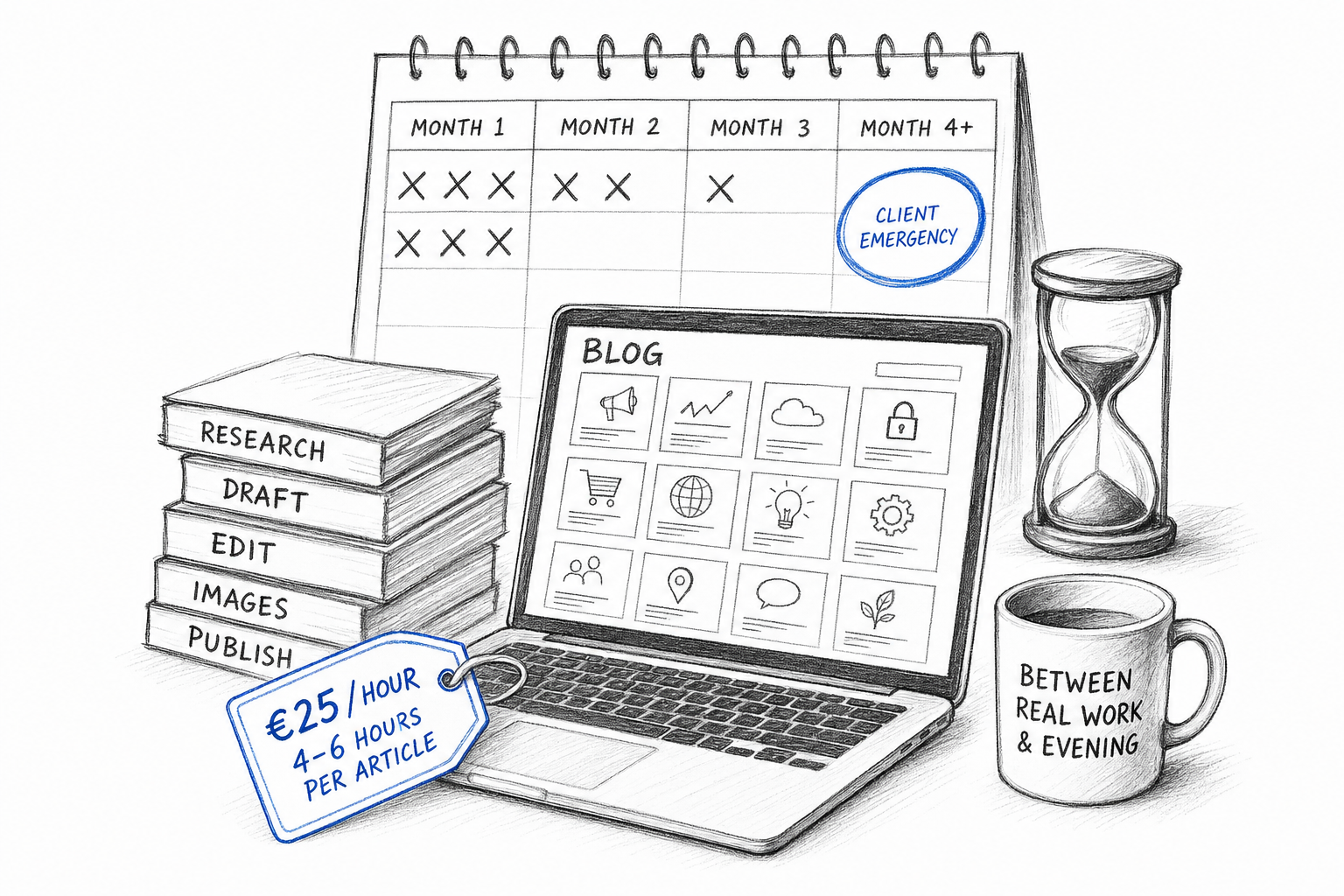
Nobody owns the calendar
The blog is launched with enthusiasm and no assigned time. Writing sits in the gap between real work and evening. The first month produces four articles, the second produces two, the third produces one, and then a client emergency eats the quarter. There was never a slot in anyone’s week that belonged to the blog, so the blog lost every scheduling conflict it entered.
Each article was chosen improvisationally
Topics are picked from whatever came to mind on Monday. The result is a blog covering twelve unrelated subjects at a shallow depth, competing with sites that cover one subject at depth. Search engines evaluate the coherence of a domain, not just of a page. Twenty scattered articles carry less weight than eight connected ones on the same theme.
The cost per article was never calculated
This one deserves a number, so let us build one honestly rather than quote an invented statistic. Take an internal marketing person with a fully loaded annual cost of, say, 40,000 euro. Across roughly 1,600 working hours, that is about 25 euro per hour. A researched, structured, edited 1,500-word article realistically consumes four to six hours between research, drafting, revision and publishing. That puts each post somewhere around 100 to 150 euro of internal cost — plus the opportunity cost of what that person did not do instead. Run the same calculation with your own salary figures. The point is not the exact result, it is that most companies commit to weekly publishing without ever doing this arithmetic, and then quietly abandon the commitment when the real cost shows up.
Results were expected too early
Organic visibility does not arrive on the schedule of a paid campaign. A new page typically needs weeks to be crawled, indexed and tested against competitors, and months before it settles into a stable position for anything competitive. Teams that measure the blog at week six conclude it does not work, stop publishing, and guarantee the conclusion becomes true. The failure is usually a timing mismatch, not a content quality problem.
The blog was never connected to anything
Articles were published as isolated pages, with no links between them and no path toward a service or product page. A visitor arrived, read, and left, because nothing on the page suggested a next step. Meanwhile search engines had no signal about which of your pages is the important one on a given topic. Internal linking is the cheapest ranking lever available and it is the one most consistently ignored.
The takeaway from this section: before you write the next article, decide who owns the calendar slot, what the blog is trying to be known for, and where each article sends the reader.
The topic tree: the structure that makes an SEO blog compound
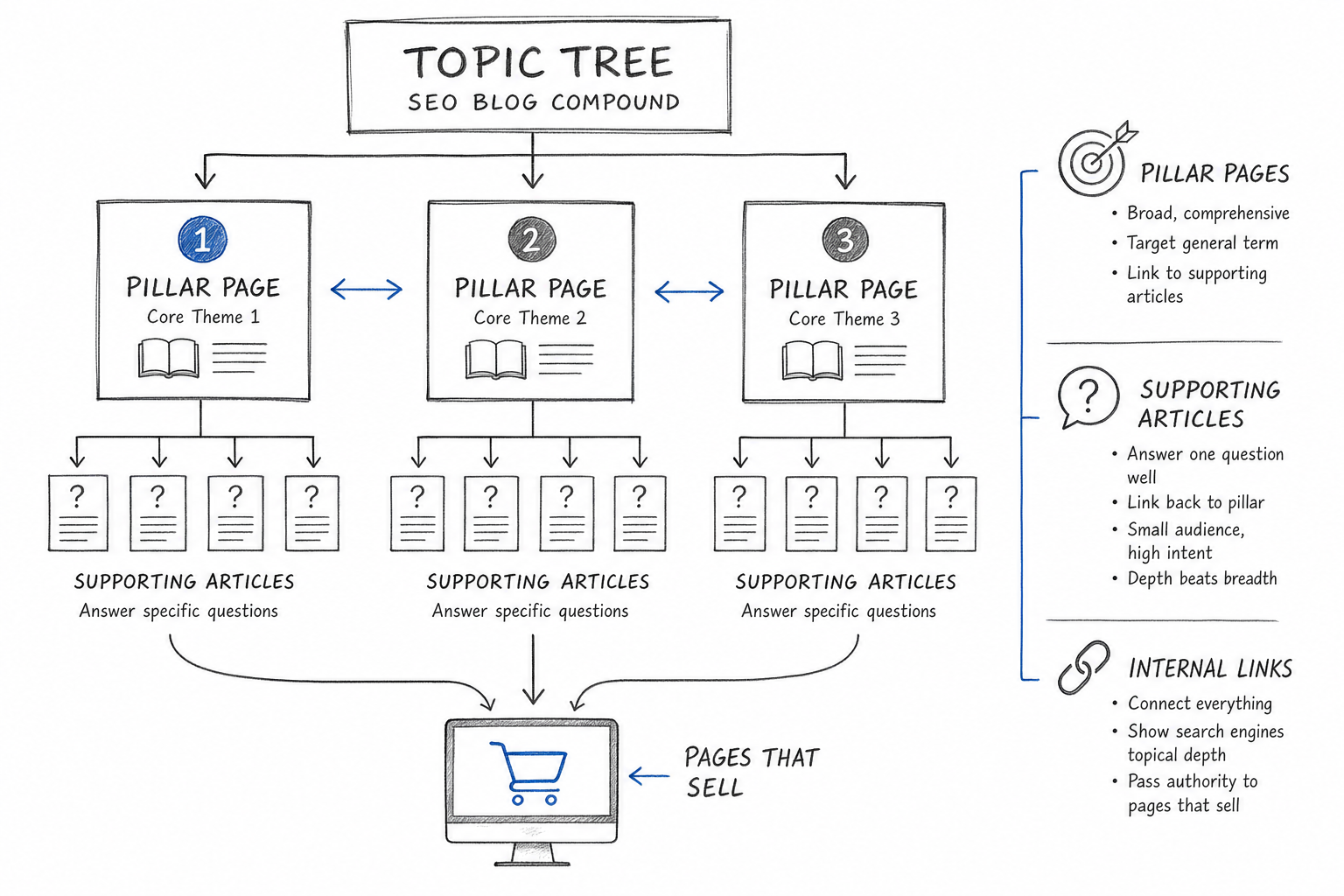
The alternative to improvised publishing is a planned structure. The model that works is a topic tree: a small number of pillar pages that own your main themes, a larger set of supporting articles that answer specific questions inside each theme, and internal links that connect them and point toward the pages that sell.
Pillar articles
A pillar is the broad, thorough page on a theme you want to be associated with. This article is one. It defines the concept, explains why it matters, covers the sub-topics at a reasonable depth, and links out to the deeper articles underneath it. A pillar is typically long, because it has to be genuinely comprehensive to deserve the position, and it is the page you want ranking for the general term.
Pick your pillars from your commercial reality, not from a keyword tool. Ask which two or three subjects a prospect must understand before they can buy from you. Those are your pillars. Most companies need three to five, not fifteen.
Supporting articles
Under each pillar sit the specific questions: the “how much does it cost”, the “what are the requirements”, the “how do I choose between”, the “what happens if I do nothing”. Each supporting article answers one question properly and links back up to its pillar. Individually they attract small, precise, high-intent audiences. Collectively they tell search engines your site covers this theme thoroughly.
This is where depth beats breadth. Eight supporting articles under one pillar build topical authority. Eight articles across eight unrelated pillars build nothing.
The internal links that carry the weight
Links between your own pages do two jobs at once. They distribute authority across the site, concentrating it where you want it, and they give readers a route: from a specific question, up to the broad theme, across to the commercial page. A blog with no internal links is a pile of articles, not a structure.
The discipline here is boring and it is exactly what teams skip. Every new article should link up to its pillar, sideways to one or two relevant siblings, and forward to whichever service page is the logical next step. Doing that manually across a hundred articles is a real maintenance burden, and it is the first thing that decays when the team gets busy — which is precisely why it should be handled by the system that publishes, rather than by memory.
Mapping the tree before writing anything
The planning session is short and it saves months. Write down your themes. Under each, list every question a prospect has actually asked you in a sales call — those are your supporting articles, and you already know them, which is why founders write better briefs than agencies. Mark which service page each cluster should feed. You now have a publishing plan for a year, and every future article has a predetermined place in the structure instead of being a fresh decision.
Writing for search engines and AI answers at the same time
Something structural changed in how people find information, and it affects how an SEO blog should be built. A growing share of questions are now answered directly by AI assistants that summarise sources instead of presenting ten blue links. If your content is not readable and citable by those systems, you lose visibility even when your ranking is intact.
This practice has a name — generative engine optimization, or GEO — and it is largely an extension of good SEO rather than a replacement for it. The overlap is high, but a few things matter more than they used to.
Answer the question in the first paragraph
Assistants extract passages that stand alone. A section that opens with three sentences of context and delivers the answer in the fourth is harder to quote than one that answers immediately and then explains. Put the conclusion first, then the reasoning. This also happens to be better for human readers, who decide within seconds whether to keep going.
Structure that machines can parse
Clear heading hierarchies, a short summary near the top, a table of contents on long pages, tables for comparisons, and a FAQ section marked up with structured data. These are not decorative. They tell a parser where the answer boundaries are. Structured data is how you say “this block is a question and this block is its answer” in a way software understands without guessing.
Specificity over adjectives
Generic content is unciteable. An assistant summarising three sources will not quote the one that says “quality is important” — it quotes the one that gives a criterion, a threshold, a procedure, a number with a visible origin. This is also the practical difference between content written by someone who does the work and content assembled from other people’s articles. Write the thing only you could write: the objection you hear every week, the mistake clients make before they call you, the reason the cheap option costs more later.
Keeping the site fresh
Both search engines and AI systems favour sources that show ongoing maintenance. A domain that published consistently for three years is treated differently from one that stopped in 2024. This is the mechanism that punishes abandoned blogs twice: first you stop adding new entry points, then the existing ones lose standing. Consistency is a ranking input, not just a discipline.
Making publication sustainable, so year two actually happens
Strategy is the easy part. Almost every company that failed at blogging had a reasonable plan; what they lacked was a production system that survived a busy quarter. Here is how to build one.
Choose a cadence you can hold at your worst month
Consistency decides the outcome more than volume, and there is a threshold worth knowing: at least three well-made articles a week to hold a niche, five or more in broad, competitive sectors, and daily publishing on the widest topics. Pick the frequency you can sustain during your busiest period, not your calmest one, and treat it as a floor rather than a target.
Separate planning from writing
The reason weekly publishing collapses is that each article restarts from zero: what should we write about, who is it for, what does it link to. Do that work once, in a planning session that produces a queue of briefed topics with their position in the tree already decided. Writing against a brief is perhaps a third of the effort of writing from a blank page.
Decide what a human must touch
Not everything needs the same level of human attention. Research, drafting, on-page optimisation, meta descriptions, alt text, internal link placement — these are systematisable. What genuinely requires a human is the judgement layer: is this claim true for our business, is this the objection our customers actually raise, does this position us the way we want, is there a number here we cannot defend.
The realistic split for most teams is generation handled by the system, approval handled by a person. That keeps the calendar full and keeps the brand accountable, which also happens to be what the compliance rules expect.
Publish where it lives, not where it waits
A draft in a folder is not published content. Every manual step between “the article exists” and “the article is live on the site” is a place where the process dies. Tools that stop at the draft hand the last and most tedious job back to the person who has the least time. If the workflow does not end with the post on your site, correctly formatted and internally linked, the workflow is incomplete.
Update as seriously as you publish
Existing articles decay. Prices change, regulations change, the competitive answer improves. Refreshing a page that already ranks is often more valuable per hour than writing a new one, because it is defending a position that took months to earn. Build a review pass into the calendar — a fixed proportion of your monthly output allocated to updates rather than new pieces.
The takeaway: sustainability is an operations problem. Solve the queue, the approval step and the publishing step, and the calendar stops depending on motivation.
AI-assisted content and the AI Act: what to actually do
If part of your blog is produced with AI, transparency is now a legal expectation in the European Union, not a stylistic choice. The AI Act entered into force in August 2024 and applies in phases, with the transparency obligations for general-purpose and generative systems in the tranche that follows the initial prohibitions. Anyone publishing machine-generated content at scale should be operating as if the requirements are live, because retrofitting compliance across two hundred published articles is far more expensive than building it in from the first post.
Mark the content in a machine-readable way
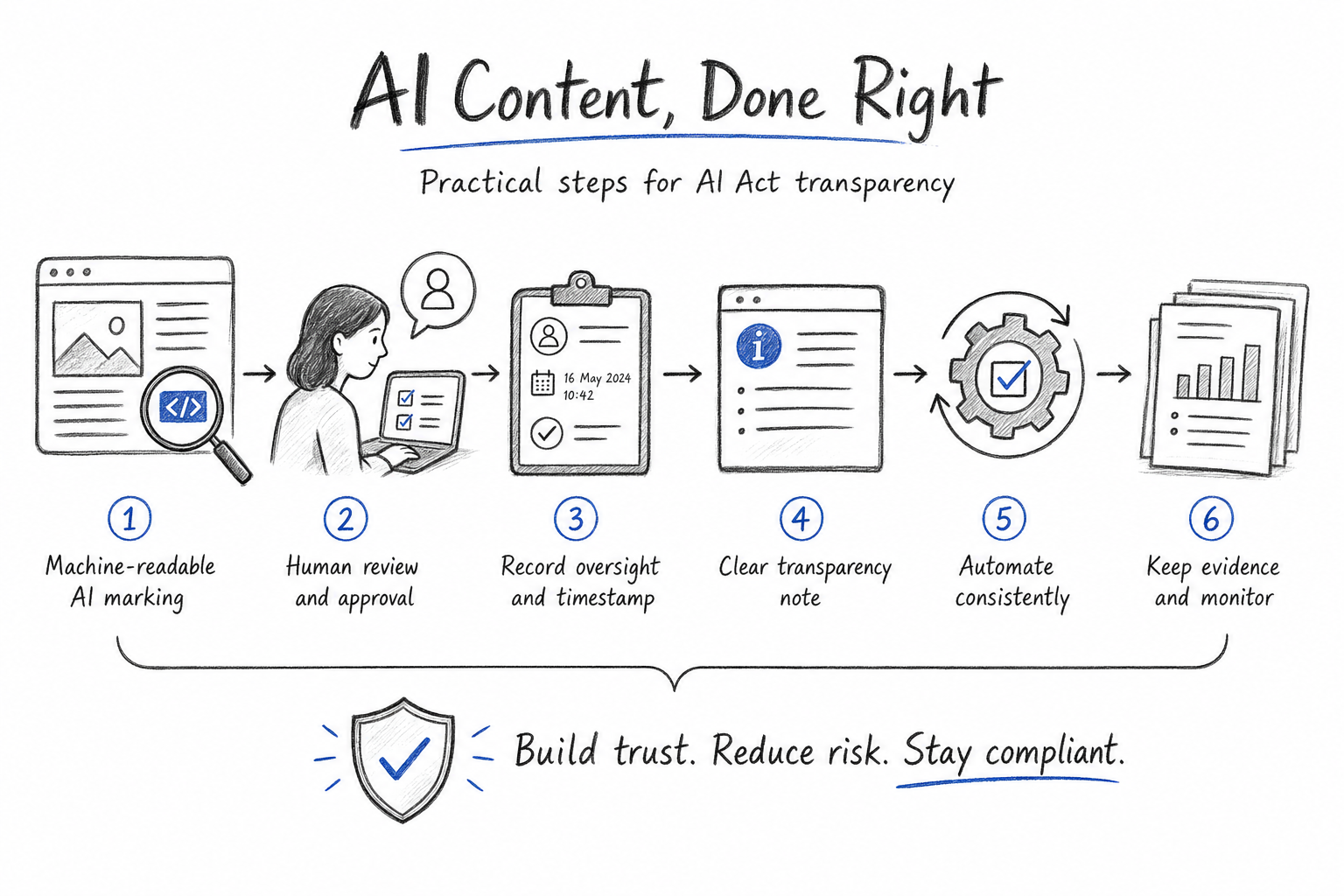
The core expectation for synthetic content is that it is identifiable as artificially generated, in a form software can detect rather than only a footnote a human might read. In practice that means the marking is embedded in the page’s technical layer, applied automatically at publication, and consistent across everything you publish. Manual disclosure applied when someone remembers is exactly what an audit finds.
Keep a record of human oversight
Transparency is strengthened considerably when you can show who approved what and when. A tracked approval — a named person, a timestamp, a state change from draft to published — turns “we review our AI content” from a claim into evidence. This is the same reason the approval step should live inside the publishing system rather than in someone’s inbox.
Write a transparency note and put it where people can find it
A short, plain page explaining how content is produced, what role AI plays, what a human checks, and how to report an error. It costs an hour to write, it answers the question a cautious buyer will otherwise ask you in a sales call, and it demonstrates good faith if anyone ever looks.
Treat compliance as a selection criterion for tools
When you evaluate a content platform, ask whether marking, approval tracking and disclosure are built in or left to you. Systems that only produce text push the entire compliance burden onto your team, and that burden is per-article, forever. This is a structural difference, not a feature checkbox.
Here is the diagnosis table to run against your own blog before you commit to another attempt.
| Symptom | Underlying cause | Action |
|---|---|---|
| No post in six months | No owned calendar slot | Assign the slot or automate the queue |
| Traffic without enquiries | Topics chosen with no purchase intent | Re-map topics to sales questions |
| Articles rank but sell nothing | No internal links to commercial pages | Link every article to its service page |
| Twenty posts, no authority | Scattered themes, no clusters | Consolidate into three to five pillars |
| Team burnout after two months | Each article restarts from zero | Separate planning from writing |
| AI content with no disclosure | Compliance added manually, or never | Machine-readable marking at publication |
Read that table as a checklist. Most stalled blogs show three or four of those rows at once, and the fixes are cheaper than the relaunch everyone assumes they need.
Frequently asked questions
How long does an SEO blog take to produce results?
Expect months rather than weeks. New pages need time to be crawled, indexed and tested against existing results, and competitive terms take longer than niche ones. A realistic horizon is a first meaningful signal within a few months of consistent publishing, and a stable contribution to pipeline within the first year. Teams that judge the blog at week six almost always stop too early.
How many articles per month does a company blog need?
Consistency comes first, and there is a threshold: at least three well-made articles a week to hold a niche, which is a dozen or more a month; five or more a week in broad, competitive sectors; daily publishing on the widest topics. Choose the frequency you can maintain during your busiest quarter, not your calmest one. A blog publishing steadily without gaps outperforms one that publishes ten articles in a launch burst and then goes silent.
What is a topic cluster and why does it matter?
A topic cluster is one broad pillar page on a theme, surrounded by supporting articles answering specific questions inside that theme, all connected by internal links. It matters because search engines assess how thoroughly a domain covers a subject, not just individual pages. Eight connected articles on one theme build more authority than eight unrelated posts.
Is AI-generated blog content penalised by search engines?
What gets penalised is content with no value: thin, duplicated, generic pages that add nothing. How the text was produced matters less than whether it answers a real question with real specificity. The practical requirement is human oversight — someone who verifies claims, adds business-specific judgement, and takes responsibility for what goes live under the company name.
What does the AI Act require for AI-generated articles?
Synthetic content must be identifiable as artificially generated in a machine-readable way, not only through a note a reader might notice. In practice: automatic marking applied at publication, a record of who approved each piece, and a public transparency note explaining how content is produced. Building this in from the first article is far cheaper than retrofitting it later.
Should I write new articles or update old ones?
Both, in a fixed ratio. Updating a page that already ranks defends a position that took months to earn and often returns more per hour than a new post. Allocate part of your monthly output to refreshes: outdated figures, changed regulations, weaker answers than competitors now provide. New articles expand the tree; updates protect it.
How do I know the blog is working before rankings arrive?
Watch leading indicators. Are pages being indexed? Are impressions growing for the terms you targeted, even at low positions? Are readers moving from articles to service pages? Are sales calls starting with fewer basic questions because the prospect already read you? These move before rankings do and tell you whether to adjust or stay the course.
What to do next
A company blog fails as a structure long before it fails as a piece of writing: the calendar has no owner, the topics have no map, and the articles point nowhere. Fix those three things and the same team that abandoned the last attempt can sustain the next one.
Start by mapping three pillars from the questions your prospects already ask you, then decide honestly whether your team will hold the calendar without help. If the answer is no, see how the topic tree and automated publishing work — including the machine-readable AI marking and tracked approvals that keep published content compliant from the first article.
Start today
A blog like this, on your site
This article was written and published by RankGrove, with the method you read about on the site. Try it free on your WordPress: the first article lands in your drafts within ten minutes.
Start free trial