Company Blog Strategy & Automation
What Happens to Your SEO When You Stop Posting

When a company blog stops publishing, nothing happens for a few weeks — then crawl frequency drops, rankings erode from the bottom of the page, and AI answer engines quietly stop citing you. The damage is invisible in month one and structural by month six, which is why the fix is a cadence you can actually sustain, not a heroic content sprint.
Here is the pattern almost every marketing lead recognises. The blog launches with real intent: twelve posts in twelve weeks, a proper brief for each one, someone senior reviewing the drafts. Traffic starts to move. Then a product launch lands, the person who wrote the posts changes role, and the publishing calendar goes quiet. Six months later someone opens Search Console for the first time in a while and finds the graph pointing down — not off a cliff, but on a steady slope nobody noticed.
That slope is the most expensive thing in an seo strategy that was never designed to be maintained. It costs organic sessions you had already paid to earn, and in 2026 it also costs something newer: being referenced inside AI-generated answers, where a site with no recent content simply stops being a candidate.
This article explains the mechanics of that decline. Not “why blogging matters” — the specific chain of events that follows the last published post. You will get a realistic timeline of when each effect becomes visible, why crawl frequency falls, why a competitor’s newer article outranks your better one, and how a stale blog reads to a human visitor who lands on it. If you want the wider view of how to build a blog that survives the first quarter, the company blog strategy pillar covers structure, ownership and cadence end to end. This piece stays on one question: what exactly you lose when you stop, and how fast.
Contents
- What content decay actually is (and why it feels like nothing at first)
- Why crawl frequency drops when publishing stops
- The realistic timeline of decline after your last post
- Why AI answer engines stop citing a quiet site
- Why a competitor’s newer article beats your better one
- If you are considering automation to fix this, evaluate three things
- Frequently asked questions
- The decision this actually comes down to
What content decay actually is (and why it feels like nothing at first)
Content decay is the gradual loss of rankings, impressions and clicks on pages that were already performing, caused by the passage of time rather than by anything you did wrong. The pages are still there. The content is still accurate. The traffic still leaves.
The reason it feels like nothing at first is arithmetic. An article that ranks well has usually accumulated links, engagement signals and topical trust. That inertia carries it for a while after the surrounding blog goes silent. So month one after stopping looks fine. Month two looks fine. The decline starts at the margins — the queries where you were ranking eighth or eleventh, the ones that produced impressions rather than clicks — and margins do not show up in a monthly traffic number.
By the time the curve is obvious in a dashboard, the erosion has been running for a quarter. That delay is the trap: the feedback loop is too slow to correct behaviour. Nobody stops publishing and immediately regrets it. They regret it two quarters later, when reviving the blog means rebuilding trust rather than continuing momentum.
The practical takeaway: judge your blog’s health on impression trends for mid-position queries, not on total sessions. That is where decay shows up first.
Why crawl frequency drops when publishing stops
Search engines allocate crawl resources according to expected value. A site that publishes something new several times a week teaches the crawler to come back often, because coming back often keeps paying off. A site whose last change was in the spring teaches the opposite lesson.
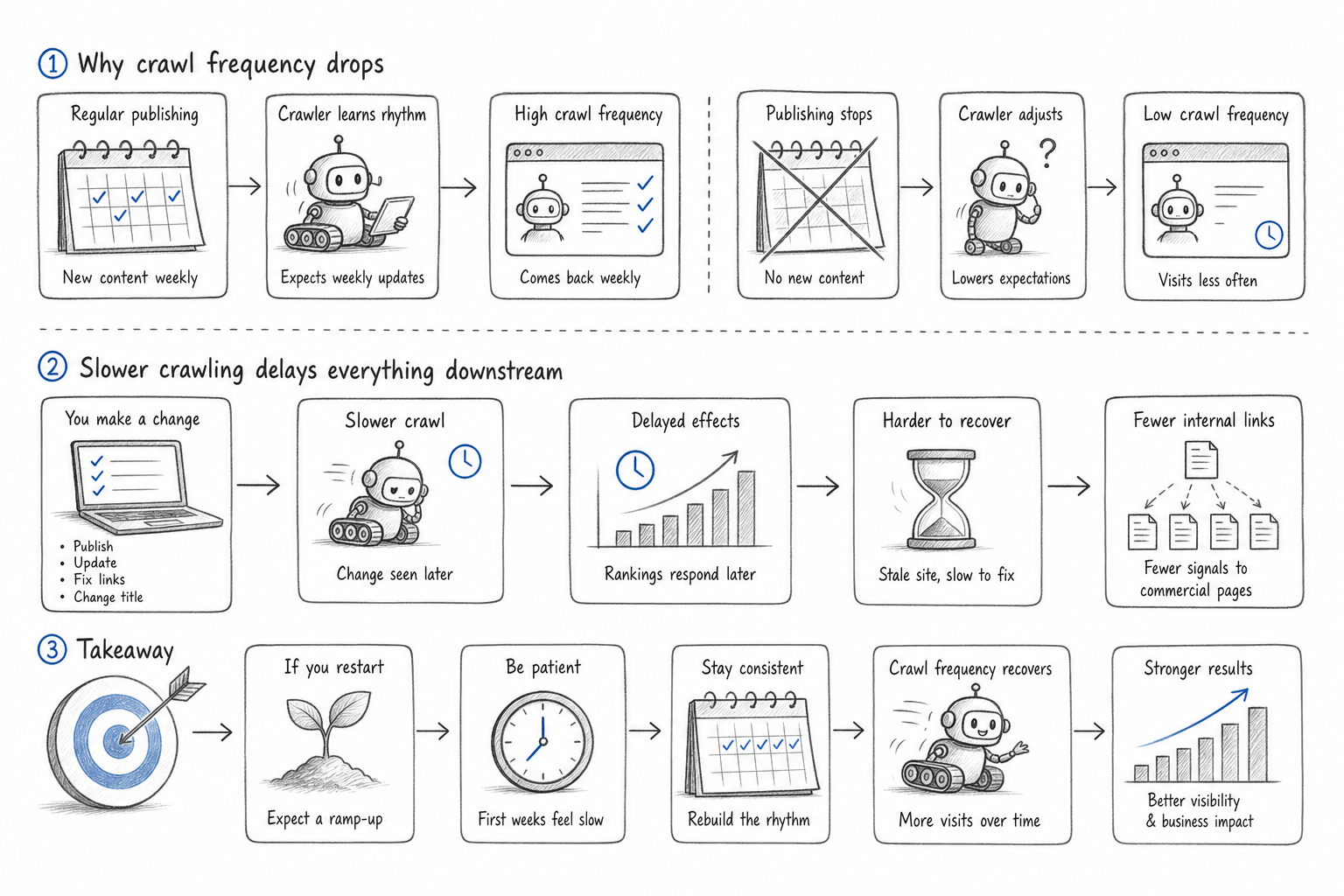
The crawler learns your rhythm
Crawl scheduling is adaptive. It responds to how often a URL or a section of a site actually changes. When a blog directory produces new URLs on a predictable cadence, that directory gets visited on a matching cadence. When the new URLs stop, visits to that section become less frequent, because there is nothing to find. This is not a penalty. It is resource allocation behaving sensibly.
Slower crawling delays everything downstream
The consequence matters more than the mechanism. Reduced crawl frequency means that when you do act — publish again, update an old post, fix an internal link, change a title tag — the change takes longer to be seen and longer to affect rankings. A stale site is a slow site to fix. Teams that restart a dormant blog often interpret this lag as “SEO doesn’t work any more”, when what they are experiencing is the cost of having trained the crawler to deprioritise them.
There is a second-order effect on your commercial pages too. Blog articles are usually where fresh internal links to service and product pages come from. No new articles means no new internal links, which means the pages that actually sell stop receiving new signals of relevance.
Takeaway: if you plan to restart, expect the first weeks to feel unresponsive. That lag is the debt, not the verdict.
The realistic timeline of decline after your last post
Nobody can promise you exact dates, and any article that gives you a precise percentage per month is guessing. What is describable is the order in which things go wrong, based on how each mechanism works. Here is the sequence, framed as ranges rather than measurements.
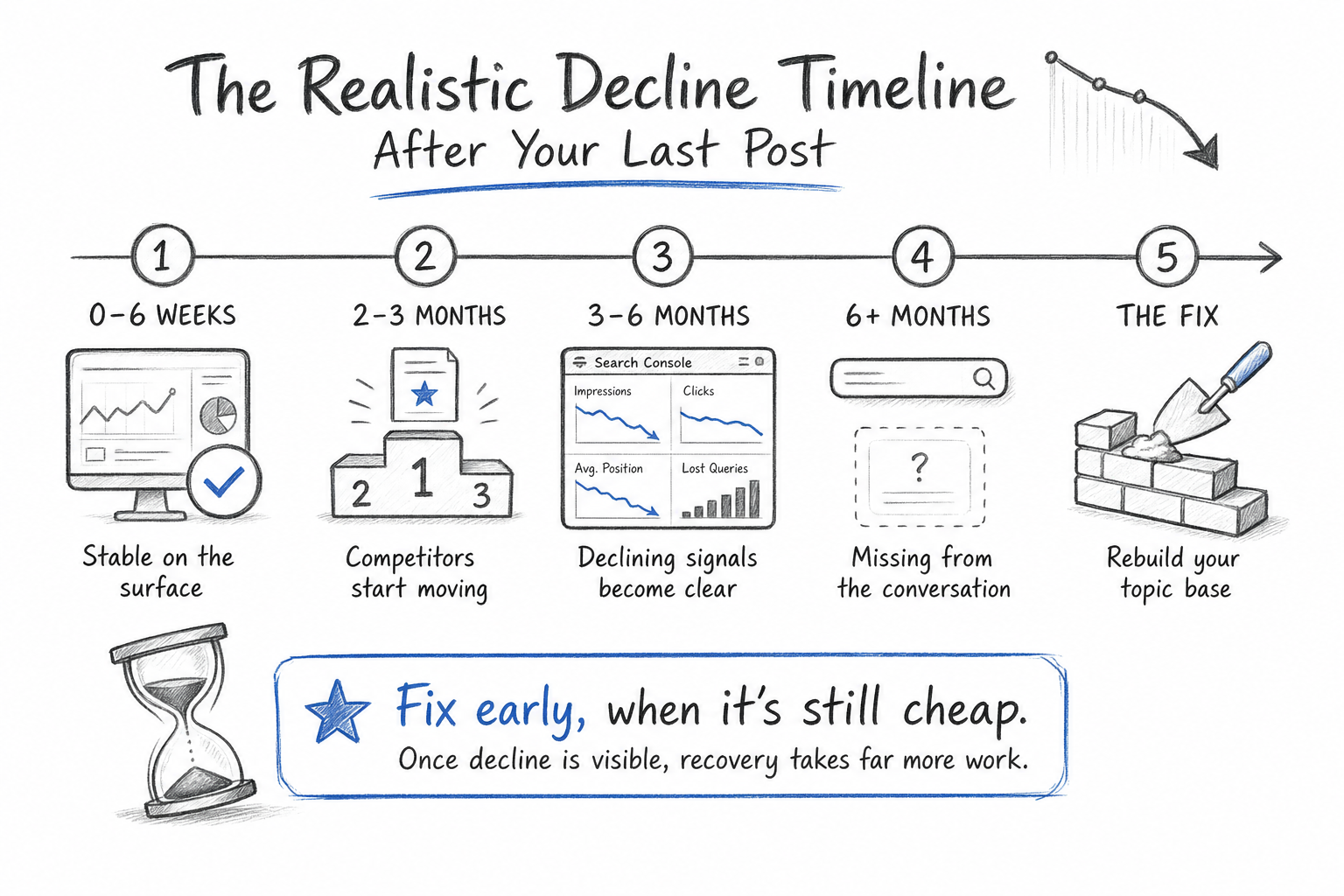
In the first few weeks, essentially nothing visible happens. Rankings hold. Sessions hold. Anyone checking a dashboard concludes the pause is harmless, which is exactly why the pause extends.
Across roughly the second and third months, competitive queries start to move. Not because your content got worse, but because someone else published something newer on the same topic and it is being tested in the results. You lose the positions that were contested, keep the ones that were not.
Between three and six months, the pattern becomes readable in Search Console: total impressions declining faster than clicks, average position drifting, a widening tail of queries where you used to appear and no longer do. This is also the window in which AI answer surfaces stop treating you as a live source, for reasons covered in the next section.
Past six months, the problem changes character. You are no longer losing momentum; you are missing from the conversation. Topics that emerged after your last post have no coverage on your site at all. Recovery stops being “publish again” and becomes “rebuild a topic base”.
The single most useful thing to internalise: the cheapest moment to fix a stale blog is before it looks broken. Once the graph is visibly down, the work required has already multiplied.
Why AI answer engines stop citing a quiet site
This is the part of the cost that did not exist a few years ago, and it is the part most companies are not measuring at all.

Generative answer systems — the AI summaries inside search results, and standalone assistants that browse the web — assemble responses from sources they retrieve at query time. Those systems have a strong structural preference for content that is current, because a large share of the questions people ask them are implicitly about the present state of things: what a tool costs now, what the rules are now, what the options are now. A source with no recent publishing loses on that criterion before any quality judgement is made.
Retrieval favours what looks maintained
Two signals compound here. The first is recency of the document itself. The second is the retrievability of your site as a whole: if crawling has slowed, the index’s picture of you is older, and older pictures get selected less often for questions framed in the present tense.
Citation loss is silent
Losing a ranking position is at least visible in a report. Losing AI citations is not, for most teams. There is no default dashboard telling you that an assistant used to reference your comparison article and now references someone else’s. You lose this channel without receiving a notification. By the time you notice — usually because a prospect mentions they found a competitor through an AI answer — the substitution has been running for months.
What actually earns citations back
The pattern that works is unglamorous: clearly structured pages that answer one question each, with the answer near the top, headings that match how the question is asked, and a short summary a retrieval system can lift cleanly. Combine that with a steady flow of new material and you become a source worth re-checking. A single excellent article published last year does not do it.
Takeaway: treat AI citations as a channel with its own maintenance requirement, not as a free by-product of ranking well.
Why a competitor’s newer article beats your better one
This is the objection every founder raises: our article is more thorough, more accurate, better written. Why is a thinner competitor post above it?
Because relevance is judged in context, and context includes time. For a large class of queries, freshness is part of what “relevant” means. Anything involving prices, tools, regulations, market practice or year references gets evaluated partly on how current it looks. Your 2024 guide competes against their 2026 guide on a field you cannot win by writing better sentences.
There is also a topical coverage effect. Search systems build a picture of what a site is authoritative about from the set of pages it publishes, not from individual pages in isolation. A competitor publishing steadily on one theme keeps deepening that picture: pillar page, satellite answers, internal links tying them together. A site that published twelve good posts and stopped has a snapshot of authority from a moment in the past, while the competitor has a growing one.
And a stale blog does something worse in front of humans. A visitor who is evaluating you as a vendor clicks “Blog”, sees the most recent post dated eleven months ago, and draws a conclusion about the company — not about the blog. It reads as a project that was abandoned. That impression lands on the same person who was about to fill in your contact form.
Takeaway: audit your blog index page as a prospect would. The date on the first card is doing more work than the article behind it.
If you are considering automation to fix this, evaluate three things
Most teams reading this already know the answer is a sustainable cadence. The reason they stopped is not ignorance; it is capacity. So the practical question becomes what to look for if you want software to carry a load of three or more articles a week.
First, publishing, not drafting. A tool that produces text still leaves you the job of formatting, adding headings, setting meta fields and pressing publish in WordPress. That last mile is where cadence dies. Check whether the connection actually writes to your site and how scheduling behaves when nobody is watching.
Second, the small-team economics. If there is no marketing department, the only cadence that survives is one that costs a fixed, small amount of attention per week. Work out what a single article costs you today in real terms — take an internal cost of, say, 40,000 euros a year for the person writing, and five hours per article including briefing and review, and you are at roughly 130 to 150 euros per piece before anything is published. That number is the benchmark any automation has to beat, and the calculation is worth redoing with your own figures.
Third, trust in a third party with publish rights. Letting an external tool post directly to your site is a legitimate governance question. What matters is whether you can review before anything goes live, whether approvals are tracked, and whether the connection can be revoked without breaking the site. Ask those three things before connecting anything.
The table below is the short version of the diagnosis, for when you want to check your own situation quickly.
| Symptom | Underlying cause | First action |
|---|---|---|
| Impressions falling faster than clicks | Losing contested mid-position queries | Identify decaying pages and refresh them |
| New posts take weeks to rank | Crawl frequency reduced by inactivity | Resume a steady cadence of three or more articles a week |
| No mentions in AI answers | Site reads as unmaintained to retrieval | Publish structured question-level pages |
| Competitors above weaker content | Freshness and growing topical coverage | Build satellites around your main themes |
| Blog index shows an old date | Publishing stopped, visitors notice | Schedule ahead so the cadence never breaks |
Takeaway: pick the row that matches your dashboard and start there rather than planning a full relaunch.
Frequently asked questions
How long does it take for SEO to drop after you stop posting?
Expect little visible change in the first few weeks, movement on competitive queries across months two and three, and a clearly declining curve between three and six months. The order is predictable even though the speed depends on your niche, link profile and how aggressively competitors publish on the same topics.
Does a company blog hurt SEO if it is out of date?
Outdated posts rarely trigger a penalty, but they do lose rankings to fresher competing pages and they signal neglect to visitors evaluating you as a supplier. The bigger cost is opportunity: topics that emerged after your last post have no coverage on your site at all.
Is it better to update old posts or publish new ones?
Both, in that order of priority. Refreshing pages that already have impressions usually produces faster gains because the page has existing signals. New publishing is what restores crawl frequency, expands topical coverage and gives AI answer engines a reason to treat your site as a live source.
How often should a company blog publish to hold rankings?
At least three articles a week keep crawling predictable and topical coverage growing, and on the widest topics one a day pays off most; with automation both are achievable. Consistency multiplies the effect: three a week held without gaps outperforms a burst of fifteen posts followed by a silent quarter.
Why do AI tools cite competitors instead of my site?
Retrieval systems favour sources that look current and are structured so a specific answer can be extracted cleanly. A site that has not published recently is retrieved less often and reads as less maintained. Clear question-level headings, a short summary near the top and steady publishing all improve your candidacy.
Can I recover organic traffic after a year of not publishing?
Yes, but the work is closer to rebuilding than resuming. Plan for a slower initial response while crawl frequency recovers, prioritise refreshing pages that still hold impressions, then add new articles around your main themes with internal links connecting them to the pages that sell.
Is it safe to let a tool publish directly to WordPress?
It is safe when three conditions hold: you can review content before it goes live, approvals are recorded, and the connection can be revoked at any time without breaking your site. Check how the integration authenticates and what permissions it requests before you connect anything.
The decision this actually comes down to
The expensive failure is not a bad blog; it is a good blog that stopped, because you paid the full cost of building authority and then let it depreciate. Decay is slow enough to ignore and cumulative enough to matter, which means the only real defence is a cadence that does not depend on anyone finding time this week. If that is the gap you are looking at, see how the automated topic-tree blog works and what it takes to keep the calendar full without a content team.
Start today
A blog like this, on your site
This article was written and published by RankGrove, with the method you read about on the site. Try it free on your WordPress: the first article lands in your drafts within ten minutes.
Start free trial