Generative Engine Optimization (GEO) & AI Search
Should a Human Always Review AI Articles Before Publishing?

Human review before publishing is worth its cost on articles that carry claims, numbers, regulated advice or commercial promises — and it is mostly ceremony on low-risk explainers that repeat what your team already knows. The practical answer is a tracked approval workflow where the risk level of each piece decides how much human attention it gets, while publishing cadence stays automated and uninterrupted.
A founder asks the question in a very specific moment: the blog is finally producing articles at a useful rate, and someone around the table says “but who checks them?”. It is a fair question, and the usual answers are both bad. “Everything gets reviewed by a human before it goes live” sounds responsible until the reviewer goes on holiday and the blog stops for three weeks. “Nothing gets reviewed, the system is good enough” sounds efficient until a legal claim about a product, a wrong deadline for a regulation, or a confidently invented statistic ends up on a page that your sales team links in proposals.
The honest answer sits in between, and it is not a compromise born of indecision. Review effort should follow content risk, not article count. Some pieces genuinely need a named person to read them and sign off. Others need a person to have designed the topic, approved the plan, and set the rules — after which publishing them automatically is a reasonable business decision.
This article works through the real arguments on both sides: what human review actually catches, what it costs you in speed and consistency, and how a tracked approval workflow gives you most of the safety without stopping the clock. It also explains why e-e-a-t ai content quality depends far more on who owns the topic than on whether a human re-read the final draft. If you want the search-visibility angle on how AI systems choose which sources to quote, the broader picture is in our guide to Generative Engine Optimization and getting cited by ChatGPT, Google AI and Perplexity.
Contents
- What human review actually catches in an AI-written article
- The real case for publishing without per-article review
- How to decide: risk level, not article count
- What a tracked approval workflow looks like in practice
- Where E-E-A-T fits, and where it does not
- Frequently asked questions
- The decision to make this week
What human review actually catches in an AI-written article
Before deciding how much review you need, it helps to be precise about what review does. The generic answer — “quality” — is useless for policy-making. In practice a reviewer catches four distinct categories of problem, and they do not all carry the same weight.
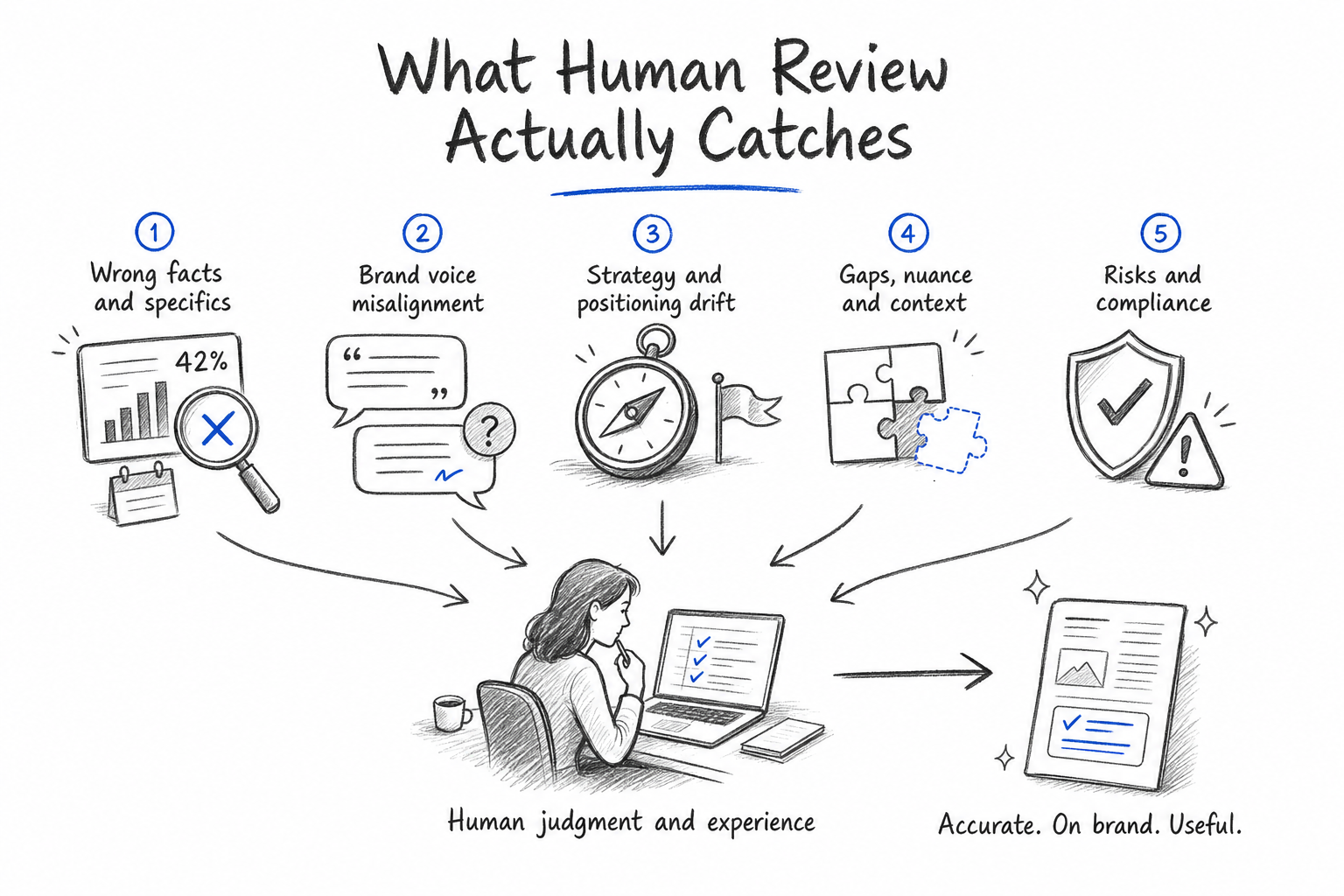
Factual errors and invented specifics
Language models produce fluent sentences whether or not they have grounds for them. The dangerous output is rarely nonsense; it is a plausible number, a plausible date, a plausible attribution. An article that says a regulation applies “from next year” when it already applies, or that quotes a market share figure nobody measured, reads perfectly and is wrong.
This is the category where human review earns its cost outright. A reviewer who knows the subject spots the suspicious specificity in seconds — and the fix is usually deletion, not research. The structural defence is to instruct the system never to produce unsourced figures in the first place, which converts a verification problem into a style rule.
Brand voice and positioning drift
The second category is softer but it compounds. An article can be factually clean and still say something your company does not believe: recommending an approach you argue against, describing your market in terms your sales team would never use, hedging on a position that is central to how you sell.
A reviewer who holds the brand’s point of view catches this. So, increasingly, does a well-configured system: if your positions are written down as explicit rules rather than living in a founder’s head, drift becomes rare. The practical takeaway here is that writing your positions down once prevents more drift than reviewing every draft forever.
Legal and compliance exposure
Claims about product performance, pricing, guarantees, medical or financial advice, employment terms, regulatory deadlines — this is where publishing something wrong costs money rather than credibility. If an article in your blog could reasonably be read as advice someone acts on, a human should read it before it is public. There is no clever automation argument against this, and pretending otherwise is how companies get into trouble.
Transparency and disclosure handling
The fourth category is procedural: does the published article correctly state that AI was involved, in readable text and in machine-readable form? Under the European framework this is a transparency obligation, not an aesthetic choice, and it is also one of the few checks a machine performs more reliably than a person. A person forgets the disclosure note; a pipeline that attaches it by default does not. We cover what that label actually contains in our explainer on machine-readable AI content disclosure.
The lesson across all four: review is not one thing. Two of these categories genuinely need a human; one needs a configuration; one is better handled by the machine.
The real case for publishing without per-article review
The argument for automation is usually caricatured as “cheap and fast”, which undersells it. Three things actually break when you make human sign-off mandatory on every piece.
Cadence collapses, and cadence is the whole asset
A blog competes by covering a topic densely and continuously. The benchmark that works is at least three articles a week, rising to one a day on broad topics, held without gaps. A mandatory per-article human gate introduces a single point of failure: one busy fortnight, one departure, one product launch, and the queue backs up. The pattern is predictable — a strong first month, then silence, then an archive whose most recent date tells every visitor the company stopped caring.
The cost is not just lost articles. Search engines and AI answer systems rank freshness and coverage depth together; a topic you abandoned half-covered is a topic a competitor finishes covering. If you want the arithmetic on cadence, we work through it in how many blog posts per month a small business actually needs.
Consistency gets worse, not better
Counterintuitively, human review can reduce consistency. Different reviewers apply different standards; the same reviewer applies different standards on a Friday afternoon. A system applies the same rules to article 3 and article 300: same heading structure, same disclosure, same internal linking logic, same alt text discipline. For the structural signals that search and AI systems read, machine consistency beats human attention.
The cost is real, and it is mostly hidden
Review time is not free, and it is rarely budgeted honestly. A worked example makes it visible: if a content lead costs the company roughly 50.000 euro a year fully loaded, that is in the region of 30 euro an hour. At three articles a week and forty minutes of genuine review each — reading, checking, fixing — you are spending around 20 euro per article and roughly 100 hours a year. The numbers are an illustration, and you should redo them with your own figures, but the shape holds: mandatory review on everything buys safety you only need on some of it.
How to decide: risk level, not article count
The workable policy classifies content before it is written, not after. Three tiers cover most company blogs.
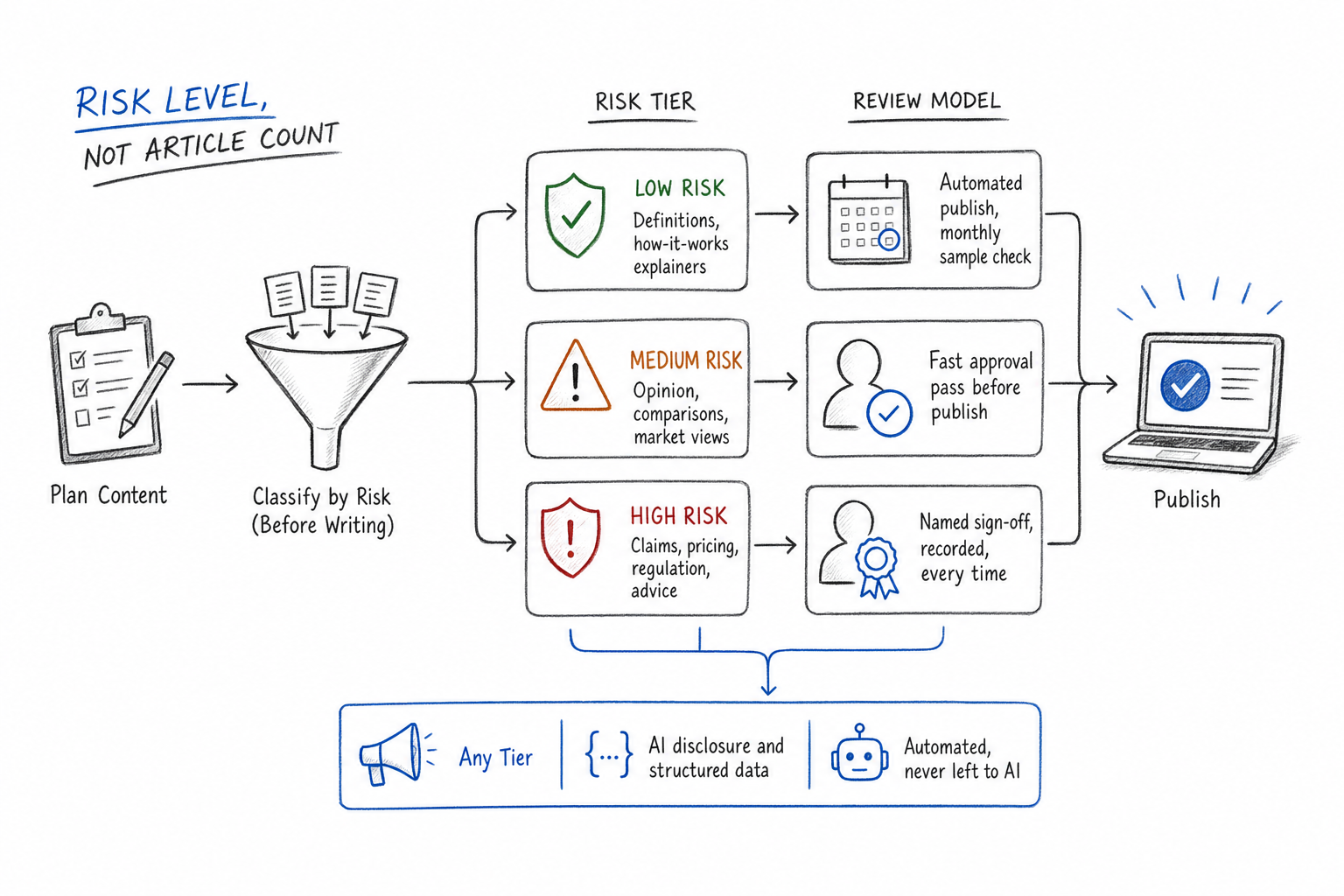
Low risk: explanatory content you could defend in your sleep
Articles that explain how something works, define terms, or walk through concepts your team discusses weekly. No new claims, no numbers you did not supply, no advice with consequences. These can publish on the automated schedule with spot-checking rather than per-article sign-off — read a sample each month, not every piece.
Medium risk: opinion, comparison and anything touching your market
Pieces that take a position, compare approaches, or describe how a category works. The factual exposure is low but the positioning exposure is real. These benefit from a quick approval pass: a reviewer reads the headings and the claims, approves or sends back, typically in minutes rather than an hour.
High risk: claims, regulation, numbers and anything a customer might act on
Pricing, compliance deadlines, performance claims, sector-specific guidance, anything a prospect could quote back to you. Named human approval, every time, recorded. If your business sits in a regulated sector, most of your blog is in this tier and your policy is simple.
| Risk tier | Typical content | Review model |
|---|---|---|
| Low | Definitions, how-it-works explainers | Automated publish, monthly sample check |
| Medium | Opinion, comparisons, market views | Fast approval pass before publish |
| High | Claims, pricing, regulation, advice | Named sign-off, recorded, every time |
| Any tier | AI disclosure and structured data | Automated, never left to memory |
Classify your editorial plan once against this table and the policy argument disappears: you stop debating “do we review AI content” and start answering “which tier is this piece in”.
What a tracked approval workflow looks like in practice
The middle path is not “sometimes someone looks at it”. It is an approval step that exists in the system, with a state and a record.
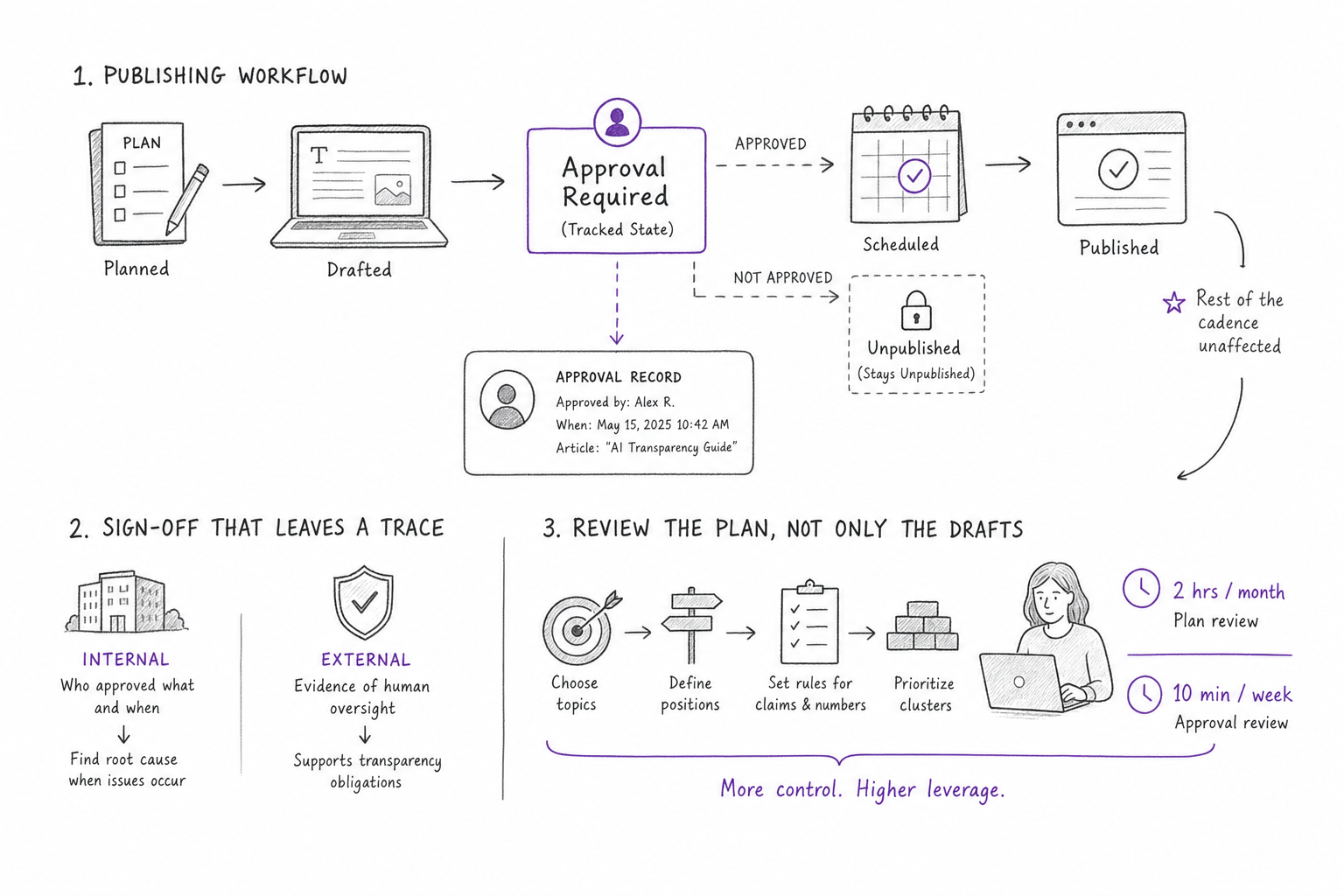
Approval as a publishing state, not an email
Each article moves from planned to drafted to approved to published. Pieces in the tiers you flagged wait in the approved-required state; the rest continue on schedule. Nothing sits in an inbox, nothing depends on someone remembering. If no one approves a flagged article, it stays unpublished — and the rest of the week’s cadence is unaffected, which is the point.
Sign-off that leaves a trace
The record matters for two reasons. Internally, it tells you who approved what and when, which is how you find the root cause when something wrong gets published. Externally, it is evidence of the human oversight your transparency obligations assume: a claim that “we review our content” carries weight only when it has timestamps behind it. The broader obligations are covered in our piece on what the AI Act requires from companies publishing AI-written blogs.
Review of the plan, not only the drafts
The highest-leverage human work happens before writing. Choosing the topics, defining the positions the blog will defend, setting the rules about claims and numbers, deciding which clusters get built first — that is editorial judgment, and no system supplies it. A content lead who spends two hours a month on the plan and ten minutes a week on approvals exerts more control than one who proofreads thirty drafts.
This is how a human-supervised editorial plan is meant to work: approval checkpoints on the pieces that need them, automated publishing on the rest, cadence unbroken either way. The tier where that supervision is included is described on our plans and pricing page.
Where E-E-A-T fits, and where it does not
It is tempting to justify mandatory review with search rankings: “Google penalises AI content unless a human checks it”. That is not what the guidance says, and building your editorial policy on a misreading of it will cost you.
Experience, expertise, authoritativeness and trustworthiness are properties of the content and the publisher, not of the production method. An article shows experience when it contains specifics only a practitioner would know. It shows trustworthiness when the publisher is identifiable, the claims are checkable, and the disclosure is honest. A human reading a generic draft adds none of those things; a well-briefed system that embeds your actual positions and your real constraints adds all of them.
So review AI content because of liability, accuracy and voice — not because you think a proofread earns ranking credit. We go deeper into the ranking side in our analysis of E-E-A-T and whether Google penalises AI-generated articles.
Frequently asked questions
Does Google require human review of AI-generated content?
No. The published guidance judges content by usefulness, originality and trustworthiness rather than by how it was produced. Human review matters for accuracy, brand voice and legal exposure, and those are business reasons. Treating review as a ranking requirement leads companies to spend effort on proofreading instead of on topic selection and factual discipline, which is where quality is actually decided.
What does the AI Act require when I publish AI-written articles?
The core obligation is transparency: content generated or substantially modified by AI should be identifiable as such, in readable text and in machine-readable form. It does not mandate that a person approve every article. Human oversight is a governance practice you adopt for your own protection, and keeping a record of approvals makes that oversight demonstrable rather than merely claimed.
Which articles should always be reviewed by a person before publishing?
Anything a reader could act on with consequences: pricing and commercial claims, regulatory deadlines, performance figures, sector-specific guidance, and statements about what your product does. Also anything that stakes out a new company position. Explanatory content covering ground your team knows well can publish on schedule with periodic sampling instead of per-article sign-off.
How long should reviewing an AI-written article take?
A medium-risk piece should take minutes, not an hour: scan the headings for structure, check every number and named entity, confirm the positions match your company’s, approve or return. If review routinely takes longer, the problem is upstream — the brief, the rules about claims, or the topic choice — and fixing it there removes the work permanently.
Can a blog publish three articles a week with human approval in the loop?
Yes, provided approval is a state in the system rather than an email thread. Flagged pieces wait for sign-off; unflagged pieces publish on schedule. Cadence breaks when every article needs the same gate and one person holds it. Separating the two keeps the calendar full while the pieces that matter still get a named approver.
What happens if nobody approves a flagged article?
It stays unpublished, which is the correct outcome. The important design detail is that it does not block the rest of the schedule. A good workflow lets an article expire in the approval queue while the week’s other pieces go live, so an absent reviewer costs you one article rather than a month of silence.
Does automated publishing damage credibility with readers?
Not by itself. Readers react to articles that are vague, wrong or obviously padded, and to blogs that stopped updating. A stated AI disclosure alongside consistent, specific and current content reads as professional. An abandoned archive with no disclosure reads worse, whatever produced it.
The decision to make this week
The question “should a human always review AI articles” is the wrong unit of analysis. Replace it with a risk classification applied to your editorial plan, an approval state that exists in your publishing system, and a record of who signed off on what — then let the rest publish on cadence without ceremony. That combination gives you defensible oversight where it matters and three or more articles a week everywhere else. To see how a planned topic structure and a supervised publishing workflow fit together for your site, start with a topic analysis of your business.
This article was produced and published automatically with the help of artificial intelligence.
Start today
A blog like this, on your site
This article was written and published by RankGrove, with the method you read about on the site. Try it free on your WordPress: the first article lands in your drafts within ten minutes.
Start free trial