Generative Engine Optimization (GEO) & AI Search
E-E-A-T and AI Content: Will Google Penalize Your Blog?

Google has never announced an algorithm that detects and penalizes AI-generated articles as such. What its public guidance and its ranking systems do target is content produced primarily to game search rankings, with no first-hand experience, no identifiable author and nothing a reader could not find elsewhere. The production method is not the risk factor: missing E-E-A-T signals and missing accountability are.
The fear is real and it comes up in almost every conversation about automating a company blog. You are about to publish articles written with AI, and someone in the room asks whether Google will de-rank the whole domain for it. The question deserves a precise answer, because the wrong assumption costs you either way: publish carelessly and you will genuinely underperform, or stay paralysed and you publish nothing while competitors accumulate coverage every week.
Here is the precise answer. Google’s public position is that it rewards high-quality content regardless of how it was produced. There has never been a confirmed “AI penalty” in the sense of a system that identifies machine-written text and demotes it for being machine-written. What exists instead is a set of quality systems and policies aimed at content made primarily for search engines rather than people: thin pages, mass-produced pages with no added value, scaled content abuse. AI makes it cheap to produce exactly that kind of page, which is why the two things get confused.
This article separates them. You will get the actual mechanics of e-e-a-t ai content — what each of the four signals means when a machine drafts the text, which ones survive automation and which ones only a human or a business can supply — plus the policy nuances that decide whether your articles are treated as useful or as noise. If you also want to understand how the same content gets picked up inside AI answers, the companion piece on Generative Engine Optimization and getting cited by AI search covers that side.
Contents
What Google actually says about AI-generated content
Google’s stated stance is consistent and has been for a while: the method of production is irrelevant to ranking; the quality and usefulness of the result is not. Automation used to manipulate rankings violates spam policies. Automation used to help people is treated like any other content.
That is a narrower statement than most people read into it. It does not say AI content ranks equally well. It says AI content is not disqualified in advance. The filter it will pass through is the same filter applied to everything else, and that filter is unusually hard on generic material.
The “scaled content abuse” line
The policy concept that matters most is content produced at scale with little original value, whose main purpose is to capture search traffic. Notice the two conditions: scale and absence of value. Volume alone is not the offence. A publisher putting out several substantive articles a week on a topic they actually know is doing normal publishing. A site spinning out hundreds of near-identical pages targeting keyword variants is doing something else, and it would have been a problem in 2010 with human writers too.
The practical test is uncomfortable but simple: if you removed your brand from an article, would a reader be able to tell it came from you rather than from any of the other twenty results? If the honest answer is no, the article is at risk — whoever or whatever wrote it.
Why “helpful content” is a system, not a punishment
Search quality systems evaluate sites broadly, not just page by page. A large volume of unhelpful material can weigh on how the whole site is assessed. This is the mechanism people mistake for an AI penalty. A company publishes eighty generic AI drafts in a month, visibility drops, and the conclusion drawn is “Google caught the AI”. What actually happened is that eighty pages of nothing were added to a domain, and the site-level assessment reflected it.
The takeaway for anyone running an automated blog: the risk lives in what you publish, not in what drafted it.
What E-E-A-T means when a machine writes the first draft
E-E-A-T stands for Experience, Expertise, Authoritativeness and Trustworthiness. It is not a score inside the algorithm. It is the framework human quality raters use to judge whether search results are good, and those judgements feed back into how ranking systems are developed and tuned. Treat it as the rubric your content is graded against, indirectly but consistently.
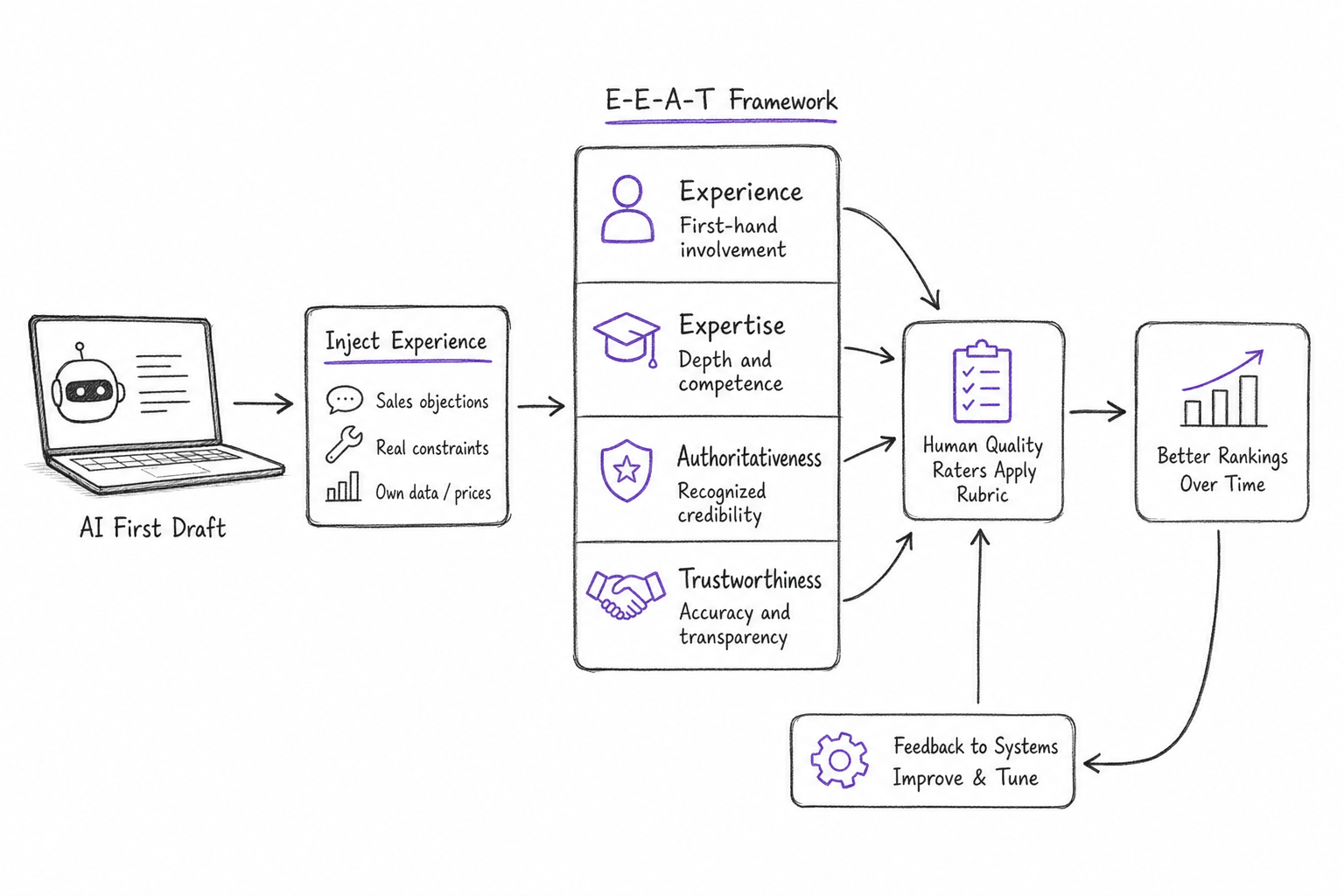
The interesting part is that the four elements behave very differently when AI is in the loop.
Experience: the one a model cannot fabricate
Experience means first-hand involvement with the subject. Did the author actually use the product, run the process, handle the case? A language model has none. It can produce a fluent paragraph about what implementation typically looks like, and that paragraph will read plausibly and add nothing.
This is where most AI content fails, and where the fix is structural rather than editorial. The experience has to be injected by the business: the objections your sales team hears every week, the constraint that makes the standard advice inapplicable in your sector, the number you can actually quote because it is your own price list. A drafting system that never receives company-specific input will produce company-neutral text, and company-neutral text is precisely what quality systems are built to filter out.
Expertise: demonstrable, not declared
Expertise is about competence in the subject matter. It is signalled by depth, by correct use of terminology, by getting the edge cases right, and by an identifiable author or organisation that plausibly holds that competence. An AI draft can carry considerable topical depth — that part automates well. What it cannot do is attach itself to a credible source of authority. That comes from your author pages, your organisation markup, your track record on the topic across the site.
Authoritativeness: earned at site level
Authoritativeness is reputational and accumulates across the whole domain. It grows when a site covers a subject comprehensively rather than sporadically, when other sources reference it, when it becomes the obvious place to look for that theme. Automation helps here more than anywhere else, because authority on a topic is partly a coverage problem: a site with forty connected articles on one subject reads as an authority; a site with four does not.
This is also why cadence matters to E-E-A-T. At least three articles a week, held without gaps, is what builds topical coverage fast enough to be recognised as authority within a competitive space. A monthly post accumulates too slowly to signal ownership of anything.
Trustworthiness: where transparency becomes a ranking asset
Trust is the element that ties the other three together — accurate information, clear attribution, honest disclosure, a visible entity behind the content. For AI-assisted publishing, this is the element you can improve immediately and completely.
Saying plainly that an article was produced with AI assistance and reviewed by a named person does not weaken trust. It demonstrates it. Concealment is what damages trust, and concealment is increasingly detectable anyway.
The real risk factors, in order of severity
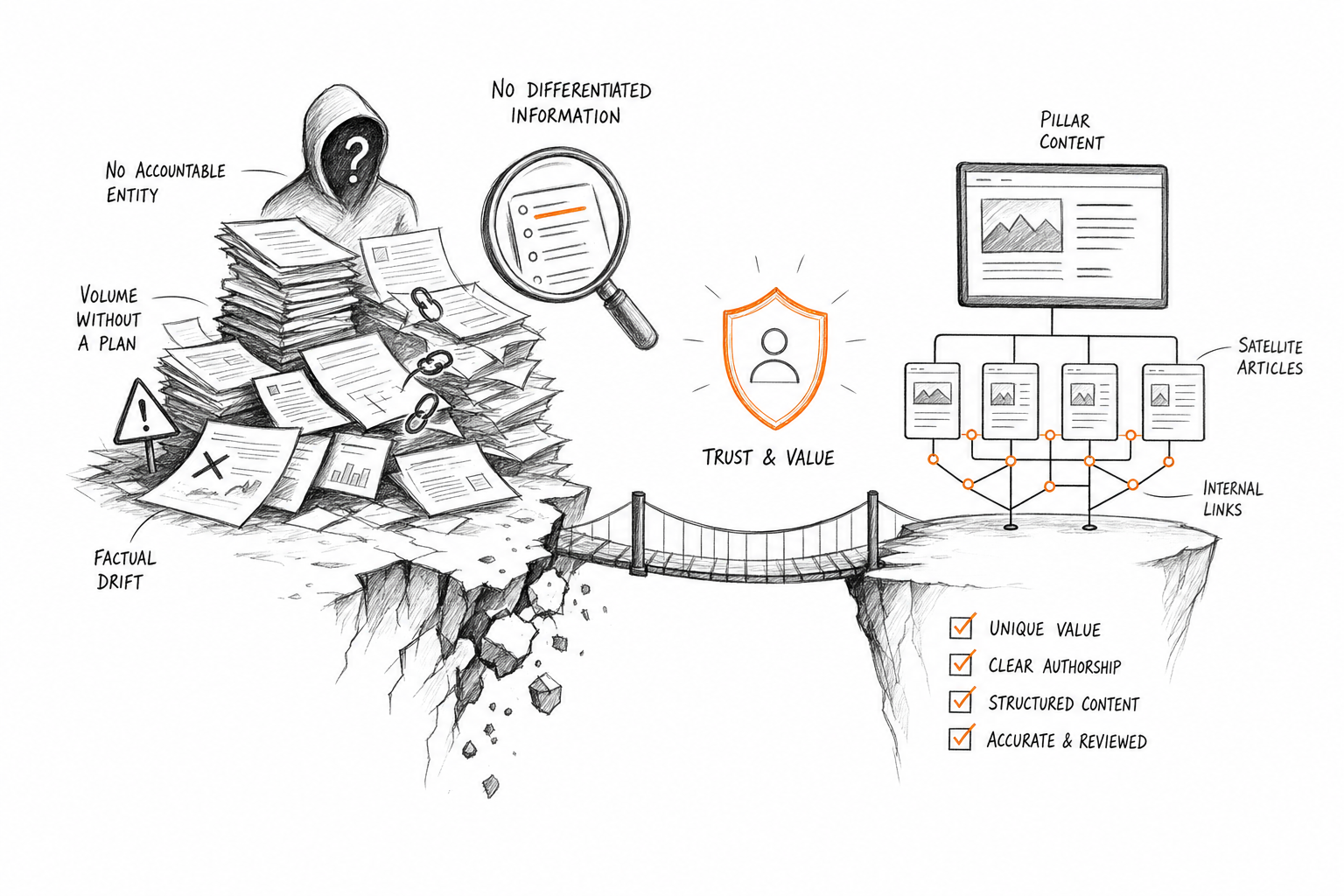
Ranking problems attributed to AI usually trace back to a small set of concrete failures. Understanding which one applies to you turns a vague fear into a fixable defect.
No differentiated information
The most common failure. The article summarises what the top-ranking pages already say. It is accurate, well-structured, and entirely redundant. Search systems are explicitly designed to avoid adding another copy of an existing answer.
No accountable entity
No author, no organisation, no way to tell who stands behind the claims. This is a trust failure that has nothing to do with AI, but AI-generated sites exhibit it far more often because nobody stopped to attach a human to the output.
Volume without a plan
Publishing a lot is good. Publishing a lot of disconnected pages that target overlapping keywords and link to nothing is the pattern that scaled-content policies describe. The difference between healthy volume and abuse is structure: a planned topic tree where pillar articles own the main themes, satellite articles answer specific questions, and internal links connect them into something navigable.
Factual drift
Language models produce confident errors. An unreviewed article that misstates a legal deadline or invents a statistic is a trust failure with real consequences — and it is exactly the kind of mistake a reader in your industry will catch immediately.
| Symptom | Underlying cause | What to change |
|---|---|---|
| Pages indexed, no impressions | No differentiated information | Inject company-specific experience into the brief |
| Traffic drop after bulk publishing | Volume without structure | Move to a planned topic tree with internal links |
| High bounce, low dwell time | Generic, unfocused answers | Narrow each article to one real question |
| Credibility complaints from readers | Unreviewed factual drift | Add a tracked human approval step |
| No AI visibility or citations | Weak trust and attribution signals | Named authors, disclosure, structured data |
None of these rows mention the word “AI” as the cause. That is the point.
How to publish AI content without triggering E-E-A-T red flags
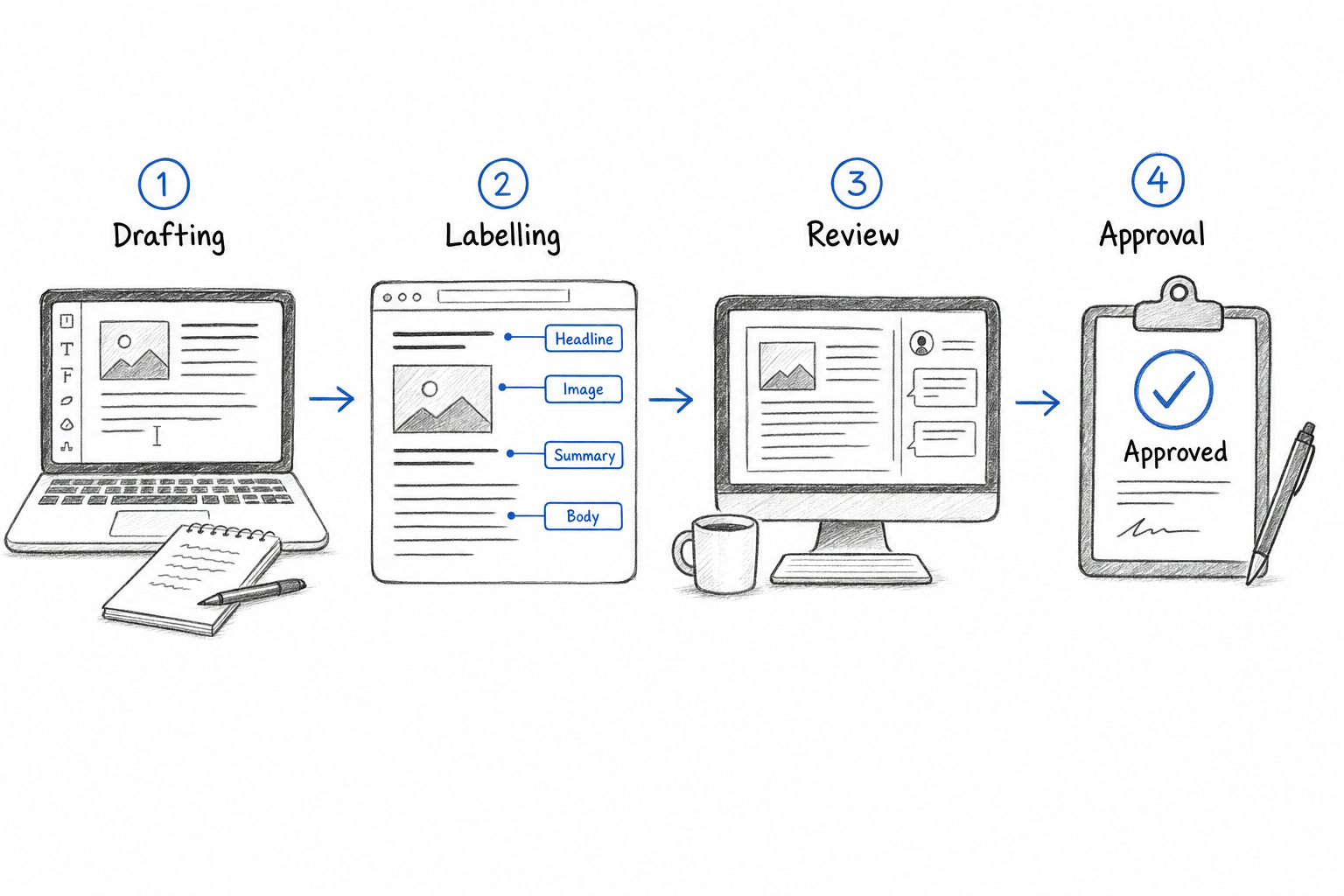
The operational answer has three parts: structure the content so it is worth publishing, mark it so its origin is verifiable, and keep a human accountable for it.
Plan the topic tree before you generate anything
Content that ranks belongs to a system. A pillar article owns a broad theme; satellite articles answer the specific questions around it; internal links carry authority between them and toward the pages that sell. This structure does more for E-E-A-T than any amount of prompt tuning, because it is what converts individual articles into demonstrated topical coverage. It also solves the scaled-content problem by construction: every article has a defined job and a defined place.
Mark AI-assisted content in plain text and in structured data
Under the EU AI Act, content generated or substantially modified by AI and published to the public carries transparency obligations — the disclosure must be clear to the reader and machine-readable, not buried in a footer nobody reads. The relevant transparency provisions apply from 2 August 2026, which makes this a 2026 operating requirement rather than a future consideration for any business publishing into the EU.
Treat it as an advantage. A machine-readable label is a trust signal that most sites still lack, and it costs nothing in ranking terms. If you want the technical detail of how the marking works, the piece on what a machine-readable AI content label means goes through it, and the wider set of company obligations is covered in AI Act and AI-written blogs.
Keep a tracked human approval on every article
Whether a human must review AI content, and how deep that review needs to go, deserves its own treatment — the short version is that approval should be recorded, attributable to a named person, and take place before publication rather than after a complaint. A tracked approval log does two jobs at once: it catches factual drift, and it produces the accountability evidence that both the AI Act and trust signals require.
This is the model to run in 2026: a system that writes, illustrates and publishes on schedule, with a person who approves. Not a human writing every word, and not a machine publishing unsupervised.
Frequently asked questions
Will Google penalize my site for publishing AI-generated blog articles?
Not for using AI as such. Google’s published guidance states that quality, not production method, determines ranking, and no algorithm has ever been announced that demotes content for being machine-written. Penalties and demotions target content made primarily to manipulate rankings: thin, duplicative, mass-produced pages with no original value. AI makes that easy to produce, which is why the two get conflated.
Can Google detect AI-generated content?
Detection is unreliable and, more importantly, largely beside the point. Ranking systems assess whether a page satisfies the query with useful, differentiated information and whether the site behind it is trustworthy. A well-researched AI-assisted article passes those checks; a generic human-written article fails them. Optimising for undetectability is the wrong objective — optimise for being worth reading.
How does E-E-A-T apply to AI content specifically?
Expertise and authoritativeness automate reasonably well through depth and topical coverage. Experience and trustworthiness do not: experience must be supplied by the business as first-hand detail, and trust comes from named authors, accurate facts and honest disclosure. Those two elements are where AI content typically fails, and where deliberate process fixes it.
Do I have to disclose that an article was written with AI?
If you publish to an EU audience, yes. The AI Act’s transparency provisions require that AI-generated or substantially AI-modified content published to the public be disclosed clearly and in a machine-readable form, applying from 2 August 2026. Beyond compliance, disclosure is a trust signal: it shows a process exists and that someone is accountable for the output.
How many AI-assisted articles a week is safe to publish?
Volume is not the risk factor; structure is. Three articles a week, each answering a distinct question inside a planned topic tree and reviewed before publication, is a healthy cadence and the minimum needed to build topical coverage at competitive speed. The same three articles produced as keyword-variant near-duplicates would be a problem at any frequency.
Does disclosing AI use hurt my rankings?
There is no evidence or stated policy suggesting that transparent disclosure reduces ranking. Search guidance focuses on whether content is helpful and trustworthy, and clear attribution of how content is produced supports the trust element rather than undermining it. Concealment, by contrast, is a reputational liability if discovered, and is a compliance breach in the EU.
What should I fix first if my AI content is not ranking?
Start with differentiation. Take your three best-performing target queries and check whether your article contains anything a reader could not get from the current top results — a constraint specific to your sector, your own pricing logic, an objection you actually handle. Then verify author attribution and internal linking. Those three fixes address most cases.
The decision this leaves you with
The question “will Google penalize AI content” is the wrong frame, and holding onto it produces bad decisions in both directions — reckless publishing on one side, paralysis on the other. The useful question is whether each article you publish adds something a reader cannot get elsewhere, whether a named person stands behind it, and whether the system producing it builds coverage of a topic rather than a pile of pages.
Get those three right and the production method genuinely stops mattering. Get them wrong and no amount of human writing will save the results. If you want to see how a planned topic tree, machine-readable AI disclosure and tracked human approvals work together in practice, start with how we research and structure a topic, then read why we built it this way.
This article was produced and published automatically with the help of artificial intelligence.
Start today
A blog like this, on your site
This article was written and published by RankGrove, with the method you read about on the site. Try it free on your WordPress: the first article lands in your drafts within ten minutes.
Start free trial