AI Act Compliance & Content Governance
AI Content Disclosure: What a Machine-Readable Label Means

A visible “written with AI” note at the bottom of an article and a machine-readable label are two different things: one talks to your readers, the other talks to crawlers, aggregators and AI systems that re-use your text. If you publish with AI on any regular cadence, the practical question is not whether to disclose, but how to attach the marking consistently to every article and every future edit without a human remembering to do it.
You have read that the AI Act asks for transparency on AI-generated content. Fine. Now you are sitting in front of your WordPress editor with a post that a model drafted and you rewrote by a third, and you want a straight answer: do I need a machine-readable label, and what does that look like in practice?
This article answers that operational question. It does not re-open the legal framing — who counts as a provider, who counts as a deployer, which obligations land on which party, and when each one applies. That is covered in depth in the pillar on what the EU AI Act asks of businesses publishing with AI, and it is worth reading before you make policy decisions. Here we stay downstream of that: assuming transparency applies to your blog, what do you physically put on the page?
You will get four things. A working definition of machine-readable that goes beyond a visible tag. The difference between a disclosure note written for a person and a label written for a machine, and why you generally want both. Three concrete scenarios — fully generated, AI-assisted, human-written with AI research — and how each one should be marked. And a short decision framework you can apply to your own archive today, plus an honest look at what this costs you in ongoing maintenance.
One caveat up front, and it is not a formality: the precise wording and scope of what you must declare depends on your jurisdiction, your sector and how the content is used. Treat what follows as an implementation guide, not as legal advice.
Contents
What “machine-readable” actually means for a blog article
A machine-readable AI content disclosure is a marking embedded in the page’s code or metadata, in a fixed format, that software can parse without reading the prose. A sentence at the end of the article saying “this text was produced with the help of artificial intelligence” is human-readable. A crawler sees it as a paragraph like any other paragraph.
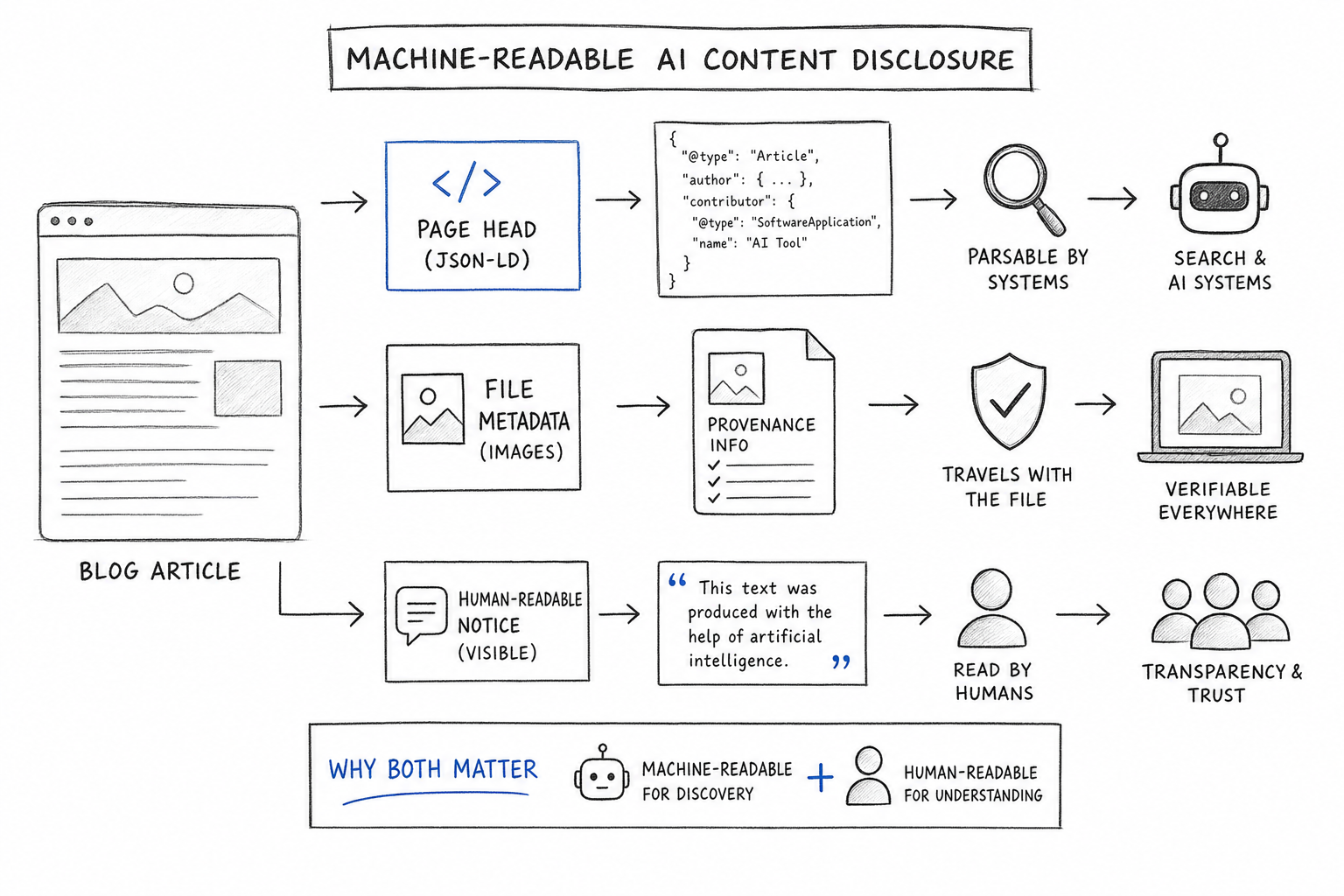
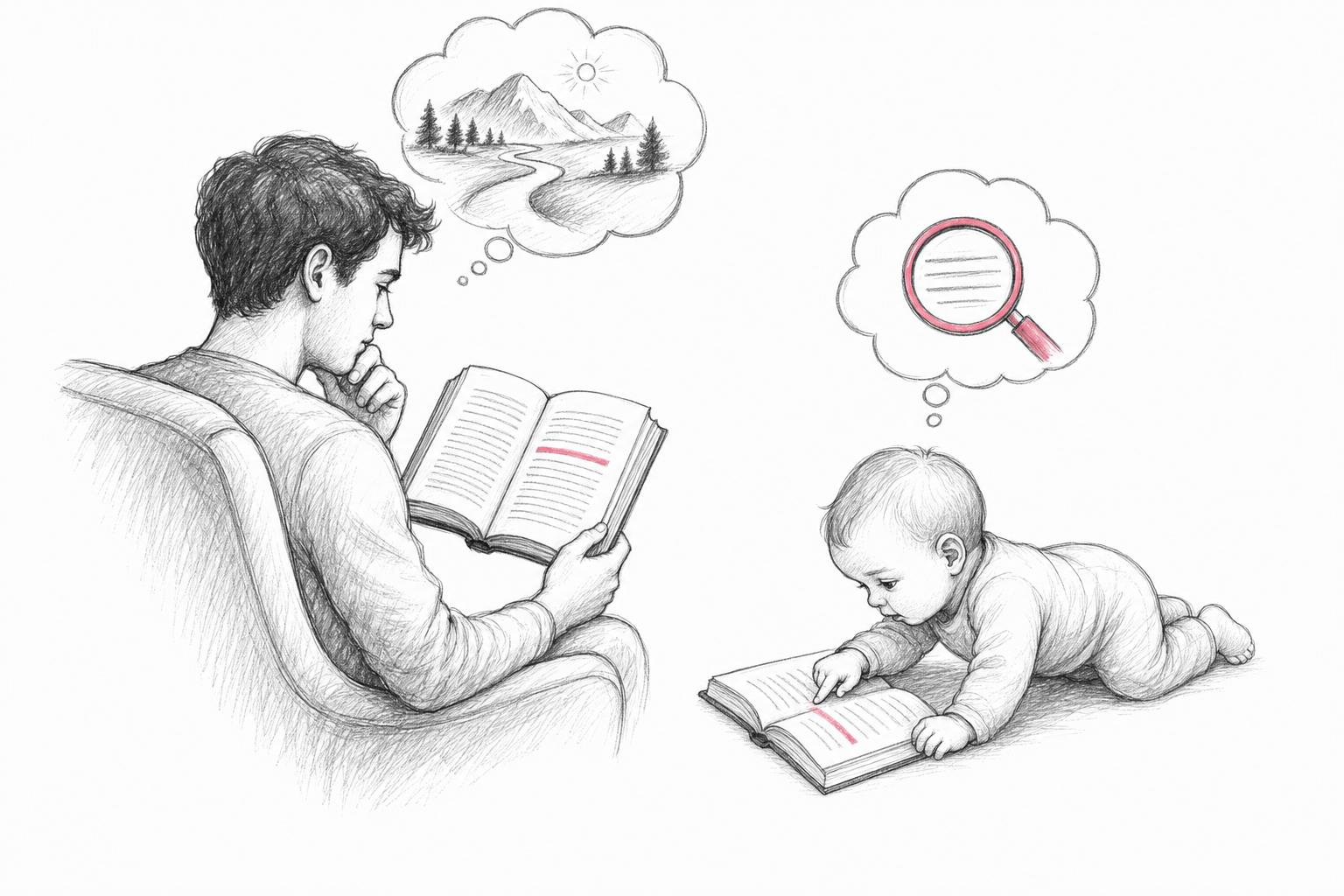
The distinction matters because the two audiences behave differently. A reader skims, understands context, forgives phrasing. A parser does neither: it looks for a known field in a known place, and if the field is absent the content is indistinguishable from anything else on the web.
Where the marking physically lives
In practice there are three layers where a label can sit, and they are complementary rather than alternative.
The first is structured data in the page head — a JSON-LD block that describes the article as an object with properties. Schema.org vocabulary already gives you the hooks: an Article can declare its author, and the creative-work vocabulary lets you express that a tool participated in production. This is the layer search engines and AI systems already parse on every crawl, so it is the cheapest place to be explicit.
The second is embedded metadata in the files themselves, most relevant for images. Provenance standards for media attach signed information about how an asset was produced and what was done to it afterwards, travelling with the file rather than with the page. If your blog uses AI-generated illustrations — and most automated blogs do — the images carry their own disclosure question separate from the text.
The third is the CMS record: custom fields, taxonomy terms, or post meta stored in your database that record which model produced the draft, when, who approved it and what changed. This layer is invisible to the public web but it is the one that saves you when someone asks, eighteen months later, how a specific article was made.
Why a visible tag alone leaves a gap
Search engines, feed aggregators, syndication partners and generative systems re-use your content through APIs and structured data, not through visual inspection. An article whose only disclosure is a line of prose is, from their perspective, unmarked. If your intent is to be transparent, the marking has to exist in the layer that the consuming systems actually read.
Takeaway: think of machine-readable disclosure as a field, not as a sentence. If it cannot be extracted by a script, it is not machine-readable.
How a human-readable note and a machine-readable label divide the work
The visible note and the structured label serve different purposes, and confusing them produces either a page cluttered with legal boilerplate or a page that looks clean and tells automated systems nothing.
The note: short, placed where it is seen, written for a person
A disclosure note works when it is specific and brief. “Draft produced with a generative model, reviewed and edited by our editorial team before publication” says more than “AI-assisted” and costs the reader three seconds. Position matters more than length: a note buried in the footer of the whole site does not attach to the article, while a line directly under the title or immediately after the body attaches unambiguously.
Resist the temptation to hedge. A vague formula invites the suspicion that you are minimising. Plain wording reads as confidence; evasive wording reads as damage control.
The label: fixed vocabulary, stable position, parseable
The structured label has the opposite constraints. Nobody reads it, so clarity of prose is irrelevant; what counts is that it uses a vocabulary the consuming system recognises and that it appears in the same place on every article. Inconsistency is the failure mode here — three articles marked one way, forty marked another, and two hundred marked not at all.
The two layers should agree. If your JSON-LD declares that a model contributed and your visible note claims the piece is entirely human-written, you have created a contradiction that is worse than either statement alone.
Takeaway: publish both, keep them consistent, and write the visible note once as a reusable template so it does not drift article by article.
Three scenarios and how each one should be marked
Most of the confusion around AI content disclosure comes from treating “AI-generated” as a binary. Editorial production is a spectrum, and the marking should describe the actual workflow.
Fully generated, published after approval
A model produces the full draft, a person reads it, approves it, and it goes live substantially as written. This is the clearest case: the content is machine-generated, a human validated it, and both facts belong in the record. The visible note says the article was produced with a generative system and reviewed before publication. The structured data declares the tool’s participation. The CMS record stores the model, the timestamp and the approving user.
This is also the case where the cost of manual compliance becomes obvious. At three articles a week, which is the minimum cadence for a blog that intends to own a topic rather than decorate a website, you are attaching and verifying this marking around a hundred and fifty times a year. Doing that by hand, every time, without a single omission, is not a realistic expectation of a human editor.
AI-assisted, substantially rewritten by a person
A model drafts, an editor restructures the argument, cuts half of it, adds original analysis. The final text is meaningfully human work built on a generated starting point. Here the honest marking describes assistance rather than generation: the note says the article was written with AI assistance and edited by the team, and the structured layer records that a tool was involved in production without claiming the model authored the result.
There is no bright line between “edited” and “rewritten”, and you will not find one. What you can do is fix an internal rule — for example, that anything starting from a generated draft is marked as AI-assisted regardless of how much survives — and apply it uniformly. A defensible policy applied consistently beats a perfect policy applied occasionally.
Human-written, with AI used for research or editing
A person writes the article; a model was used to summarise sources, suggest headings, or check grammar. Most reasonable readings put this outside the scope of generated-content disclosure, because the published text is not model output. Still, recording the tool use in your internal CMS field costs nothing and answers the question if it is ever asked.
The table below condenses the three cases into something you can pin next to your editorial checklist.
| Production mode | Visible note | Machine-readable marking |
|---|---|---|
| Model drafts, human approves | Yes, explicit | Structured data plus CMS record |
| Model drafts, human rewrites | Yes, as AI-assisted | Structured data plus CMS record |
| Human writes, AI assists research | Optional | Internal CMS record only |
| AI-generated images in the article | Yes, in caption or credit | File-level provenance metadata |
Takeaway: classify by workflow, not by how the text reads, and write your classification rule down before you need it.
A decision framework you can apply to your blog this week
Start with the archive you already have, because retroactive marking is the part everyone postpones. Sort your published posts into the three production modes above. You will probably find that the boundary cases are fewer than you feared and the unmarked generated pieces are more numerous.
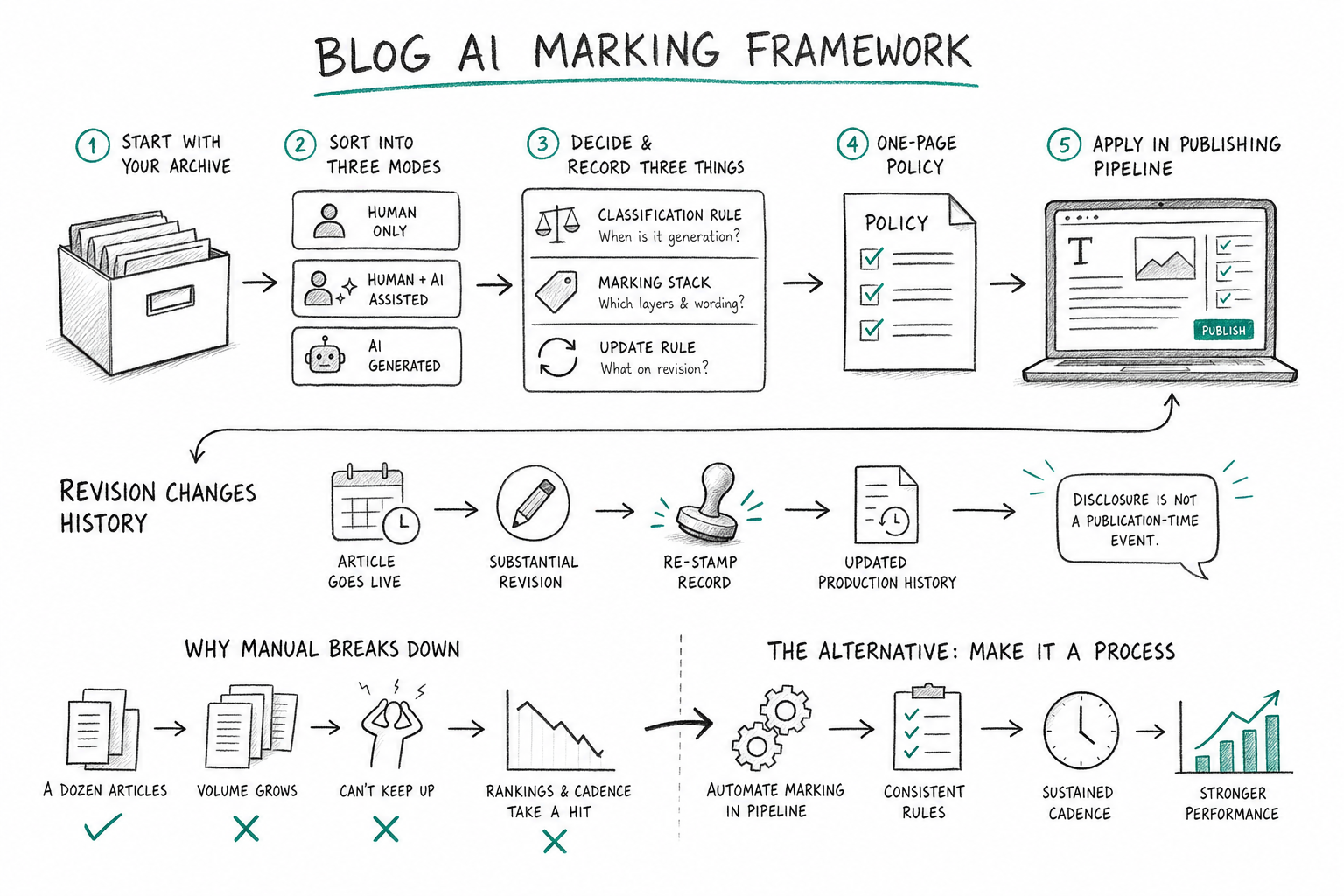
Then decide three things and record them in a one-page internal policy. First, your classification rule: at what point does assistance become generation, in your own terms. Second, your marking stack: which of the three layers you will use, and the exact wording of the visible note. Third, your update rule: what happens when an article is substantially revised later, which is the step most teams forget entirely.
That third point deserves emphasis. Disclosure is not a publication-time event. An article edited by a model six months after it went live changes its own production history, and a marking that reflects only the original draft is quietly wrong. Any workable system has to re-stamp the record on every meaningful revision — which is precisely why this belongs in the publishing pipeline rather than in a checklist.
Where the manual approach breaks down
Doing this by hand works for a dozen articles. It stops working at volume, and volume is the whole point of a blog that competes: what happens to your rankings when you stop posting is the reason nobody serious publishes monthly. Sustained cadence plus manual per-article compliance is a combination that fails on the first busy week.
The alternative is to make the marking a property of the publishing system. If the structured data, the visible note and the internal record are generated at the moment the article is pushed to WordPress, and regenerated on every update, compliance stops depending on memory. The same logic applies to the rest of your on-page structure, which is why structured data for AI visibility and disclosure markup end up living in the same layer of the stack.
Takeaway: write the policy this week, apply it to the archive, and automate the application before you scale the cadence.
Frequently asked questions
Is a visible “AI-generated” tag enough for AI content disclosure?
For your readers, often yes. For automated systems, no: crawlers, aggregators and AI models parse structured data and metadata, not prose. A visible note plus a machine-readable label in the page’s JSON-LD covers both audiences. Publishing one without the other leaves a gap on whichever side you skipped, and the structured layer is the one nobody notices is missing.
What does a machine-readable label look like in code?
Typically a JSON-LD block in the page head describing the article as a structured object, with properties recording that a generative tool participated in production alongside the human author and reviewer. The exact vocabulary comes from schema.org. What matters operationally is that the same fields appear in the same position on every article, so a parser finds them reliably.
Do I need to disclose if a human heavily edited the AI draft?
Most teams mark it as AI-assisted rather than AI-generated, because the workflow started from model output even if little of it survived. There is no universal threshold separating editing from rewriting, so fix your own rule, write it down, and apply it to every article without exception. Consistency is what makes the policy defensible.
Does AI content disclosure hurt my SEO rankings?
Search engines evaluate whether content is useful, original and well structured, not whether a model was involved in drafting it. A transparency marking is metadata about production, not a quality signal. The risk to rankings comes from thin or duplicated content, which is a writing problem, not a disclosure problem.
What about AI-generated images in my blog posts?
Images carry their own disclosure question. Provenance standards attach signed production information directly to the file, so the marking travels with the asset even when it is republished elsewhere. A visible credit in the caption handles the human side. If your blog illustrates every article automatically, this doubles the number of items to mark.
Do I have to re-mark an article when I update it later?
Yes, if the update changes how the content was produced. An article revised with a model six months after publication has a different production history than the original draft, and a label reflecting only the first version is inaccurate. Build the re-stamp into your publishing workflow rather than relying on someone remembering.
Should I retroactively label old AI-written articles?
It is the cleaner position and usually straightforward if your archive is small. Sort existing posts by production mode, apply your classification rule, and update the structured data in bulk where your CMS allows it. Starting the policy from today while leaving the archive unmarked creates an inconsistency that is hard to explain later.
The point of all this
Transparency about AI-assisted publishing is easiest to sustain when it is a property of the pipeline rather than a task on someone’s list — attached automatically at publication, refreshed on every edit, recorded where both readers and machines can find it. Declaring how your content is made is an advantage: it is the part of your production process your competitors are quietly hoping nobody asks about. If you want to see how automatic marking and approval tracking work as part of publishing, here is the reasoning behind how we build it in.
This article was produced and published automatically with the help of artificial intelligence.
Start today
A blog like this, on your site
This article was written and published by RankGrove, with the method you read about on the site. Try it free on your WordPress: the first article lands in your drafts within ten minutes.
Start free trial