SEO Content Structure & Topic Clusters
FAQ Schema Markup and Structured Data for AI Visibility

FAQ schema markup is the difference between content an answer engine can quote and content it has to guess at. This guide covers the JSON-LD you need to emit, how to shape a TL;DR and table of contents so a parser finds the answer in the first block, and how to validate the markup before it ships.
An AI answer engine reading your page does not experience it the way a person does. It does not scroll, it does not skim the hero image, it does not infer that the bold sentence under the second subheading is the actual answer. It ingests HTML, extracts what is machine-readable, and assembles a response from the fragments it can attribute with confidence. FAQ schema markup is one of the few mechanisms that lets you tell a machine, explicitly, “this is a question and this is its answer.”
That matters more in 2026 than it did when rich snippets were the only prize. Google’s AI Overviews, ChatGPT’s browsing and search modes, and Perplexity all build answers by lifting short, self-contained passages and citing the source. Content that is one long undifferentiated block gets read, maybe summarised, rarely cited. Content with a clear question-answer structure, declared in structured data, gets lifted intact.
This guide is the technical setup for a single article: what FAQPage JSON-LD actually looks like, where to put a TL;DR so parsers reach it first, how a table of contents helps machine navigation, and how to validate everything before publishing. The broader question of how articles link together into a coverage structure belongs elsewhere — if you need that layer, start with how topic clusters and pillar pages structure an SEO blog. Here we stay strictly in the markup lane.
Contents
- What FAQ schema markup actually is, in plain terms
- How to structure a TL;DR so a parser finds the answer first
- How to write and place the FAQ JSON-LD block
- How a table of contents helps machine navigation
- How to validate structured data before publishing
- Common mistakes that cost you citations
- Frequently asked questions
- The setup is small, the discipline is the hard part
What FAQ schema markup actually is, in plain terms
FAQ schema markup is a block of structured data, written in JSON-LD and embedded in the page’s HTML, that declares a list of questions and their corresponding answers in a format machines parse without ambiguity. It uses the FAQPage type from the schema.org vocabulary, with each pair expressed as a Question containing an acceptedAnswer of type Answer.

JSON-LD stands for JavaScript Object Notation for Linked Data. It is a way of attaching a machine-readable description of a page’s content alongside the visible HTML, inside a <script type="application/ld+json"> tag. The visible page stays exactly as a human sees it; the script block adds a parallel, explicit description of what the page contains. Nothing in the JSON-LD renders on screen.
The important property is redundancy with intent. A well-marked FAQ says the same thing twice: once in visible HTML for the reader, once in structured data for the parser. Search engines have been explicit for years that the two must match — markup describing content that does not appear on the page is a policy violation, and in practice it gets ignored or penalised.
Why this still matters after rich result changes
Google narrowed the display of FAQ rich results in search listings a while back, and a lot of teams concluded FAQ markup was dead. That conclusion confuses one display surface with the underlying mechanism. The markup is still parsed, still used to understand page structure, and still consumed by systems that build answers rather than link lists.
The audience for structured data has widened. Retrieval systems behind conversational search need to chunk documents into passages and decide which passage answers a query. A FAQPage block hands them a pre-chunked document with the boundaries already drawn. You are doing the segmentation work that the retriever would otherwise do heuristically, and heuristics on your page are a coin flip.
The practical takeaway: judge FAQ markup by whether your content gets quoted and cited across answer engines, not by whether an accordion appears under your blue link.
How to structure a TL;DR so a parser finds the answer first
Position is leverage. Retrieval systems weight early content heavily, because the opening of a document is statistically where documents state their subject. A summary block placed immediately after the H1, before the first body paragraph, is the single highest-value real estate on the page for AI visibility.
Write it as a standalone answer
The test for a good TL;DR is whether it survives extraction. Pull those two or three sentences out of the page, show them to someone with no context, and ask what the article says. If they can answer, the block works. If the sentences reference “this approach” or “the method described below,” they are dependent on surrounding text and useless as a quoted passage.
Write in complete, self-contained statements. Name the subject explicitly rather than using pronouns. Include the specific term someone would search for. A summary that opens with “It depends on several factors” is invisible; one that opens with “FAQ schema markup is a JSON-LD block that declares question-answer pairs to search engines and AI answer engines” is quotable.
Mark it semantically, not just visually
Styling a paragraph bold and grey tells a browser how to paint it. It tells a parser nothing. Wrap the summary in a container with a meaningful class — something like <div class="article-tldr"> — so the block is identifiable in the DOM and in any downstream extraction pipeline. Keep the emphasis markup inside, because <strong> carries semantic weight where a CSS font-weight rule does not.
Keep the block short. Two to four sentences. A twelve-sentence “summary” is a second introduction and defeats the purpose: the value of the block is that it is small enough to lift whole.
Keep length and specificity in balance
Aim for roughly forty to eighty words. Below forty you rarely say anything a machine can use; above a hundred you are asking a retriever to decide which part of your summary to quote, which puts you back where you started. Include one concrete noun that anchors the topic, and avoid hedging verbs in the first sentence.
How to write and place the FAQ JSON-LD block
Here is the shape of a minimal, valid FAQPage block. Two questions is enough to illustrate the structure; in practice five to eight pairs per article is a workable range.
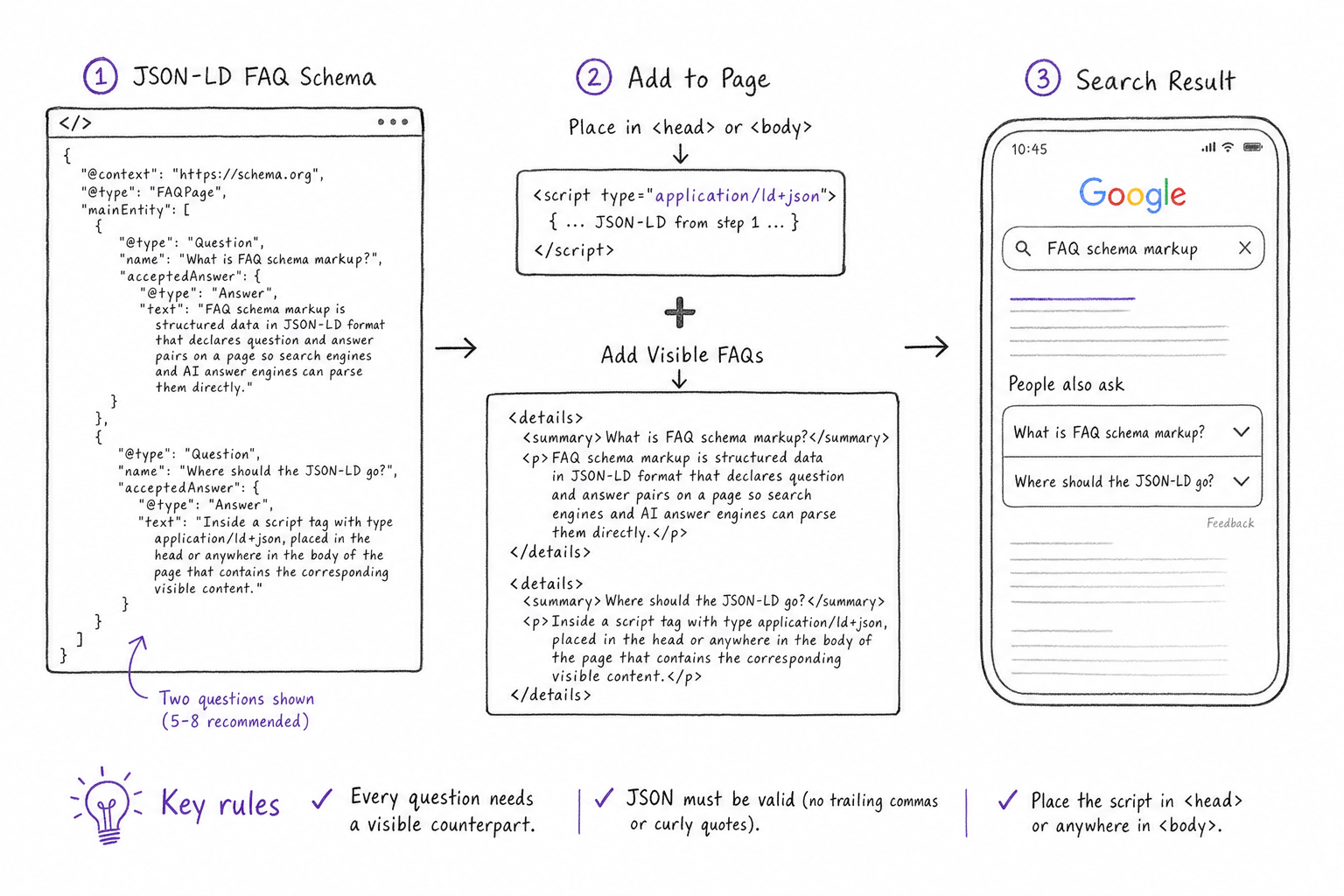
{"@context": "https://schema.org", "@type": "FAQPage", "mainEntity": [{"@type": "Question", "name": "What is FAQ schema markup?", "acceptedAnswer": {"@type": "Answer", "text": "FAQ schema markup is structured data in JSON-LD format that declares question and answer pairs on a page so search engines and AI answer engines can parse them directly."}}, {"@type": "Question", "name": "Where should the JSON-LD go?", "acceptedAnswer": {"@type": "Answer", "text": "Inside a script tag with type application/ld+json, placed in the head or anywhere in the body of the page that contains the corresponding visible content."}}]}
That object goes inside <script type="application/ld+json"> tags. Formatting is free — indentation and line breaks are for your benefit, parsers do not care — but the JSON must be strictly valid. A trailing comma or a curly quote breaks the entire block, and a broken block is treated as absent rather than partially read.
The visible markup that must accompany it
Every question in mainEntity needs a visible counterpart. The cleanest pattern is the native HTML accordion: a <details> element wrapping a <summary> with the question and a paragraph with the answer. It requires no JavaScript, it is keyboard accessible, it collapses cleanly on mobile, and the question text sits in the DOM as real content rather than as an attribute.
Match the text closely. The name in your JSON-LD should be the question as written in the <summary>; the text in acceptedAnswer should be the answer paragraph. Minor differences in punctuation are tolerated; answering a different question in the markup than on the page is not.
Writing questions that match real queries
The value of the block scales with how closely your questions resemble what people actually type or say. Write questions in the grammatical form of a query, not of a section heading. “How do I validate FAQ schema markup?” is a query. “Validation considerations” is a heading and will never match anything.
Keep answers between forty and eighty words. Long enough to be a complete response, short enough to be lifted whole into an AI answer without truncation. Put the direct answer in the first sentence and the qualification after it — retrievers that cut answers short cut from the end.
Avoiding the multiplication mistake
Do not emit a FAQPage block on every page of the site with the same generic corporate questions. Duplicated structured data across a domain dilutes the signal and looks, correctly, like templating rather than content. One FAQ block per article, with questions specific to that article’s subject, is the pattern that holds up.
How a table of contents helps machine navigation
A table of contents is usually treated as a courtesy for readers. For AI visibility it does something more structural: it creates an explicit, linked map of the document’s sections, in the document itself, near the top.
When a retriever chunks a page it has to decide where sections begin and end. A TOC built from real anchor links to real heading IDs makes those boundaries unambiguous and, just as importantly, gives each section a short label written by you. The heading text becomes the summary of the chunk beneath it, which is why vague headings hurt twice: humans skip them, and machines mislabel the passage.
Build it from the heading tree, with real anchors
Generate the list from your H2 and H3 elements, each with a stable ID, each linked with a fragment URL. Nested where the document is nested. Placed above the first H2 so it appears early in the source order.
Stable IDs matter beyond navigation. Answer engines and some search features cite fragment URLs that jump the reader to the exact section quoted. If your headings have no IDs, or IDs that change when the CMS regenerates the page, you lose that granularity.
Write headings that answer questions
An H2 reading “Overview” carries no information. An H2 reading “How to write and place the FAQ JSON-LD block” tells a parser what the next eight hundred words are about, in the phrasing someone would use to search for it. Treat each heading as a mini query and the section beneath it as the answer. This costs nothing and is the highest-leverage on-page edit most teams never make. For the wider set of on-page elements that work the same way, the technical on-page fundamentals for 2026 covers headings, meta tags and alt text together.
How to validate structured data before publishing
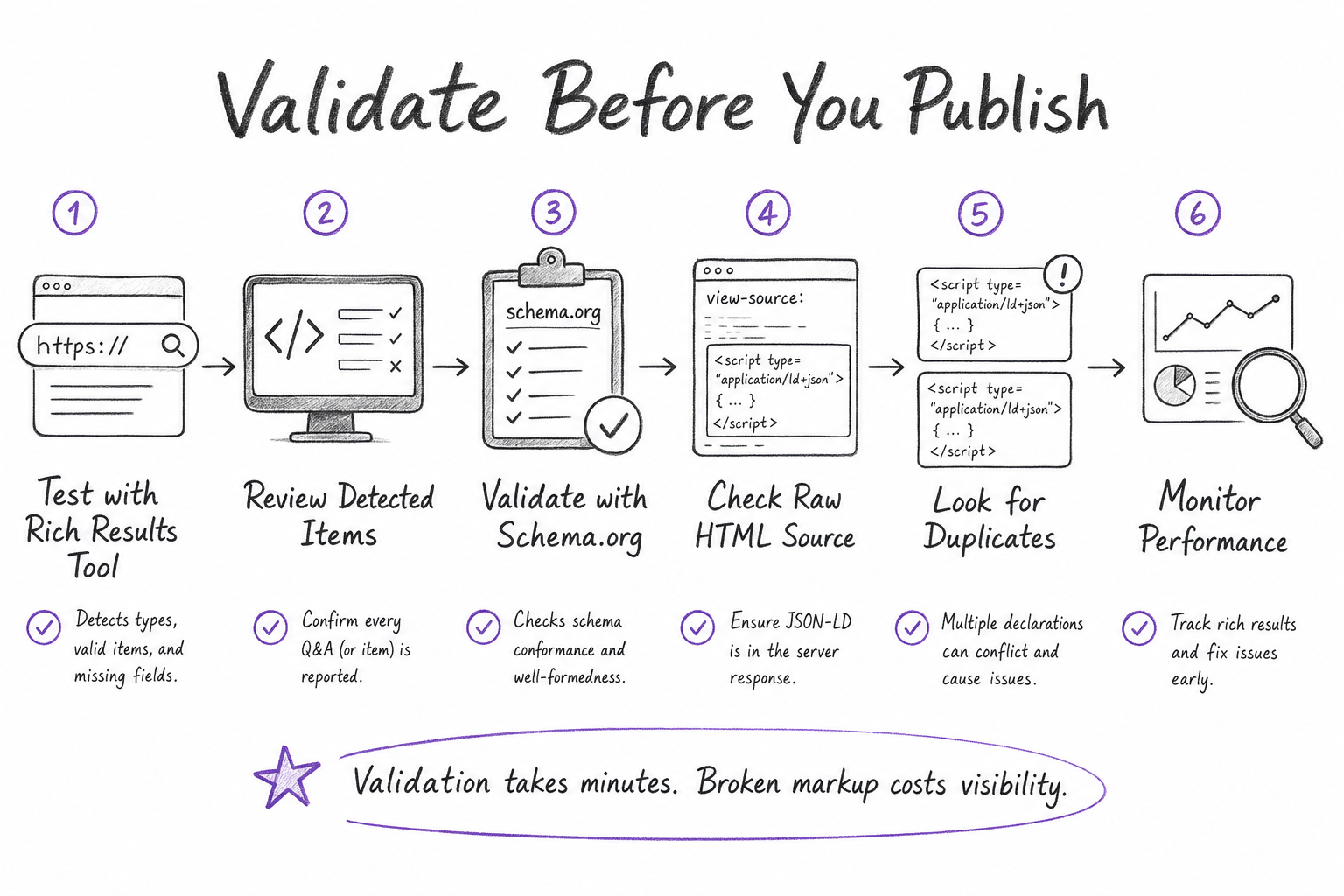
Markup that is subtly broken is worse than no markup, because you believe it is working. Validation takes two minutes and belongs in the publishing routine, not in a quarterly audit.
Run the Rich Results Test and the schema validator
Google’s Rich Results Test accepts either a live URL or a pasted code snippet and reports which rich result types it detects, which items are valid, and which fields are missing or malformed. For a FAQPage you want to see the type detected and every question-answer pair listed. If a pair is missing from the report, the JSON is malformed at that point or a required property is absent.
The schema.org validator is the complementary tool: it checks conformance to the vocabulary rather than eligibility for a specific search feature. Use it when the Rich Results Test says a type is not eligible but you want to confirm the markup itself is well formed.
Check what the crawler actually receives
A common failure mode on JavaScript-heavy sites is markup that exists in the rendered DOM but not in the initial HTML response. Fetch the page as a crawler would — view the raw source, not the inspector — and confirm the <script type="application/ld+json"> block is present in the server response. If the structured data is injected client-side, assume a meaningful share of parsers will never see it.
Also check for duplicates. Some themes and SEO plugins emit their own schema blocks. Two FAQPage declarations on the same URL with different content is a conflict, and the resolution is not in your favour.
Monitor after publication
Search Console reports structured data errors per URL and per type, with the affected pages listed. Errors that appear in bulk after a deployment usually trace to a template change rather than to individual articles. Set the expectation that validation is a recurring check, because the thing that breaks your markup is almost always a platform update nobody connected to schema.
| Check | What you are confirming | When |
|---|---|---|
| Rich Results Test | Type detected, all Q&A pairs parsed | Before publishing |
| Schema.org validator | Vocabulary conformance, no invalid properties | When eligibility is unclear |
| Raw HTML source | JSON-LD present server-side, not JS-injected | After any template change |
| Duplicate scan | One FAQPage block per URL | After plugin or theme updates |
| Search Console | Error trends across the whole site | Monthly, and after deployments |
Run the first three on every article and the last two on a schedule, and structured data stops being a source of silent failure.
Common mistakes that cost you citations
The most frequent error is markup without matching visible content — an FAQ block in JSON-LD for questions that appear nowhere on the page. It is treated as deceptive, and the penalty is that the whole block is disregarded.
Second: answers written as marketing copy. An answer that says “our approach is uniquely designed to deliver value” answers nothing and will never be quoted, because a retriever selecting between candidate passages picks the one that contains an actual fact. Write the answer a knowledgeable colleague would give.
Third: treating structured data as the whole job. Schema makes content parseable; it does not make weak content worth citing. An answer engine quoting your page is making an editorial judgment about whether the passage is a good answer. Markup gets you into the candidate set.
Fourth, and specific to 2026: omitting the AI transparency declaration on content produced with AI assistance. If the article was generated or assisted by a model, say so in plain text on the page and mark it in structured data. Under the AI Act’s transparency obligations this is a requirement, not a stylistic choice — and it sits comfortably alongside the rest of your schema rather than competing with it. Declared provenance is a trust signal for readers and for the systems deciding what to cite.
Frequently asked questions
What is FAQ schema markup?
FAQ schema markup is structured data written in JSON-LD that declares question and answer pairs on a page using the schema.org FAQPage type. It sits inside a script tag in the HTML and lets search engines and AI answer engines parse each question and its answer directly, rather than inferring structure from visible formatting.
Does FAQ schema still work now that Google reduced FAQ rich results?
Yes, though the benefit has shifted. Rich result display in standard search listings is limited, but the markup is still parsed and still used to understand page structure. Its main value in 2026 is with AI answer engines, which need pre-segmented question-answer passages to quote and attribute confidently.
Where should the JSON-LD script go in the HTML?
Inside a script tag with type application/ld+json, either in the head or in the body. Position does not affect parsing, but the block must be present in the HTML the server returns. Structured data injected only by client-side JavaScript is invisible to a meaningful share of crawlers and retrieval systems.
How many FAQ questions should one article have?
Five to eight pairs per article works well. Fewer than five rarely covers the genuine queries around a topic; more than ten tends to produce padded questions nobody searches. Each question should be phrased as a real query, and each answer should run roughly forty to eighty words with the direct answer first.
How do I validate FAQ schema markup?
Paste the URL or the code into Google’s Rich Results Test and confirm the FAQPage type is detected with every question-answer pair listed. Use the schema.org validator to check vocabulary conformance. Then view the raw page source to confirm the JSON-LD is served in the initial HTML, not added by JavaScript.
Does the FAQ text have to appear on the visible page?
Yes. Structured data must describe content the user can see. Questions and answers declared in JSON-LD but absent from the page violate search engine guidelines and typically cause the whole block to be ignored. The native HTML details and summary accordion is the simplest way to render them accessibly.
Do I need to declare AI assistance in structured data?
If content was generated or substantially assisted by AI, transparency obligations under the AI Act require a clear declaration. Best practice is a plain-text note on the page plus a machine-readable marker in structured data, with the approval recorded. Declared provenance builds trust with readers and with systems deciding what to cite.
The setup is small, the discipline is the hard part
Getting FAQ schema markup, a quotable TL;DR and an anchored table of contents onto one article is an afternoon’s work. Getting them onto every article you publish, correctly, without a template change quietly breaking the JSON three months later, is an operational problem rather than a technical one.
That is where the gap usually opens: teams implement structured data on a handful of flagship pages and leave the rest of the blog unmarked, which means the majority of their content stays unquotable. RankGrove emits the TL;DR block, the nested table of contents with stable anchors, the FAQ accordion and its matching FAQPage JSON-LD on every article it publishes, along with the AI transparency marking in plain text and in structured data — see how the platform handles it if you would rather the markup ship by default than by checklist.
This article was produced with the help of artificial intelligence and reviewed by our editorial team before publication.
Start today
A blog like this, on your site
This article was written and published by RankGrove, with the method you read about on the site. Try it free on your WordPress: the first article lands in your drafts within ten minutes.
Start free trial