Generative Engine Optimization (GEO) & AI Search
Best AI SEO Tools in 2026: GDPR and AI Act Ready
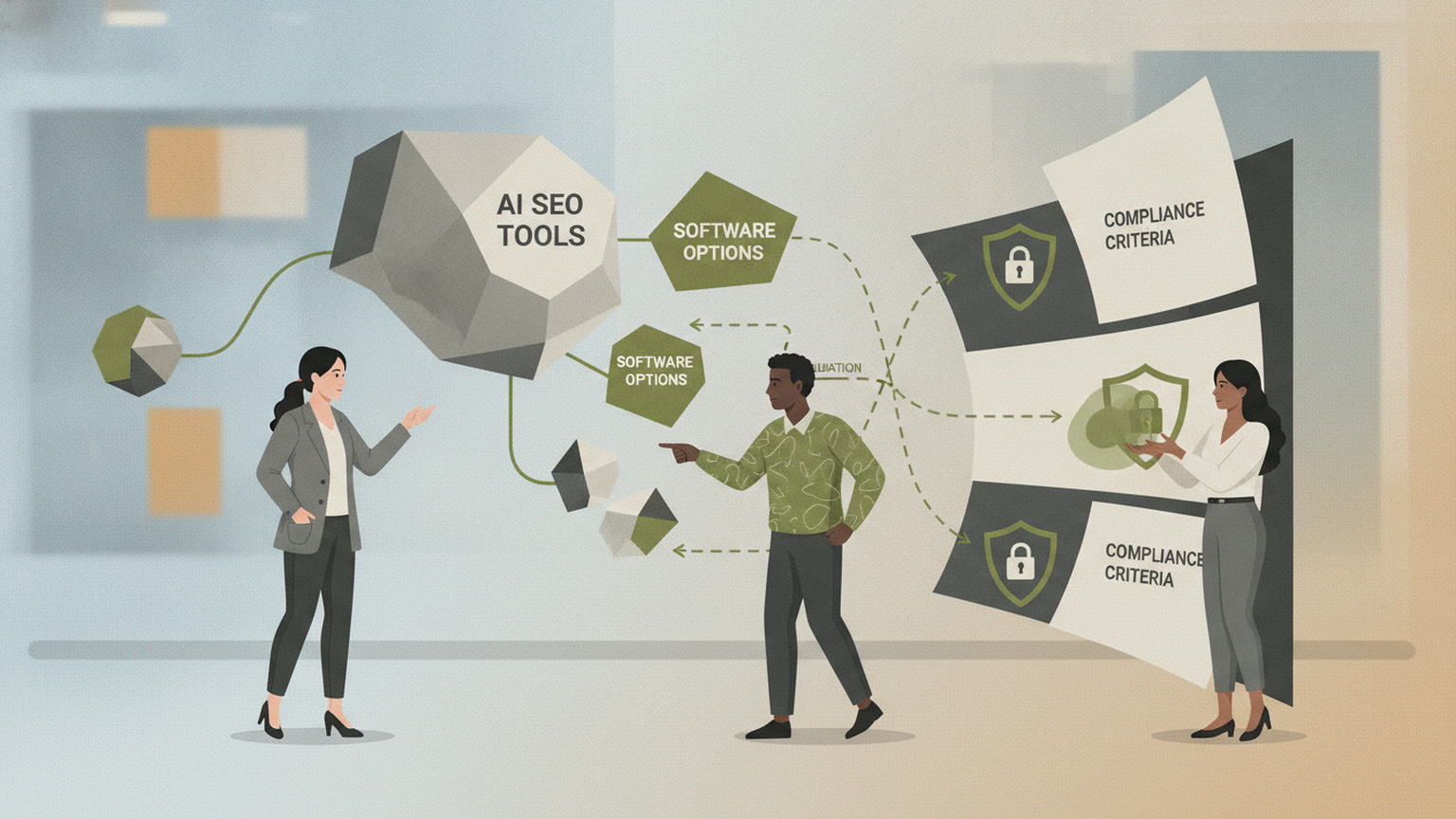
Choosing AI SEO tools in 2026 is no longer only a quality question: for an EU business it is also a data-processing and transparency decision. This guide walks through the main categories of tools, what each one actually does, and the two questions you should ask every vendor before you connect it to your website — where the data goes, and whether the published output carries a machine-readable AI disclosure.
A marketing manager evaluating ai seo tools in 2026 is doing two jobs at once. The first is the familiar one: find software that helps the blog rank, cover the topics customers search for, and get quoted inside AI answers. The second is newer and less comfortable: make sure the tool you pick does not hand your legal team a problem. The AI Act’s transparency obligations for synthetic content apply from 2 August 2026, and GDPR has applied since 2018 to every piece of personal data your stack touches — including the prompts, drafts and customer examples your writers paste into a chat window.
Most comparison articles still treat these as separate conversations. They rank tools on output quality, then add a paragraph about privacy at the end. For a European business that order is backwards. A tool that writes beautifully but stores your content in a jurisdiction you cannot document, or that publishes AI-assisted articles with no disclosure, creates exposure you will have to fix later — usually at the worst moment.
This guide covers the categories of tools you will realistically shortlist, what each is good for, and where each one sits on compliance. It assumes you already understand why AI visibility matters; if you want the strategic layer first, start with how Generative Engine Optimization works and how businesses get cited by ChatGPT, Google AI and Perplexity, then come back here to choose the software.
Contents
- What makes an AI SEO tool compliant for an EU business
- The main categories of AI SEO tools in 2026
- RankGrove: topic-tree automation with disclosure built in
- How to compare AI SEO tools without a six-week evaluation
- Building the stack rather than buying one tool
- Frequently asked questions
- The decision underneath the shortlist
What makes an AI SEO tool compliant for an EU business
Before the list, the filter. Two obligations shape the decision, and they ask different things of a vendor.
GDPR: where the data lives and who processes it
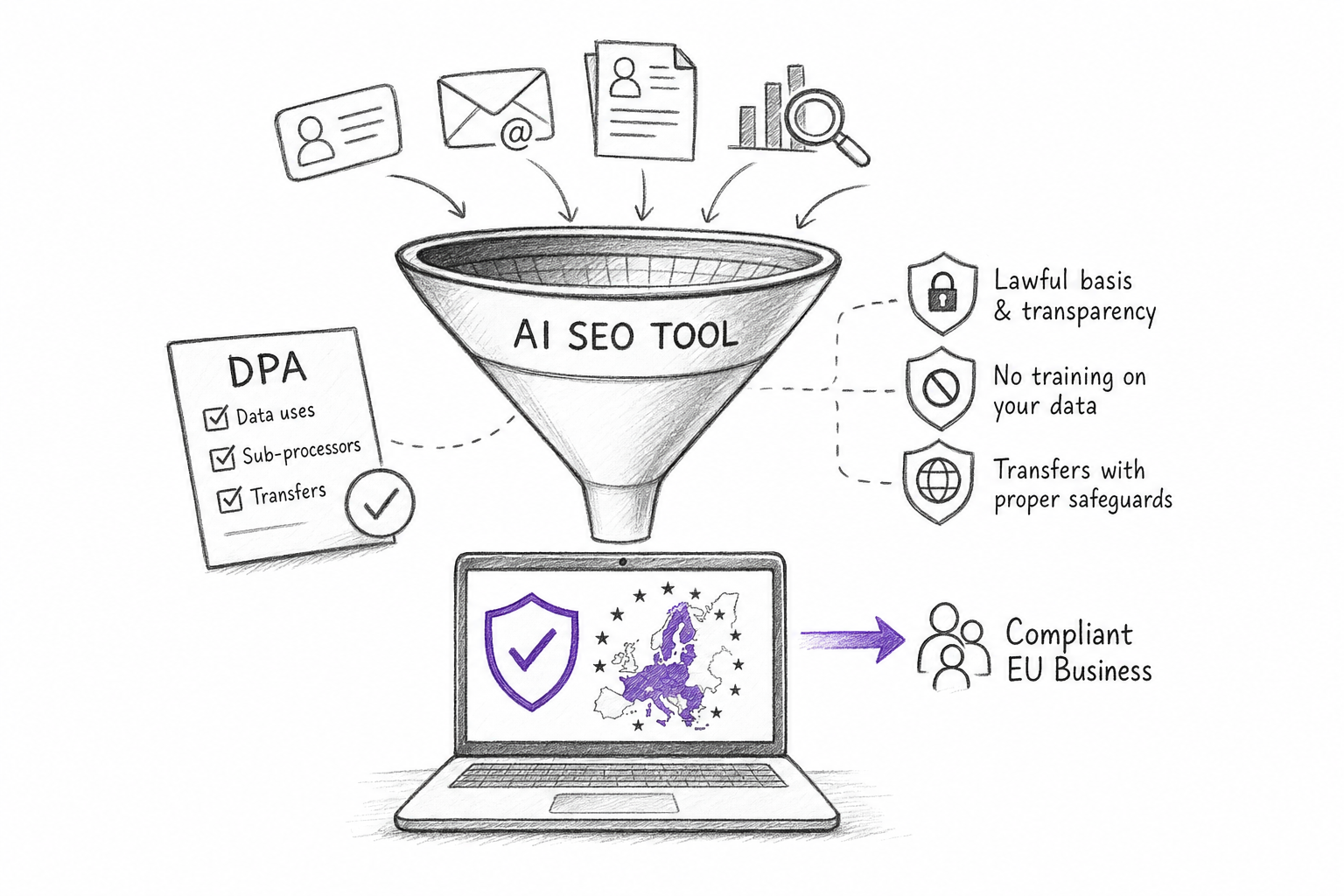
Every AI writing tool processes something. At minimum it processes your prompts and your drafts. In practice it often processes more: customer names in case studies, email addresses in examples, competitor research pulled from your CRM. If any of that is personal data, you need a lawful basis, a data processing agreement with the vendor, and clarity on transfers outside the EEA.
The practical test is boring and effective. Ask the vendor for the DPA and the list of sub-processors. A mature product has both on a public page. If the answer is a sales call instead of a document, that tells you where the product is in its maturity curve. Ask also whether your content is used to train models. Many vendors offer an opt-out; some make no-training the default for business plans. Get it in writing, because “we don’t train on your data” in a chat message is not a contractual commitment.
The jurisdiction question deserves its own moment. A US-headquartered tool is not automatically non-compliant — transfers are manageable with the right framework and documentation. But the documentation burden sits with you, the controller, not with the vendor. We cover the specifics in the compliance implications of using a US AI writing tool from an EU business.
AI Act: the disclosure has to survive publication
Article 50 of the AI Act requires that synthetic content be marked in a machine-readable format. The key word is machine-readable. A sentence at the bottom of the post saying “written with AI assistance” is good practice and good manners, but it is not the whole obligation: the marking has to be detectable by systems, not only by humans reading the page.
This is where most writing assistants simply stop. They produce text. What happens to that text afterwards — where it is published, how it is labelled, whether the label travels with it into your CMS — is your problem. If you are copying drafts out of a chat interface and pasting them into WordPress, there is no disclosure unless you build one yourself, on every single post, forever. That is not a workflow that survives a busy quarter.
The distinction to hold in mind while reading the rest of this guide: some tools generate text, some tools run a publishing pipeline. Only the second kind can attach a persistent, structured disclosure to what goes live. The mechanics are explained in detail in what a machine-readable AI content label actually is.
Takeaway: judge every tool on two axes at once — the quality of what it produces, and whether the compliance artefacts reach the published page without manual work.
The main categories of AI SEO tools in 2026
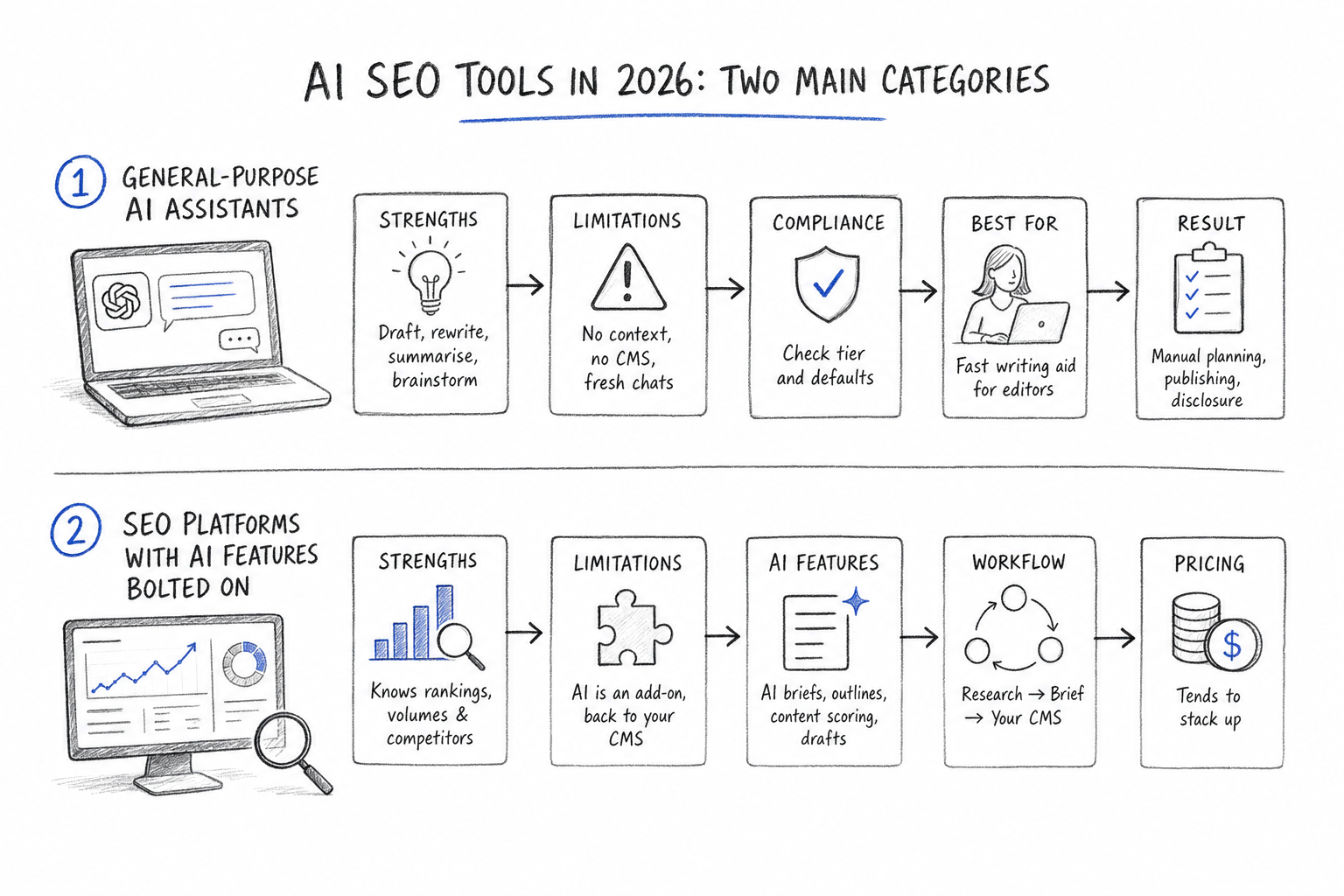
The market has sorted itself into recognisable types. Knowing which type you are looking at saves you from comparing products that solve different problems.
General-purpose AI assistants
The large conversational models are the default starting point for most teams, usually because someone already pays for them. They are genuinely strong at drafting, rewriting, summarising and brainstorming angles. For a marketing manager who needs a landing page rewritten by Thursday, they work.
Where they fall short is everything around the text. They have no idea what you published last month, no view of your topic coverage, and no connection to your CMS. Every article is a fresh conversation. On compliance, the enterprise tiers typically offer data-processing terms and no-training defaults — check which tier you are actually on, because consumer plans often behave differently. Choose this category when you need a fast writing aid for a human editor, and accept that planning, publishing and disclosure stay manual.
SEO platforms with AI features bolted on
The established keyword research and rank tracking suites have all added generative features: AI briefs, outline generators, content scoring against the pages currently ranking. Their strength is data. They know what ranks, what the search volumes look like, and what your competitors cover that you do not.
Their weakness is that the AI layer is an accessory to a research product. You get a brief, maybe a draft, and then you are back in your CMS doing the work. Pricing in this category tends to be per-seat and climbs quickly when a team grows. On the AI Act question, these platforms generally treat disclosure as out of scope — their output never touches your website directly. Choose this when keyword and competitive data is the gap, and you already have writers to act on it.
Single-article AI generators
A large and growing category: tools whose core promise is “describe a topic, get a finished article”. Several of these are built specifically for SEO-shaped output, with headings, meta tags and internal link suggestions generated alongside the text. Products in this space include outrank.so and lovarank.com, both positioned around producing SEO-oriented articles quickly.
The structural characteristic to understand is the unit of work: one article at a time. You bring the topic, the tool brings the draft. That is useful, and for a team that already has an editorial plan it can be enough. But it means the strategic layer — which topics to own, in what order, how articles should reference each other — stays with you, and so does whatever labelling your jurisdiction requires once the piece is live. Choose this when your bottleneck is drafting speed, not topic strategy.
Full blog automation systems
The newest category treats the blog as a running system rather than a sequence of documents. These tools plan a topic tree, generate and illustrate articles on a schedule, publish them into the CMS, and link them to each other and to commercial pages automatically. The output is not a draft in a dashboard — it is a live, internally linked post.
This is the only category where AI Act disclosure can be solved structurally, because the tool controls the publication step. It is also the category with the highest switching cost: you are connecting software to your website, so the vendor’s data practices and uptime matter more. Choose this when the problem is a blog that keeps going quiet, not a blog that lacks a writer for one piece.
RankGrove: topic-tree automation with disclosure built in
Full disclosure, since this is our guide: RankGrove belongs to the last category, and it was designed around the two obligations described above rather than retrofitted to them.
What it does structurally: it plans a topic tree — pillar articles that own a main theme, supporting articles that answer the specific questions underneath it, and automatic internal links connecting them and pointing at the pages that sell. It then writes, illustrates and publishes to WordPress on a schedule, with a person approving. Every article carries an AI transparency note in plain text and a machine-readable marking in structured data, and approvals are tracked, so the compliance record exists without anyone maintaining a spreadsheet.
Where it differs from the single-article generators above is the unit of work. A generator answers “write me this article”. A topic-tree system answers “cover this subject until we own it”, which is a different question with different output: planned coverage, cadence, and links that compound. It supports 22 European languages, one per project, and has multi-client plans for agencies running several blogs. It is designed and developed in Italy, which for the jurisdiction question means the processing conversation starts inside the EU rather than needing a transfer framework around it.
Honest limits: if you want a chat window to rewrite a single landing page, this is the wrong shape of tool. It is built for continuous publication, which means it earns its keep over months, not in an afternoon. Choose it when you need a blog that publishes three or more times a week without gaps and need the AI Act paperwork handled at the same time. The full capability list is on the features page, and the plan tiers — including the agency options — are on the pricing page.
How to compare AI SEO tools without a six-week evaluation
Procurement for content software has a habit of expanding. Here is a compressed version that gets you to a defensible decision.
Start from the bottleneck, not the feature list
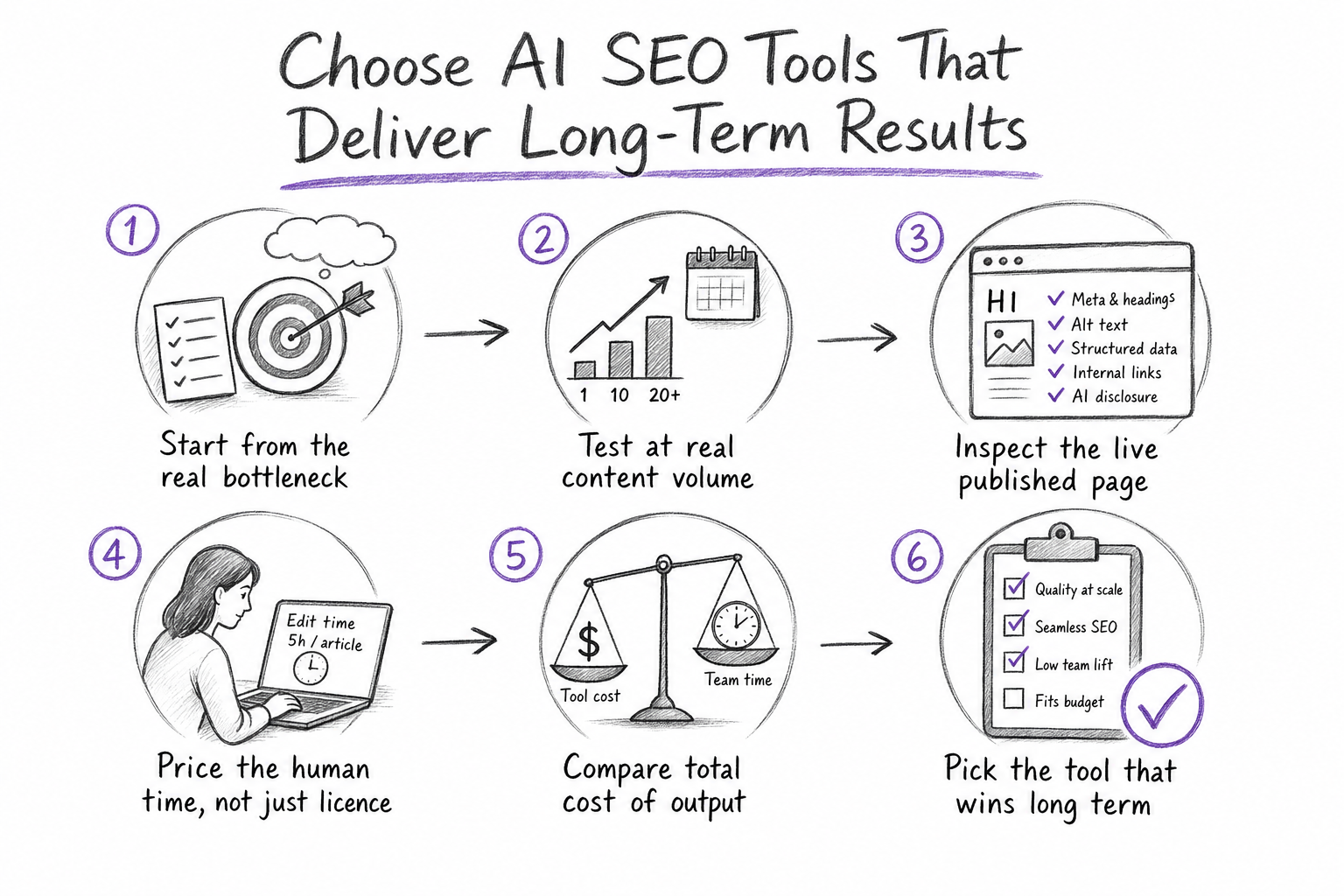
Write down, in one sentence, what is actually broken. “We have no idea which topics to cover” leads to a different shortlist than “we know exactly what to write and nobody writes it” or “we publish but nothing gets indexed”. Most bad tool purchases come from buying a solution to a problem the team did not have.
Test cadence, not a single output
Every AI tool produces a decent first article — vendors optimise demos for exactly that moment. The question that matters is the twentieth article. Does the quality hold? Do the pieces start repeating each other? Do they link together or sit as orphans? A blog that wants to own a topic publishes at least three articles a week, and the difference between tools only becomes visible at that volume.
Check what reaches the published page
Ask the vendor to show you a live post produced by their system, not a draft in their interface. Look at the heading structure, the meta description, the alt text, the structured data, the internal links, and whether an AI disclosure is present in both human-readable and machine-readable form. Anything that is missing on the live page is work that will land on your team.
Price the human time, not just the licence
A tool at a low monthly fee that needs five hours of editing per article is expensive. Run the arithmetic with your own numbers: if an internal content role costs the company 40,000 euros a year fully loaded, roughly 1,600 working hours puts an hour at about 25 euros, so five hours of editing adds something like 125 euros per article on top of the licence. That is a hypothesis, not a measurement — but it is the right calculation to run, and it usually reorders the shortlist.
| Question to ask the vendor | What a good answer looks like |
|---|---|
| Where is the data processed, and who are the sub-processors? | A public DPA and a named sub-processor list |
| Is our content used to train models? | No by default, stated contractually |
| Does the AI disclosure reach the live page? | Yes, in plain text and structured data |
| What is the unit of work? | A planned topic tree, or a single article — know which |
| Who approves before publication? | A named person, with the approval logged |
Takeaway: the five questions above can be answered in two emails. If a vendor cannot answer them in two emails, that is the answer.
Building the stack rather than buying one tool
Most teams end up with two or three tools, not one, and that is fine as long as the seams are deliberate. A common and sensible configuration pairs a research source for keyword and competitive data with an automation system that handles planning, production and publication, plus a general assistant for the ad-hoc writing that will never fit a pipeline.
The failure mode to avoid is overlap without ownership: three tools that all generate articles, none of which owns the editorial calendar, and a blog that still goes quiet in month four. Decide which single tool owns cadence, and make the others serve it. Consistency is the variable that compounds — three articles a week sustained for a year beats fifteen in a launch month followed by silence, and no amount of software fixes a stop.
One more consideration specific to 2026. The compliance posture of your stack is now part of your brand surface. Published articles carry visible AI transparency notes; buyers, journalists and procurement teams read them. Treating that marking as something to minimise is a misread — a clear, honest disclosure signals a company that manages its processes, which is precisely the signal a B2B buyer is looking for. For a sense of how search engines treat quality and experience signals in this context, the relationship between E-E-A-T and AI-assisted content is worth a read, and the frequency question is unpacked in how many posts a small business blog actually needs.
Frequently asked questions
Are AI SEO tools legal for EU businesses in 2026?
Yes. Using AI to produce content is permitted. What the AI Act adds is a transparency obligation: synthetic content must be marked in a machine-readable format, with the relevant provisions applying from 2 August 2026. GDPR obligations around the data you feed the tool apply independently. The tool is not the problem; undocumented processing and missing disclosure are.
Which AI SEO tool is best for a marketing team of one?
It depends on the bottleneck. If you know what to write but never find time, an automation system that plans, writes and publishes on a schedule removes the work. If you already publish but choose topics by instinct, a research platform fixes more. Buying a drafting assistant when the real gap is cadence rarely changes the numbers.
Do I need a DPA with an AI writing tool?
If the tool processes personal data on your behalf — prompts containing customer details, draft case studies, contact information — then yes, a data processing agreement is required under GDPR. Ask for it before the trial ends, along with the sub-processor list and the transfer mechanism if processing happens outside the EEA. Public documentation is a good maturity signal.
What does machine-readable AI disclosure actually mean?
It means the marking is embedded so that automated systems can detect it, typically through structured data in the page rather than only a sentence of body text. A visible note tells human readers; the structured marking satisfies the machine-readable requirement. Tools that stop at generating a draft cannot provide this, because they never touch the published page.
Can one AI tool replace an SEO agency?
It can replace the production line — planning, writing, illustrating, publishing, internal linking — which is the part that consumes most agency hours on content retainers. What stays human is positioning, offer definition, and judgement about which commercial pages deserve traffic. Many agencies now run automation internally across client blogs rather than competing with it.
How often should a company blog publish to see results?
At least three articles a week, and more on broad topics where competitors publish daily. One post a week is a beginner’s cadence: topic coverage builds too slowly to compete for a cluster. The harder requirement is continuity — a blog that runs for twelve months without gaps outperforms one that sprints and stops.
Should I disclose AI assistance even if nobody asks?
Yes. From August 2026 the marking is a legal requirement for synthetic content in the EU, and ahead of that it is a trust signal rather than a liability. Readers who find an undisclosed AI article and recognise it react worse than readers told upfront. Make the note standard on every post and stop thinking about it.
The decision underneath the shortlist
The real choice in 2026 is not between one AI writing tool and another — the drafting quality across serious products has converged. It is between buying a drafting aid and buying a publishing system, because only the second one carries the topic strategy, the cadence and the AI Act disclosure through to the live page. Pick the shape of tool that matches your actual bottleneck, verify the data-processing answers in writing before you connect anything to your CMS, and if you want the strategic groundwork on getting quoted inside AI answers before you commit, start with the GEO fundamentals.
This article was produced and published automatically with the help of artificial intelligence.
Start today
A blog like this, on your site
This article was written and published by RankGrove, with the method you read about on the site. Try it free on your WordPress: the first article lands in your drafts within ten minutes.
Start free trial