Company Blog Strategy & Automation
Digital Marketing for Startups: Keep a Blog Alive Without a Team

A blog is the cheapest durable acquisition channel a startup has when there is no ad budget, but only if it keeps publishing. Doing it manually costs roughly four to six hours per article once you count research, writing, optimisation, images and internal links — which is why the two things that get skipped first under time pressure are exactly the two that make the channel work: consistency and internal linking. This guide shows how to batch, template and, where the maths says so, automate.
Most advice about digital marketing for startups assumes there is someone whose job it is to do marketing. In a company of three, or seven, or one, there isn’t. The founder writes the article between a support ticket and an invoice, publishes it, feels good about it, and then doesn’t publish anything for five weeks. That pattern is so common it has become the default state of the small-business blog: a handful of posts from a hopeful quarter, the most recent one dated more than a year ago.
The reason this matters more than it used to is that a blog is now the only acquisition channel a company without an ad budget can own outright. Paid traffic stops the day the card stops. A blog that covers a topic properly keeps pulling in searches, and increasingly gets quoted inside AI-generated answers, which is where a growing share of commercial research now starts. If you want the full strategic frame behind this, the company blog strategy guide sets out how the whole structure fits together.
This article stays narrower and more practical. It is about one question: how do you keep this specific channel alive when nobody on the payroll has “marketing” in their job title? You will get a realistic time budget, a batching method, a minimal SEO checklist, and a clear rule for when doing it yourself stops being the cheaper option.
Contents
- What does one blog article actually cost you in hours?
- How do you find topics without paying for keyword tools?
- How do you batch a quarter of content in one sitting?
- What is the minimum SEO you can get away with?
- When does automating the blog cost less than doing it yourself?
- Frequently asked questions
- The channel survives on cadence, not on effort
What does one blog article actually cost you in hours?
Before deciding anything, price the work honestly. Founders underestimate blog cost because they only count the writing.
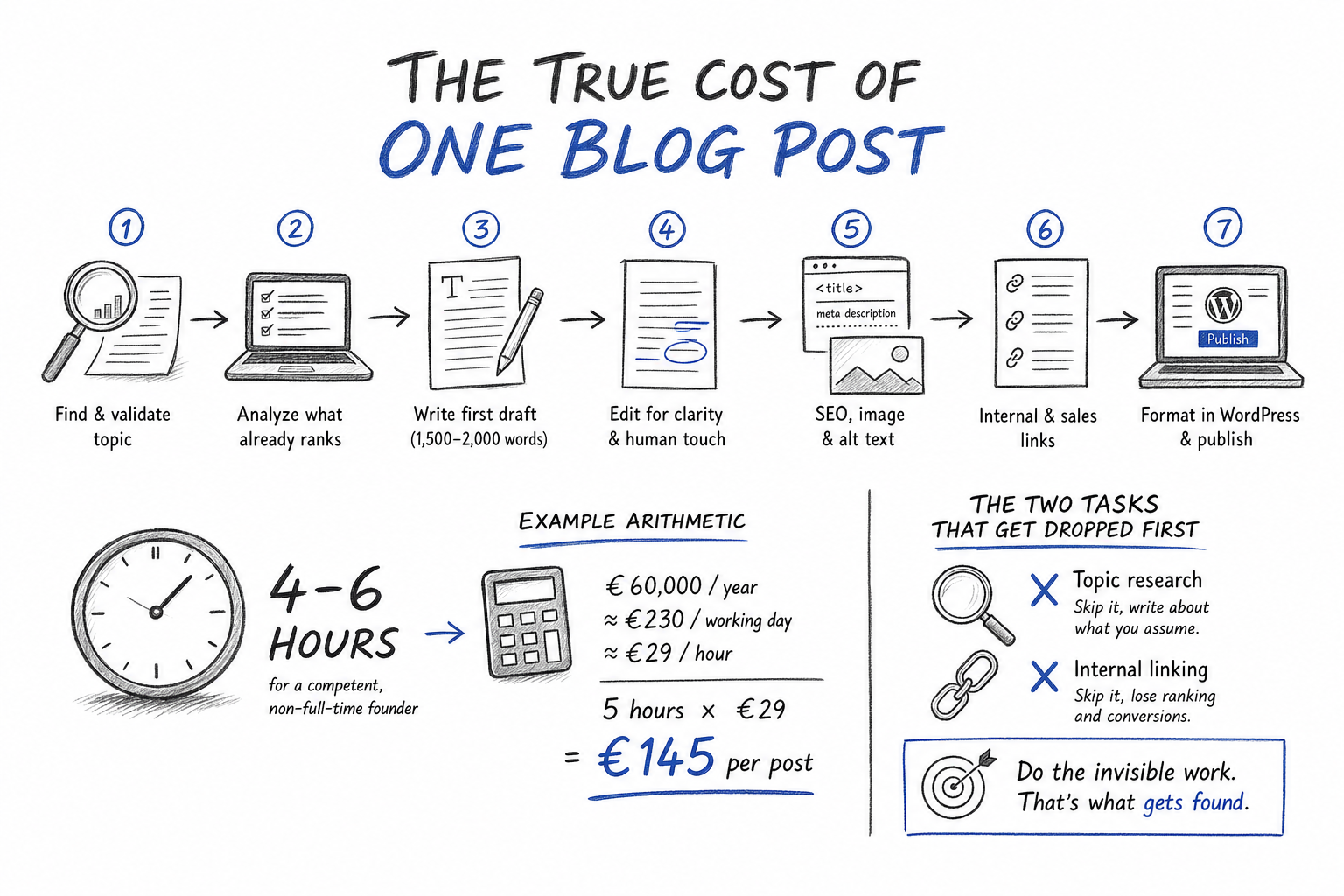
A single article that is genuinely useful and genuinely findable involves picking a topic that someone actually searches for, checking what already ranks for it, drafting fifteen hundred to two thousand words, editing it so it reads like a person wrote it, writing the title tag and meta description, sourcing or generating an image with sensible alt text, adding links to your own related articles and to the pages that sell, formatting it in WordPress, and publishing. Realistically, that is four to six hours for someone who is competent but not doing it full time.
Now run the arithmetic with your own number. Take a founder whose fully loaded cost is, say, 60,000 euros a year — roughly 230 euros a working day, or about 29 euros an hour. At five hours per article, each post costs around 145 euros of founder time, and that is the expensive kind of time, the kind that was supposed to go into sales calls and product. The premise is yours to change: put in your own salary figure and your own hours and the number moves, but the shape of the conclusion rarely does.
The two tasks that get dropped first
Under time pressure, nobody drops the writing — writing is the visible part. What gets dropped is the topic research at the front and the internal linking at the back. Both are invisible to the author and both are the parts search engines and AI systems read most attentively.
Skip research and you write about what interests you rather than what people type. Skip internal links and each article sits alone, with no path from it to the next article or to the page where someone can buy. Then the cadence slips, because the article that took five hours competed with payroll, and the blog starts ageing. What happens next — and why a stale blog actively works against you — is covered in the pillar; no need to repeat it here.
Takeaway: write down your real hourly cost and multiply by five. That single number decides most of what follows.
How do you find topics without paying for keyword tools?
The cheapest topic research on earth is already in your inbox. Every question a prospect asked before buying, every objection on a sales call, every confused reply to your onboarding email is a query someone else is typing into a search box right now, phrased almost identically.
Mine the questions you already answer
Open your sent folder and your support history and pull out the questions that came up more than twice. “How long does setup take?” “Does this work with our existing system?” “What happens to our data if we cancel?” Each of those is an article, and because you have already answered it in writing, you are not starting from a blank page — you are expanding an answer you have given a dozen times.
This has a second benefit that matters for digital marketing for startups specifically: questions asked by real buyers map to commercial intent. They are asked by people close to a decision, not by students. An article answering a pre-sale objection converts far better than a broad piece about industry trends.
Check the demand side cheaply
You still need to know whether anyone searches a phrase. Free signals get you most of the way: the autocomplete suggestions a search engine offers when you start typing your question, the “people also ask” block on the results page, and the related searches at the bottom. If a question generates several variations in autocomplete, it has volume. If the current results are thin, generic or ten years old, you have an opening.
For the method in full, with how to turn a raw list into an ordered plan, there is a practical keyword research guide that goes deeper than space allows here.
Group topics into a tree, not a list
A flat list of twenty titles produces twenty orphan posts. Group them instead: one broad article that owns a theme, and six to ten narrower ones that each answer a specific question inside that theme, all linked to each other and up to the broad one. This is the structure that makes a small blog punch above its size, because coverage of a topic — rather than a single strong post — is what search engines and AI answer systems reward.
Takeaway: spend one hour pulling thirty real customer questions out of your inbox, then cluster them into three or four themes. That is your next quarter’s plan.
How do you batch a quarter of content in one sitting?
Batching works because context switching is the hidden tax. Deciding what to write is a different mental mode from writing, which is different again from formatting and publishing. Doing all three for every article, every week, multiplies the cost.
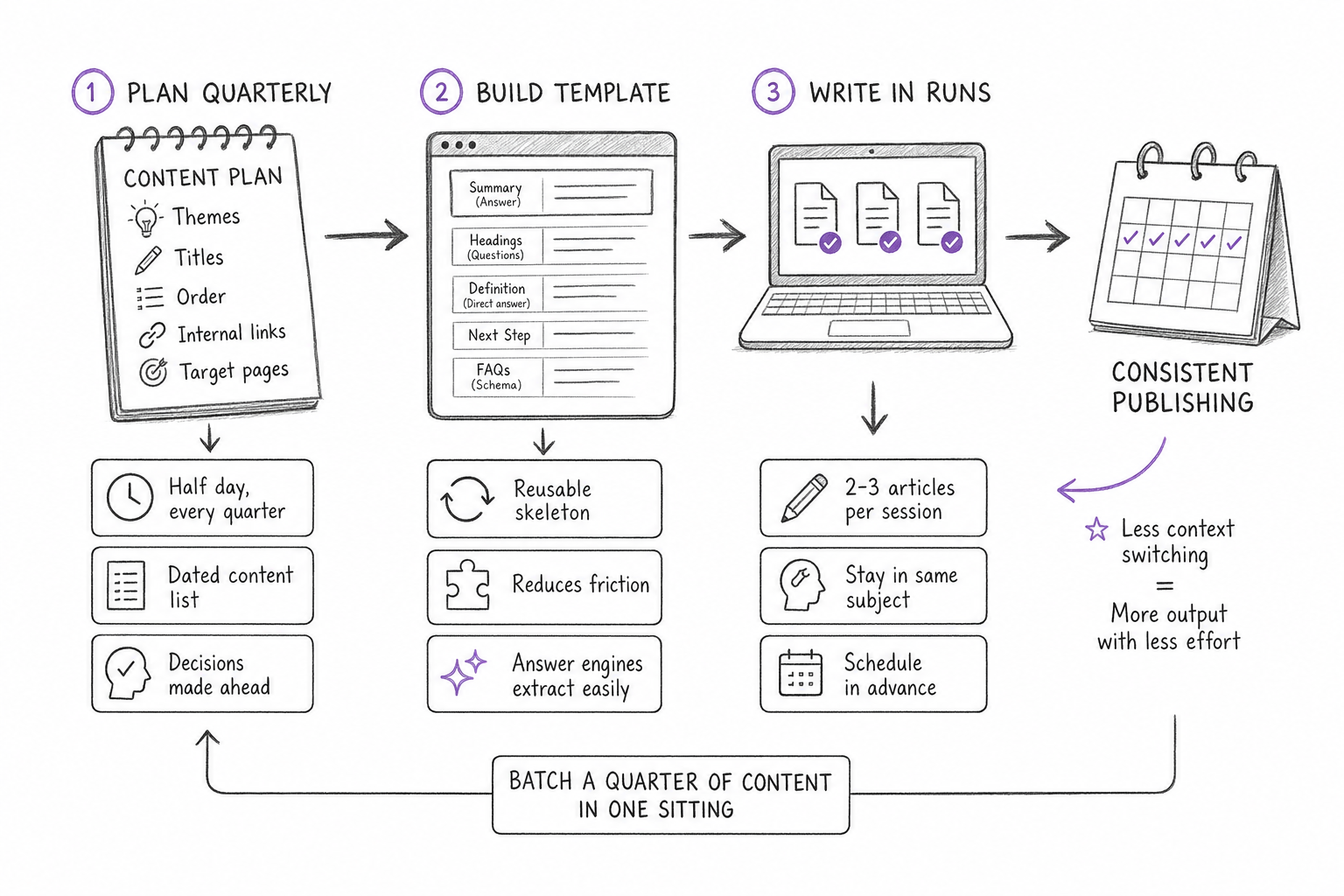
Plan quarterly, in one block
Set aside half a day once every three months. In that block you do nothing but decide: which themes, which titles, which order, which internal links each piece will carry, and which product or service page each theme should point to. You come out with a dated list. The hardest decision of the week — “what do I write about today?” — has already been made, for thirteen weeks.
Build a template you reuse
A reusable article skeleton removes a surprising amount of friction: a short summary at the top that states the answer immediately, headings phrased as the questions people actually ask, a short definition near the start that could be lifted as a direct answer, a closing section with the next step, and a handful of frequently asked questions at the end. The same skeleton works for most informational articles and removes the blank-page problem entirely.
The summary-at-the-top and FAQ-at-the-bottom pattern is not decoration. Both are the formats that generative answer engines extract most readily, which is why structuring FAQs with proper schema markup pays off disproportionately for small sites.
Write in runs, publish on schedule
Write two or three articles in the same session while your head is in the same subject, then schedule them across the following weeks. Publishing cadence should look steady from the outside even if your work is lumpy on the inside. Aim for at least three articles a week if you intend to own a topic rather than visit it — one a week builds coverage too slowly to compete with anyone who is serious. If that number sounds impossible by hand, you have just discovered the real argument for automation, which the last section deals with.
Takeaway: book a recurring half-day in your calendar for quarterly planning and treat it as unmovable, the way you would treat a board meeting.
What is the minimum SEO you can get away with?
There is a long version of on-page optimisation and a short one. For a company without a marketing team, the short one captures most of the value.
Every article needs one clear primary query it is trying to answer, used in the title, in the opening paragraph and in at least one heading, without repeating it mechanically. It needs a title tag under about sixty characters and a meta description that reads as a complete sentence. It needs headings that mirror real questions rather than abstract labels like “Overview”. It needs an image with alt text that describes the image in plain words. And it needs links: two or three to your own related articles, and one to the page that sells whatever the article discusses.
Internal linking is the part worth protecting
If you only have energy for one technical habit, make it internal linking. Links between your own articles tell search engines which pages belong to which theme and which page is the important one. They also give a reader who arrived from a search somewhere to go next, which is the only way a blog turns traffic into enquiries.
The practical trick is to decide the links at planning time, not at publishing time. When you write the quarterly list, note next to each title which other two articles it will link to. Then the link is a fact to execute, not a decision to make while tired.
Say that AI helped, in plain text
If you draft with AI assistance — most small teams now do — the article should say so, and the declaration should exist both as a sentence a human can read and as structured data a machine can read. Under European transparency rules this is an obligation for published synthetic content, and it is also, pragmatically, a trust signal rather than an embarrassment. How the machine-readable side works is explained in detail in this piece on AI content disclosure labels.
Takeaway: a short checklist beats an exhaustive one you abandon. Below is the version worth taping to the wall.
| Element | What good looks like | Time |
|---|---|---|
| Primary query | One per article, in title, intro, one heading | 5 min |
| Title tag and meta | Under 60 chars, full sentence description | 10 min |
| Headings | Phrased as real search questions | included in draft |
| Internal links | 2-3 to related posts, 1 to a sales page | 10 min |
| Image and alt text | Plain description, no keyword stuffing | 15 min |
| AI disclosure | Visible sentence plus structured data | 2 min |
When does automating the blog cost less than doing it yourself?
Do the comparison with your own numbers rather than someone else’s enthusiasm.
The break-even calculation
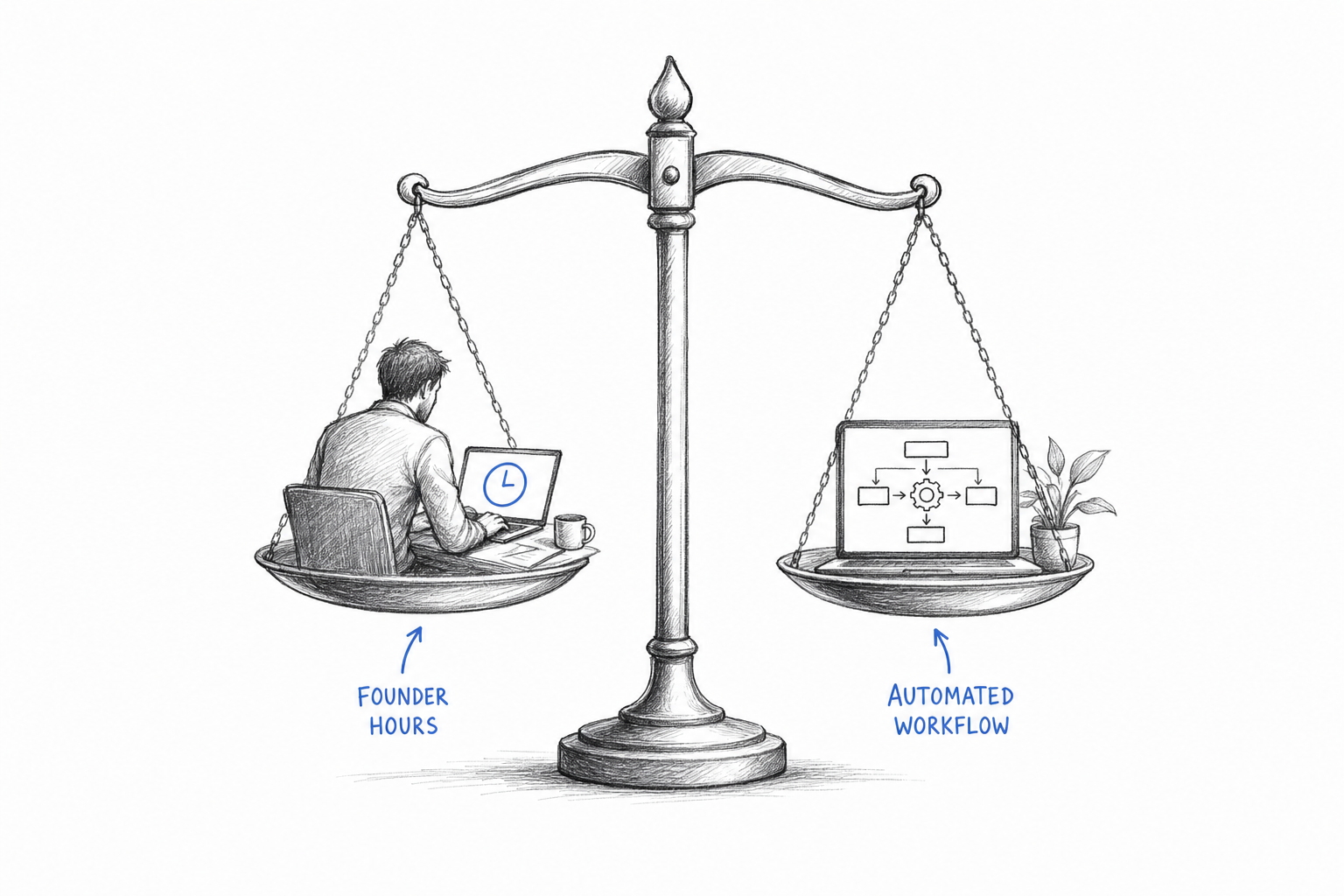
Take the per-article cost you worked out earlier. At the illustrative 145 euros of founder time per post, three articles a week is roughly 1,900 euros a month of your own time — time that does not appear on any invoice, which is precisely why it gets ignored. Compare that against the cost of a system that plans the topic tree, drafts, illustrates, adds the internal links and publishes to your site, with you approving. If the system costs materially less than the hours it replaces, continuing by hand is a choice to spend expensive time on a repeatable task.
The cases where doing it yourself still wins
Manual writing stays the right call when the article depends on information only you have: original data from your product, a technical argument nobody else in your market can make, a strong opinion that defines your positioning. Those pieces are worth your five hours. They are also, typically, a small minority of what a blog needs to publish to cover a topic properly.
The approval step is the point
Automation without review is how companies end up publishing something embarrassing. The workable model in 2026 is a system that writes, illustrates and publishes on schedule, with a named person who approves before anything goes live — ten minutes per article rather than five hours. That is also what keeps the AI Act transparency obligations clean, because approvals are tracked and the disclosure is applied automatically rather than remembered.
If you want to see how that approval loop and the WordPress connection work in practice before committing anything, see how the service works end to end and judge it against the hour count you calculated at the start.
Frequently asked questions
How often should a startup publish blog articles?
At least three a week if the goal is to own a topic, up to one a day on broad subjects. A single post a week builds topic coverage too slowly to outpace competitors already publishing daily. What matters more than the peak is the absence of gaps: three a week sustained for a year beats fifteen in a launch month followed by silence.
Is blogging still worth it for a small business with no ad budget?
Yes, and arguably more than before. Paid traffic stops when spending stops, while an article that covers a question properly keeps attracting searches and now also gets quoted inside AI-generated answers. For a company that cannot outbid larger competitors on ads, organic coverage of specific buyer questions is the cheapest durable channel available.
What should I write about when I have no keyword research tool?
Use the questions prospects already ask you. Pull every recurring question from your sent folder, support inbox and sales calls, then validate demand with free signals: search autocomplete, the people-also-ask box and related searches at the bottom of the results page. Buyer questions carry commercial intent that generic industry topics do not.
How much time does one blog article really take?
Four to six hours for a competent non-specialist, counting topic selection, checking competing results, drafting fifteen hundred words, editing, writing the title tag and meta description, sourcing an image with alt text, adding internal links and publishing. Multiply by your own hourly cost to get the real figure before deciding between doing it yourself and automating.
Do I have to declare that an article was written with AI?
If you publish synthetic content in Europe, yes. The declaration should be readable by a person and machine-readable in the page markup. Treating it as a transparency advantage works better than hiding it: readers increasingly assume AI assistance anyway, and a clear statement with a named human approver signals process rather than carelessness.
What is the single most skipped SEO task on small business blogs?
Internal linking. It is invisible to the author, feels optional, and is the first thing dropped when an article runs late. Yet links between your own posts are what tell search engines which pages belong to a theme, and what gives a reader arriving from search somewhere to go next. Decide links during planning, not at publishing time.
Can automation replace the founder entirely in content production?
No, and it should not. Articles built on proprietary data, technical arguments only you can make, or opinions that define your positioning deserve your own hours. Automation handles the repeatable coverage work — the dozens of articles answering specific questions — with a human approving each one before publication.
The channel survives on cadence, not on effort
The reason small business blogs fail is rarely quality. It is that the system depends on a person who also has to run the company, and that person eventually has a bad month. Design the process so a bad month does not break it: decide topics a quarter ahead, reuse a template, protect the internal links, and automate the repeatable portion once the arithmetic says your hours cost more than the alternative. A blog that publishes steadily at modest quality beats a brilliant one that stopped in March.
This article was produced and published automatically with the help of artificial intelligence.
Start today
A blog like this, on your site
This article was written and published by RankGrove, with the method you read about on the site. Try it free on your WordPress: the first article lands in your drafts within ten minutes.
Start free trial