Generative Engine Optimization (GEO) & AI Search
E-E-A-T AI Content: Make AI Articles Read Trustworthy

AI drafts read generic for predictable reasons: they hedge, they repeat the same sentence shape, and they describe categories instead of cases. This guide gives you six editorial passes — specificity, rhythm, stated opinion, named mechanisms, honest structure, and a phrasing blacklist — that turn a competent draft into something a reader trusts and an AI engine is willing to quote.
You have already settled the bigger question. You publish AI-assisted articles, you declare them, and you are not interested in relitigating whether that is acceptable. The problem now is narrower and more annoying: the drafts are correct, well organised, grammatically clean — and they sound like every other article on the subject.
That flatness has a cost beyond pride. A reader who recognises the texture of unedited model output stops treating the page as a source and starts skimming for the exit. Generative engines behave in a related way: they pull passages that say something specific and attributable, and they skip paragraphs that could have been written about any company in any industry. Getting quoted by an assistant is the core mechanic behind Generative Engine Optimization and how businesses get cited by ChatGPT, Google AI and Perplexity, and the raw material for that citation is a sentence that carries information nobody else has phrased the same way.
This is a working guide to the editorial layer. Automation gives you the structure — a topic tree, consistent publishing, correct headings, internal links, machine-readable AI disclosure. Structure gets you indexed; craft gets you believed. What follows are six passes you can run on any draft, in order, with before-and-after examples of what each one changes. Budget thirty to forty minutes per article at first; it drops to fifteen once the patterns are in your hands.
Contents
- Why AI drafts sound generic in the first place
- Pass one: replace every abstraction with a specific
- Pass two: break the rhythm and cut the connective tissue
- Pass three: add opinion, trade-offs and first-person signals
- Pass four: make the structural elements carry real information
- Pass five: run a phrasing blacklist and a final cold read
- What changes when the editorial layer is in place
- Frequently asked questions
Why AI drafts sound generic in the first place
A language model produces the most probable continuation of a sentence. Averaged across the whole internet, the most probable continuation is the one that offends nobody and commits to nothing. That single mechanism explains almost every symptom you have noticed.
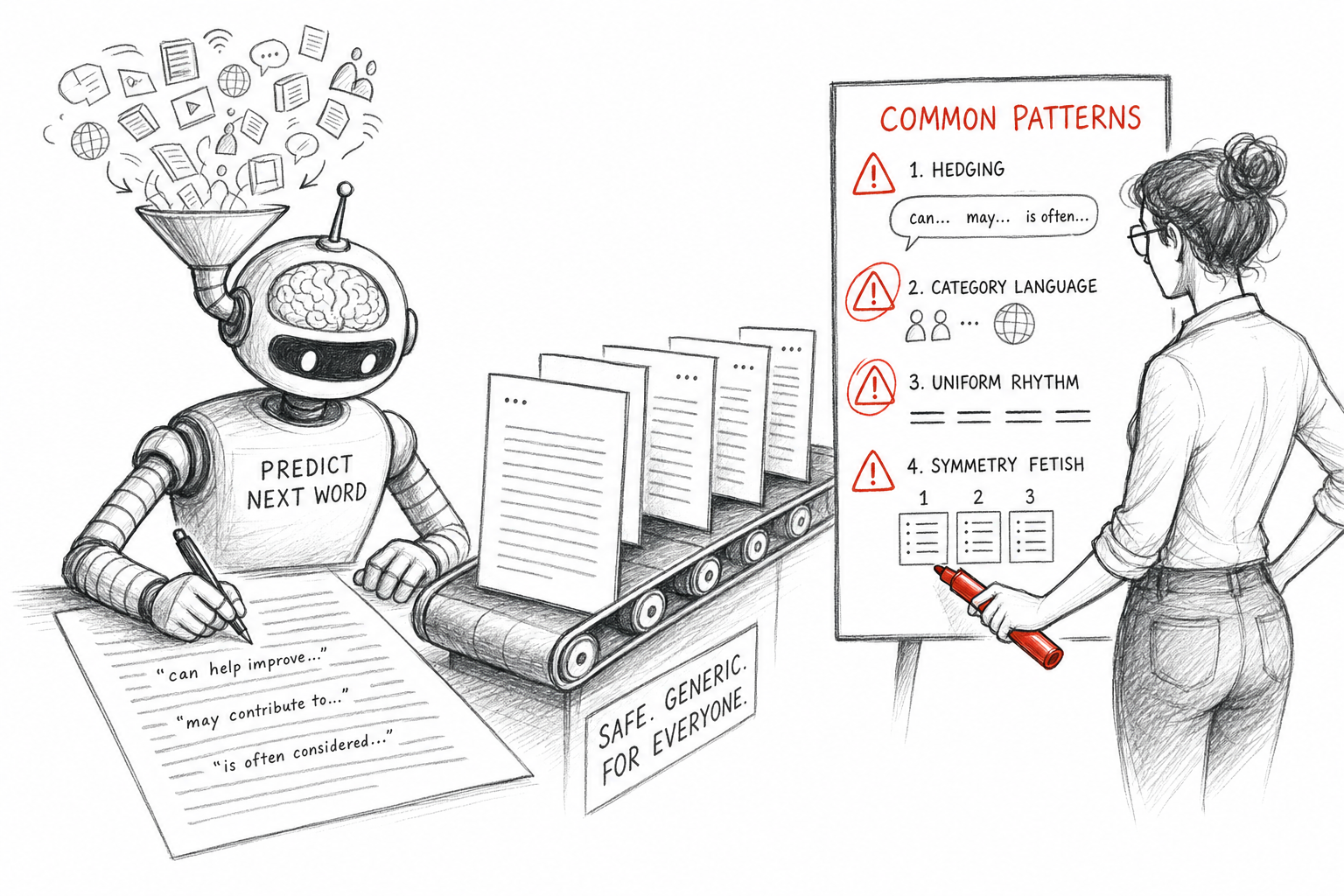
Hedging. The draft says “can help improve”, “may contribute to”, “is often considered”. Each hedge is individually defensible and collectively fatal, because a page that never commits never gives the reader a reason to prefer it.
Category language instead of cases. The model writes “businesses in various sectors” because it has no idea which sector you serve. You do. Every uncorrected category noun is a place where your knowledge was available and went unused.
Uniform rhythm. Sentences arrive at a steady eighteen to twenty-four words, each with a subordinate clause, each landing with the same cadence. Human writing is lumpier: a three-word sentence, then a long one, then a fragment.
Symmetry fetish. Three benefits, three challenges, three best practices — regardless of whether reality has three of anything. Real analysis is asymmetric, because some factors matter far more than others.
Name these four patterns out loud before you start editing. The passes below each attack one or two of them directly, and knowing which symptom you are treating makes the edit faster.
Pass one: replace every abstraction with a specific
This is the pass with the highest return, and you run it first because it changes what the rest of the article has to say.
Go through the draft hunting for nouns that could describe anything: businesses, content, results, strategies, improvements, stakeholders, various industries. Each one is a slot. Fill it with something only someone who does the work would write.
Before: Companies that publish consistently tend to see better results from their content over time.
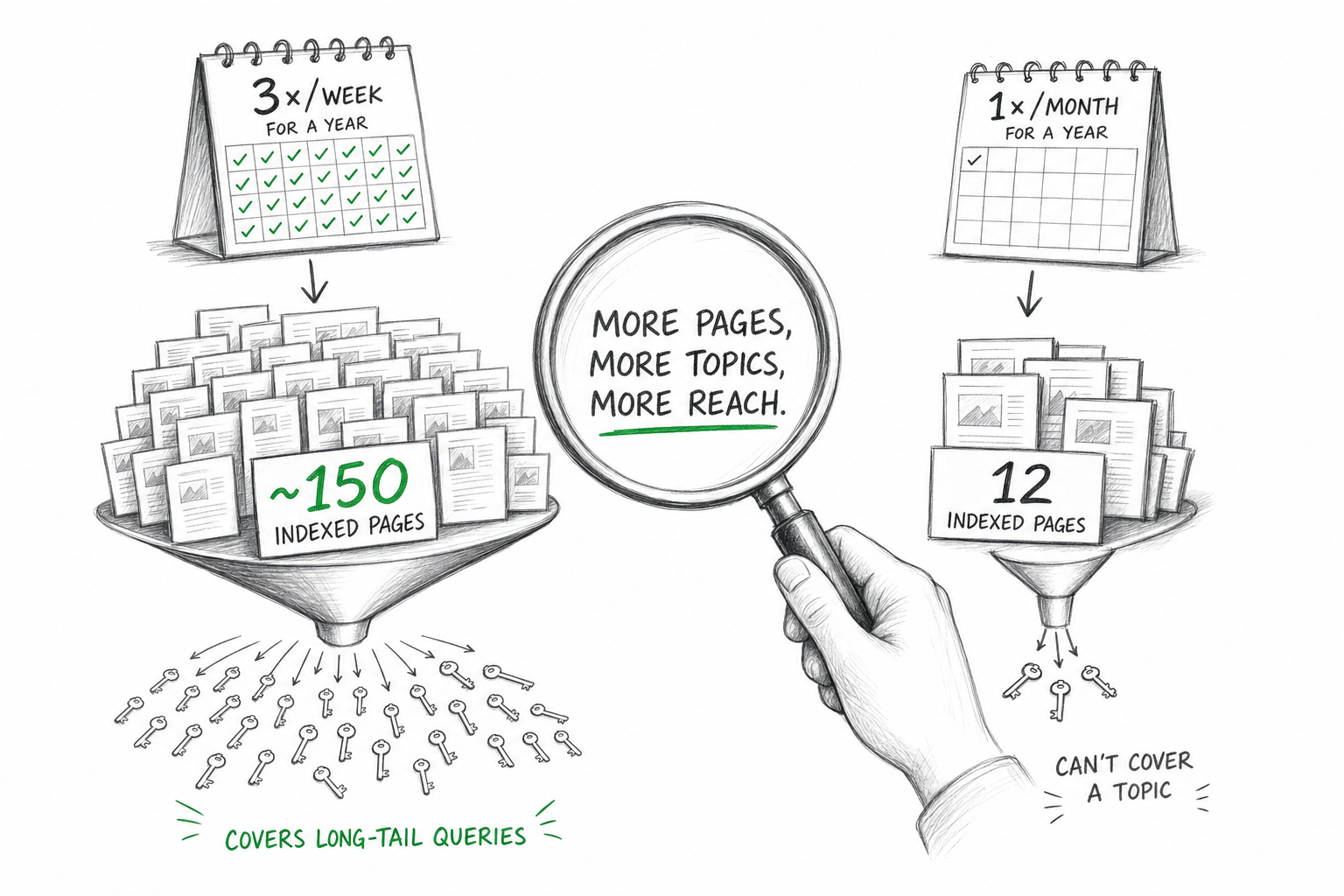
After: A blog that publishes three articles a week for a year has roughly 150 indexed pages competing for long-tail queries; one that publishes monthly has twelve, and twelve pages cannot cover a topic.
The second version is longer, and it earns the length. It names the cadence, shows the arithmetic, and states a consequence. A reader can disagree with the second sentence — that is precisely what makes it worth reading.
Where to find the specifics
If you have internal knowledge, use it: the objection clients raise most often, the step people skip, the configuration that breaks. If you have none, use a public fact anybody can check — a regulation’s date of application, a documented platform behaviour, a definition with a settled meaning. If neither is available, show a calculation and label the inputs as assumptions: “assuming a loaded cost of 40,000 euro a year and five hours per article, each piece costs somewhere around 130 to 150 euro.” The reader can rerun it with their own numbers, which is a form of honesty a model will not produce on its own.
What you must never do is invent the specific. A fabricated statistic is worse than an abstraction, because an abstraction only bores the reader while a fake number, once caught, retroactively discredits everything else on the page.
The two-specifics-per-section rule
Set a floor: every H2 section carries at least two concrete elements — a number with a visible origin, a named mechanism, a described situation, or a stated trade-off. Sections that cannot reach two are usually sections with nothing to say, and the right edit is to delete them and fold the useful sentence into a neighbour.
Pass two: break the rhythm and cut the connective tissue
Read the draft aloud. Where your voice flattens into a drone, the rhythm is uniform. The fix is mechanical and fast.
Take any paragraph of three same-length sentences and rewrite the middle one as a fragment or a short declarative. Then cut the opening connectives the model loves to stack: moreover, furthermore, additionally, in addition, it is important to note that, as previously mentioned. Roughly nine out of ten can be deleted with no loss of meaning, and the paragraph gets faster.
Before: Furthermore, it is important to note that structured data can also play a significant role in how content is interpreted. Additionally, this can have implications for visibility in AI-generated answers, which are becoming increasingly relevant for businesses today.
After: Structured data changes how a page is parsed. An FAQ marked up as FAQPage is a set of discrete question-answer pairs; the same text without markup is one undifferentiated block. Assistants quote the pairs.
Twenty-nine words became thirty-one, and the meaning went from zero to actionable. The edit is not about shortening — it is about replacing filler clauses with claims.
Also kill the summary sentence that closes AI paragraphs by restating the paragraph. You will recognise it: “In short, structured data is an important factor to consider.” Delete it. The reader already read the paragraph.
Pass three: add opinion, trade-offs and first-person signals
Models default to balance. Expertise sounds different: it tells you which option it would choose and what that choice costs you.
Add at least one stated position per article — a sentence that a competent professional could argue with. “Publishing once a week is a beginner’s cadence, not a benchmark” is a position. “Publishing frequency depends on your goals and resources” is wallpaper.
Say what the recommendation costs
Every real recommendation has a downside, and naming it is the strongest credibility signal available to you, because nobody fakes a disadvantage. If you advise long-form pillar pages, say that they take longer to produce and go stale in a harder way when a product changes. If you advise daily publishing, say that it only works when the review step is genuinely fast, otherwise the backlog becomes the bottleneck.
Use first person where it is earned
“In our experience” is worth nothing when it introduces a generic statement. It is worth a great deal when it introduces something unexpected: “In our experience the hard part of multilingual publishing is not translation, it is keeping the internal links pointing inside the right language tree.” Use first person to mark observations, surprises and reversals of expectation — the places where someone actually learned something.
Name mechanisms, not brands
Specificity does not require naming companies. Describe the mechanism precisely and the reader recognises the case: “tools that stop at the draft leave the client with the publishing work” tells a buyer more than any comparison table. Mechanisms also age better than product names.
Pass four: make the structural elements carry real information
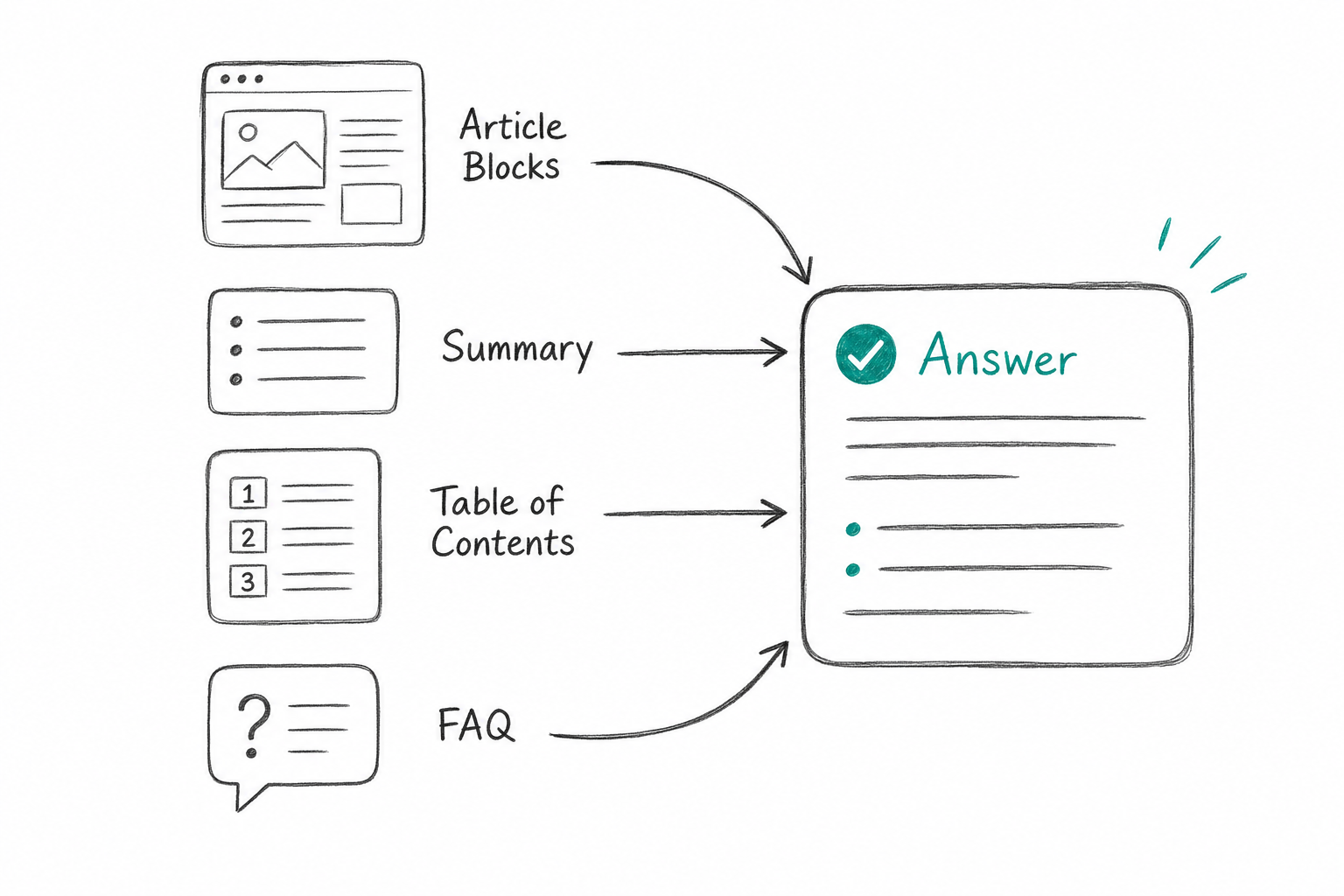
TL;DR blocks, tables of contents and FAQ sections are GEO infrastructure: they give an assistant clean, self-contained chunks to lift. They only work when they contain substance. A summary that says “this article explores the topic of AI content quality” is a wasted slot in the most valuable position on the page.
Write the TL;DR as the article’s conclusion, not its announcement. Three sentences that state the finding. If a reader stops there, they should still leave with the answer.
FAQ sections follow the same rule. Each question has to be something a person would genuinely type, and each answer has to resolve it inside roughly fifty to eighty words without requiring the rest of the page. Questions invented to pad the section — “What is content?” — actively hurt you, because they signal padding to both readers and parsers.
Tables are the third element worth earning. Use one per article, after you have explained the comparison in prose, to crystallise it. The table below summarises the passes as a working checklist.
| Pass | What you remove | What you add |
|---|---|---|
| Specificity | Category nouns, vague results | Numbers with visible origin, named cases |
| Rhythm | Stacked connectives, restating closers | Short sentences, fragments, varied length |
| Opinion | Both-sides balance | A stated position and its cost |
| Structure | Decorative TL;DR and filler FAQ | Self-contained answers worth quoting |
| Phrasing | Blacklisted stock expressions | Plain verbs, concrete subjects |
| Cold read | Sentences true of any company | One detail only you would write |
Run the passes in order. Specificity first changes what the other passes have to work with; the phrasing sweep last catches what the rewrites reintroduced.
Pass five: run a phrasing blacklist and a final cold read
Keep a list of expressions that mark text as unedited model output and search for them before publishing. The usual suspects: in today’s fast-paced world, ever-evolving landscape, delve into, it’s worth noting, unlock the potential, game-changer, robust solution, navigate the complexities, at the end of the day, when it comes to. Add your own as you spot them. A find-and-fix sweep takes four minutes and removes the most recognisable tells.
Watch two subtler patterns as well. The first is the triad reflex — everything arriving in threes. Break it deliberately: give four reasons when there are four, or one when there is one. The second is the universal opener, the paragraph that begins by restating the heading as a sentence. Start with the claim instead.
Then do the cold read. Pick three paragraphs at random and ask one question of each: could a competitor publish this sentence unchanged? If yes, it is not your content yet. Replace it with something drawn from how you actually work. This single test catches more generic writing than any style guide, and it is the step that distinguishes an edited article from a proofread one.
The same discipline applies to images, disclosure text and metadata. An article that declares its AI assistance in plain language and in structured data, then reads like someone with judgment wrote it, carries a stronger trust signal than a human-only article that reads like a template. Transparency and quality reinforce each other; the related question of whether Google penalises AI-generated articles and how E-E-A-T applies is worth reading alongside this one.
What changes when the editorial layer is in place
Expect the shift to show up first in behaviour, not rankings. Time on page rises, because readers stop bouncing off paragraph three. Then internal navigation improves, because an article that says something specific makes the next article look worth opening. Citation in AI answers follows later, and unevenly: assistants quote the passages that answer a question completely in one block, which is exactly what passes one and four produce.
None of this replaces the structural work. Three articles a week, held for a year, arranged as a topic tree with working internal links, is the base layer — craft applied to a blog that publishes sporadically produces beautiful pages nobody finds. Fifteen articles in a launch month followed by silence loses to steady cadence every time. Automation handles the cadence, the headings, the markup and the links; the six passes above are what you add on top, and they are the reason an approval step exists in the first place.
Start with one article. Run the passes in order, keep the before-and-after versions side by side, and note which pass changed the most. That becomes your house style, and from there it is a checklist your reviewers can apply in a quarter of an hour. If you want the structural half handled so your team spends its time on the editorial half, see how we plan and build the topic tree.
Frequently asked questions
How do I make AI-written content sound less generic?
Replace every abstract noun with a specific: a number whose origin the reader can see, a named mechanism, a described situation. Then break the uniform sentence rhythm, delete stacked connectives like “furthermore” and “additionally”, and add one stated position the reader could argue with. Specificity and commitment are what generic drafts lack.
Does E-E-A-T apply to AI content the same way it applies to human content?
The evaluation looks at the page, not the production method. Experience, expertise, authoritativeness and trust are judged from what the text demonstrates: firsthand detail, accurate specifics, clear authorship and transparency. AI-assisted articles satisfy those signals when an editor adds real knowledge; they fail when the draft ships unedited.
How long should editing an AI draft take?
Budget thirty to forty minutes per article while you are learning the passes, dropping to around fifteen once the patterns become automatic. Most of the time goes to the first pass, replacing abstractions with specifics, because that is where your knowledge enters the text. The phrasing sweep takes under five minutes.
Can I add statistics to make AI content more credible?
Only ones the reader can trace. Public facts such as regulation dates or documented platform behaviour are fine. Your own company figures are fine. A calculation with its assumptions stated is fine. An invented percentage attributed to a research firm destroys credibility the moment someone checks, and someone eventually checks.
What phrases immediately signal unedited AI writing?
“In today’s fast-paced world”, “ever-evolving landscape”, “delve into”, “it’s worth noting that”, “unlock the potential”, “navigate the complexities”, “game-changer”. Also watch structural tells: everything arriving in groups of three, paragraphs that open by restating the heading, and closing sentences that summarise the paragraph just read.
Should the TL;DR and FAQ be written by the AI or by the editor?
Draft them with the model, rewrite them by hand. These blocks are the passages assistants quote most often, so they need to be self-contained and substantive. Write the TL;DR as the article’s conclusion rather than its announcement, and keep only FAQ questions a real person would type into a search box.
Does declaring that an article is AI-assisted reduce reader trust?
Disclosure paired with evident quality strengthens trust rather than weakening it. The damaging combination is hidden assistance plus a text that obviously reads as machine output. State the assistance in plain language and in machine-readable form, then make sure the article demonstrates judgment a model would not produce by default.
Generic AI writing is a solvable editorial problem, and the solution is unglamorous: specificity, varied rhythm, stated positions, and structural blocks that actually answer something. Pair those passes with a blog that publishes often enough to build topic coverage, and you get pages readers finish and assistants quote.
This article was produced and published automatically with the help of artificial intelligence.
Start today
A blog like this, on your site
This article was written and published by RankGrove, with the method you read about on the site. Try it free on your WordPress: the first article lands in your drafts within ten minutes.
Start free trial