Content ROI & B2B Lead Generation
SEO Agency Software Pricing: Fair Models for 10+ Client Blogs

The pricing model of your blogging vendor decides your margin more than the headline price does. Per-project flat pricing scales cleanly past ten client blogs because cost moves with the thing you bill for; per-seat pricing taxes your team size instead of your output, and revenue-share erodes exactly the accounts you worked hardest to grow. Run the math per client, per month, before you sign.
Most agency owners discover the real cost of a content tool in month four, not on the pricing page. The first three clients fit comfortably inside the starter plan. Then client eight arrives, and the account manager who onboards them needs a login, and the login costs as much as a junior’s phone bill. Then client twelve wants two articles a week instead of one, and the volume tier jumps. The spreadsheet that showed a comfortable margin now shows a thin one.
This is a comparison of the four pricing archetypes you will meet when you shop for seo agency software to run client blogs at volume: a flat fee per project, tiers based on article volume, per-seat licensing, and revenue-share or white-label markup. The question is not which is cheapest at three clients. It is which keeps your cost per client predictable when you pass ten, and which lets you quote a client a number without doing arithmetic every time.
Content billing only works when the content actually produces something you can point to in a renewal meeting, which is the subject of the broader argument in how a company blog turns into traffic, leads and revenue. Here we stay on the commercial side: what you pay, what you charge, and what survives between the two.
Contents
What breaks in agency pricing when you pass ten client blogs
Up to roughly five clients, almost any pricing model works, because the numbers are small enough that a bad model costs you a few hundred euros a month rather than a few thousand. Past ten, three things change at once.
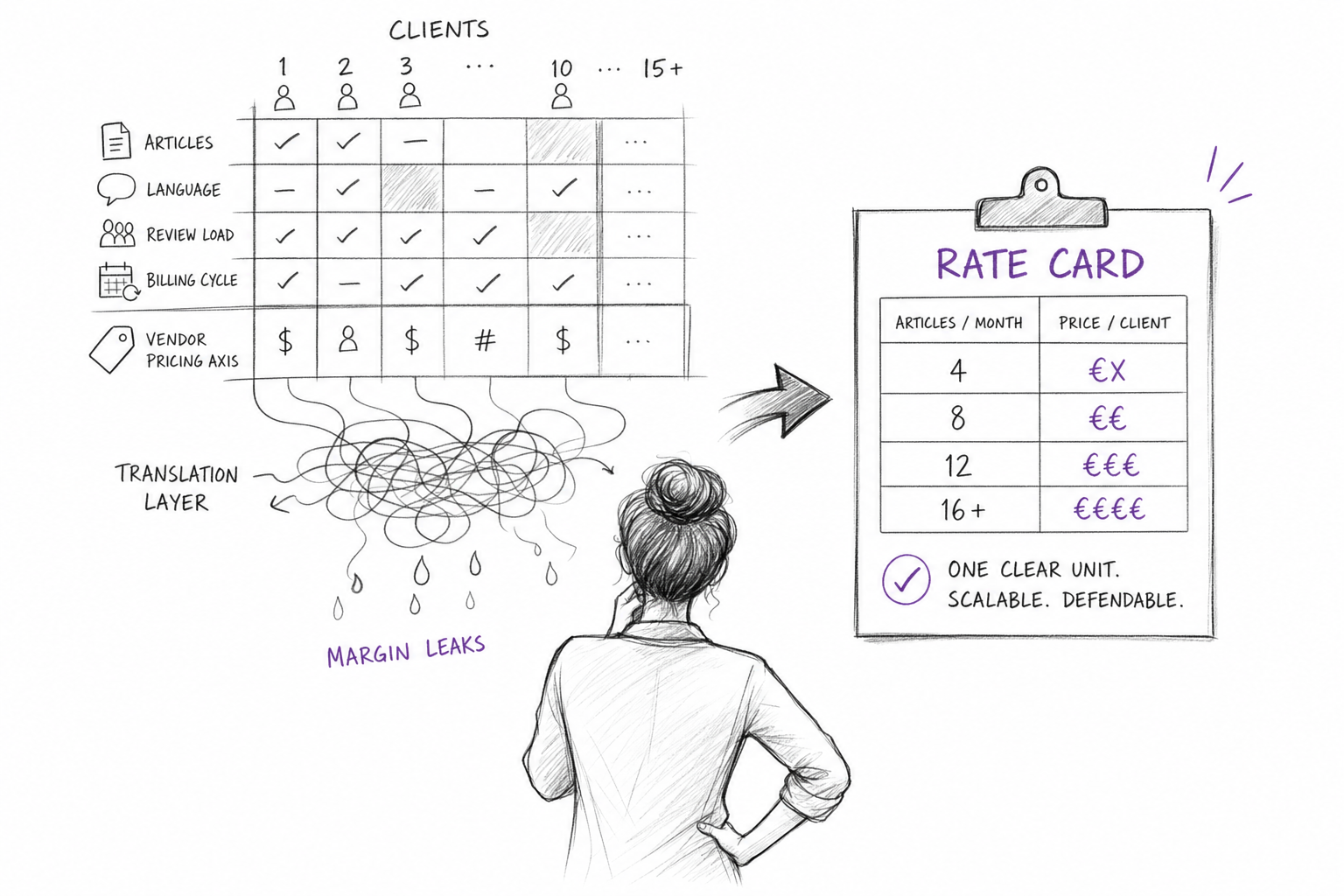
Your cost base stops being a single line and becomes a grid. Each client has a volume, a language, a review workload and a billing cycle. If your vendor charges on a different axis than you bill on, you now maintain a translation layer between the two. That translation layer is where margin leaks.
Your team grows non-linearly with clients. Ten client blogs at three articles a week is thirty articles a week moving through review. That is not one person’s job, but it is also not ten people’s job. If your tool prices by human login, you pay for the shape of your org chart rather than for the work the software does.
And your sales motion changes. At three clients you quote bespoke. At fifteen you need a rate card, because every bespoke quote costs you an hour of thinking and introduces an inconsistency you will have to defend later. A rate card requires a cost per client that is stable and knowable in advance.
The practical takeaway: before comparing vendors, write down your own billing unit. If you sell “a managed blog, X articles a month, per client”, your vendor should charge on something close to that shape.
The four pricing archetypes, and the math behind each
Flat fee per project or per blog
In this model, you pay a fixed monthly amount per blog property, with a defined publishing allowance, regardless of how many people in your team touch it. Ten clients means ten units. Fifteen clients means fifteen.
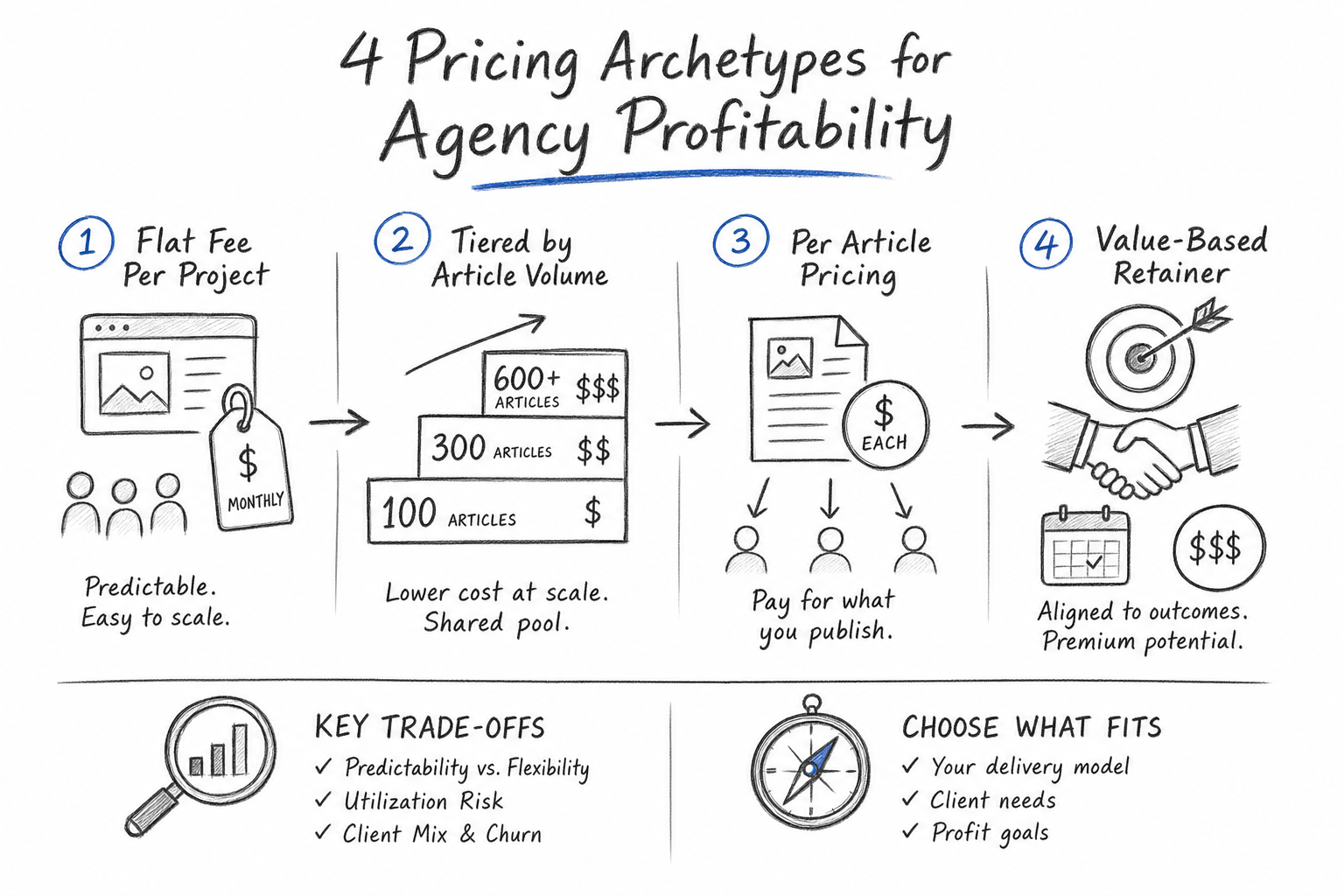
The arithmetic is trivial, which is the point. If a unit costs you, say, a fixed monthly figure and you bill the client a managed-blog retainer, your gross margin per client is a subtraction you can do in your head, and it is identical on client two and client twenty. Adding an account manager changes nothing. Giving the client read-only access to review drafts changes nothing. Taking on a second blog for the same client changes exactly one unit.
The weakness is real: you pay for a unit even in a slow month, and a client who pauses for six weeks still occupies a slot until you cancel it. Some agencies absorb this; others write a minimum term into the client contract so the two sides match. The model rewards agencies with stable rosters and punishes those with high churn.
This is also the model that makes white-label resale straightforward, because the thing you buy and the thing you sell are the same shape. You buy one blog, you sell one blog, the markup is a percentage you choose.
Tiered by article volume
Here you buy a pool of articles per month — a hundred, three hundred — and allocate them across clients as you like. Volume tiers look attractive on paper because the unit cost drops as the tier rises.
The problem is allocation. A pool is shared, so a client who ramps up quietly consumes the allowance of a client who did not. At ten-plus blogs you will spend real time deciding who gets what, and you will either over-buy a tier to be safe, which destroys the unit-cost advantage you bought the tier for, or you will under-buy and hit the ceiling in the third week of the month.
Volume pricing also fights the cadence you actually need. A blog that wants to own a topic publishes at least three articles a week, climbing toward daily on broad topics, and it holds that pace without gaps. Ten clients at three a week is around 130 articles a month before you add anything seasonal. Agencies on volume tiers tend to drift down to one article a week per client to stay inside the pool, which is a beginner’s cadence and will not build topical coverage fast enough to compete. You end up paying for a pricing model that makes your service worse.
Volume tiers fit agencies with a small number of high-output accounts and a clear idea of which client gets the surplus. They fit badly when every client expects an equal, steady pace.
Per-seat licensing
Per-seat pricing charges by human login. It is the default in most B2B software, which is why it keeps appearing in content tooling, and it is the model that degrades fastest in an agency context.
Consider the structure of agency work. One strategist sets the topic plan. Three account managers handle client communication and approvals. A junior checks drafts. Someone in operations handles billing and reporting. That is six seats before a single client logs in to see their own blog. If the vendor also charges for client-side viewers, every new account adds seats without adding capability.
Now scale it. Going from ten to twenty clients might add two account managers — a 33% increase in seats for a 100% increase in revenue, which sounds fine until you notice the opposite case: going from ten clients to eleven might add zero seats one month and a full seat the next, so your cost per client jumps in steps that have nothing to do with the work produced. You cannot build a rate card on a cost curve shaped like a staircase.
There is a second, quieter cost. Per-seat pricing creates an incentive to share logins, which breaks the audit trail. If you need to show who approved which article — and under the AI Act you do, for anything produced with AI assistance — a shared account means you cannot. You have traded compliance evidence for a line item.
Per-seat makes sense for software where the value genuinely is per-person: a design tool, an IDE. For a system whose output is articles, it charges you for the wrong thing.
Revenue share and white-label markup
In a revenue-share arrangement, the vendor takes a percentage of what you bill the client, or prices its own white-label tier as a function of your resale price. The attraction is a low or zero fixed cost at the start.
The math turns against you precisely where you succeed. If you grow a client from a modest retainer to a large one through two years of work, the vendor’s cut grows with it, even though their cost to serve has barely moved. You are paying a tax on your own account management. And the model is hostile to a rate card: your cost per client is now a function of your price, so every discount you grant is partly a discount you fund and partly one the vendor funds, which makes negotiation harder, not easier.
Revenue share has one legitimate use: testing a new service line with no capital at risk. If you are not yet sure you can sell managed blogs, paying a percentage of something is better than paying a fixed cost for nothing. Move off it as soon as the service line is proven.
Which model protects your margin past ten clients
Put the four side by side on the dimensions that actually matter when you are building a rate card: can you predict the cost, can you bill it cleanly, and does it hold up as the roster grows.
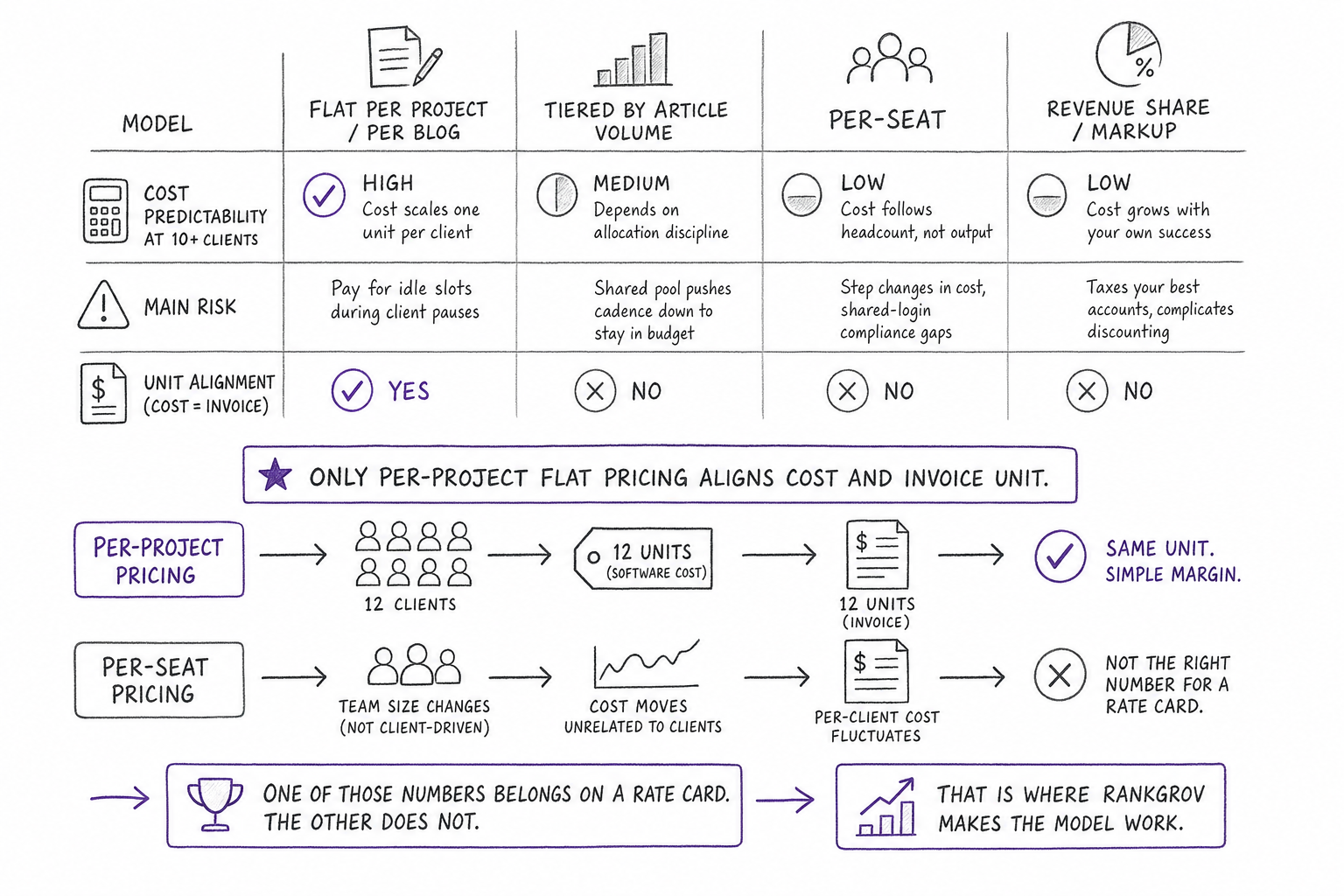
| Pricing model | Cost predictability at 10+ clients | Main risk |
|---|---|---|
| Flat per project / per blog | High: cost scales one unit per client | You pay for idle slots during client pauses |
| Tiered by article volume | Medium: depends on allocation discipline | Shared pool pushes cadence down to stay in budget |
| Per-seat | Low: cost follows headcount, not output | Step changes in cost, shared-login compliance gaps |
| Revenue share / markup | Low: cost grows with your own success | Taxes your best accounts, complicates discounting |
The pattern is consistent. Per-project flat pricing is the only one of the four where your cost and your invoice share the same unit. That alignment is worth more than a lower headline price, because it removes an entire class of monthly decisions: who gets the leftover articles, whether to add a seat, how to reprice when a client grows.
Say you run twelve client blogs. Under per-project pricing, your software cost is twelve units, full stop; your margin per client is the same subtraction twelve times. Under per-seat, your cost is a function of a team size that changes for reasons unrelated to those twelve clients — someone goes on parental leave, you hire a freelancer for two months — and your per-client cost moves even though nothing about the clients moved. One of those two numbers belongs on a rate card. The other does not.
This is where RankGrove’s plan structure sits in the comparison: plans are built around the project — one blog, one language, a defined publishing pace — rather than around how many people in your agency log in to approve the work. You buy what you sell. Check the current plan details and allowances there before you build your own numbers on top.
Two things this article deliberately leaves alone. How the day-to-day actually runs — review queues, approvals, who signs off before publication — is covered in running client blogs without a huge team. What to verify about a vendor before you resell their output under your own brand, from AI Act transparency marking to approval logs, belongs to the white-label checklist before you resell. Price is only one of the three decisions, and it is the easiest of them.
Building a rate card you can defend
Start from the client-facing number, not the vendor’s. Decide what a managed blog costs a client per month at your standard cadence, then work backwards: vendor cost per blog, review time per article multiplied by your internal hourly cost, reporting time per quarter. If you assume, for example, thirty minutes of human review per article at your loaded internal rate, you can calculate that line exactly — the point is that it is your number, built from your assumptions, and you can show it to a partner.
Then stress-test it at twenty clients, not ten. Any model that holds its shape when you double the roster is a model you can sell against for the next two years. Any model that requires a renegotiation at fifteen clients is a problem you have scheduled for yourself.
Finally, price the cadence honestly. If your service promises a blog that competes, that means three or more articles a week per client, held without gaps, and your cost model has to survive that volume rather than quietly discourage it. A pricing structure that makes you publish less is not saving you money; it is reducing what you can charge for later.
Frequently asked questions
What is the best pricing model for SEO agency software when managing many client blogs?
Flat per-project pricing, where you pay a fixed amount per blog regardless of team size, tends to protect margin best past ten clients. Your cost and your client invoice share the same unit, so margin per client stays constant as the roster grows and your rate card stays valid without renegotiation.
Why is per-seat pricing a problem for agencies?
Per-seat charges track your headcount, not your output. Strategists, account managers, reviewers and client-side viewers all consume seats without adding articles, so cost per client moves in steps unrelated to the work. It also tempts teams to share logins, which destroys the approval audit trail you need for AI transparency compliance.
How many articles a month should I budget per client blog?
Plan on at least three articles a week per client, which is roughly thirteen a month, and more on broad topics. Ten clients at that pace is around 130 articles monthly. Budget for that volume from the start: pricing models that push you toward one article a week will slow topic coverage to an uncompetitive pace.
Is revenue-share pricing ever worth it for an agency?
Only when you are testing a new service line and want no fixed cost at risk. Once the offer is proven, revenue share becomes a tax on your best accounts: the vendor’s cut grows as you grow the client, while their cost to serve stays flat. Move to fixed per-project pricing as soon as volume justifies it.
How do volume-tier plans fail at scale?
A shared article pool has to be allocated across clients every month. You either over-buy the tier to stay safe, losing the unit-cost advantage, or hit the ceiling mid-month. Agencies on volume tiers often quietly reduce each client’s cadence to stay inside budget, which weakens the service they are selling.
What should I verify beyond price before reselling a blogging tool white label?
Check who owns the published content, whether AI-assisted articles carry machine-readable transparency marking, whether approvals are logged per person, how WordPress publishing is authenticated, and what happens to the client’s blog if you cancel. Price is the easiest of these to compare and the least likely to cause a dispute later.
Should I pass the software cost to clients as a line item?
Usually not. Clients buy a managed outcome, not a tooling invoice, and itemising the vendor cost invites a conversation about buying direct. Bundle it into a single managed-blog retainer and keep the cost breakdown internal, where it belongs in your margin model rather than in the client’s procurement file.
Pricing models are commitments about how your business will behave at scale, and the one you accept today sets the shape of every quote you write for the next two years. Choose the model whose unit matches the unit you sell, test it at twice your current client count, and treat a low headline price attached to a mismatched structure as the more expensive option it usually turns out to be.
This article was produced and published automatically with the help of artificial intelligence.
Start today
A blog like this, on your site
This article was written and published by RankGrove, with the method you read about on the site. Try it free on your WordPress: the first article lands in your drafts within ten minutes.
Start free trial