Content ROI & B2B Lead Generation
SEO Agency Software: Running Client Blogs Without a Huge Team

An agency with three people can keep twenty client blogs publishing every week, but only if the repetitive work — briefing, drafting, formatting, internal linking, uploading — stops being done by hand. The job that remains for humans is approval, brand voice and client relationship, and that job scales far better than writing does.
Most agencies discover the limit of manual content operations somewhere between the eighth and the twelfth client. Up to that point, a spreadsheet, a shared drive and two reliable freelancers hold everything together. Past it, the cracks appear in a predictable order: briefs get written in a hurry, two clients in the same vertical receive near-identical articles, WordPress credentials go missing the day before a deadline, and the account manager spends more hours chasing drafts than reviewing them.
The painful part is that the client rarely notices the effort — they notice the gap. A blog that published four times in March and once in June tells visitors and search engines the same thing: nobody is home. And since the agency’s renewal usually depends on showing a traffic line that goes up, the gap becomes a commercial problem within a quarter.
This article explains what seo agency software actually removes from the workload, how team structure changes when publishing is automated, and which decisions must stay with a person. It is written for agency owners and account managers who already understand SEO and are trying to solve an operations problem, not a strategy one. If you also need the numbers side — how a blog turns into traffic, leads and revenue for the client paying the invoice — the full breakdown of content marketing ROI for a company blog covers the measurement layer this piece assumes.
Contents
- What seo agency software actually replaces in a content workflow
- How agency team structure changes when publishing is automated
- How to keep quality consistent across fifteen different blogs
- Where a human editor still has to step in
- What to decide before you change your content operation
- Frequently asked questions
- The decision underneath the tooling
What seo agency software actually replaces in a content workflow
Seo agency software, in the sense that matters here, is a system that plans, writes, illustrates and publishes blog content directly into each client’s site, keeping every client as a separate project with its own topic structure, language and tone. That definition is narrower than “SEO tool”. A rank tracker tells you where you stand. A keyword tool tells you what to write. Neither produces the article, formats the headings, writes the meta description, links the piece to three others on the same site and pushes it live on a Tuesday morning.
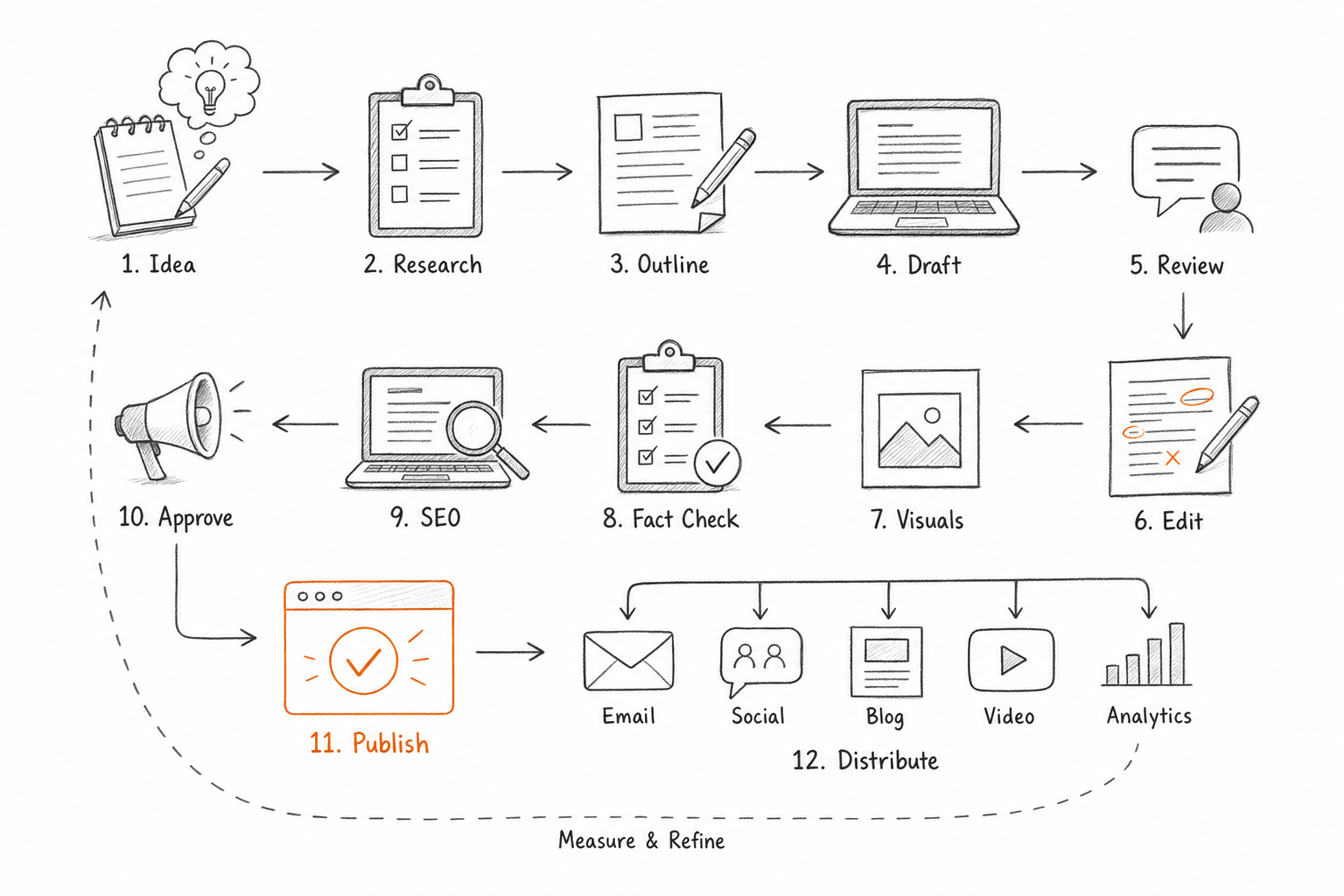
The production layer is where agency hours disappear. Think about the chain for a single article: pick the topic, check it against what the client already published, write the brief, send it to a writer, wait, review, request changes, wait again, paste into WordPress, fix the formatting the paste broke, add the image, write the alt text, set the category, choose internal links, schedule. That is roughly five to eight touchpoints for one piece of content, and most of them are clerical.
Multiply by three articles a week — the minimum cadence that lets a blog build real topic coverage — and by fifteen clients. You are looking at forty-five articles a week moving through a pipeline designed for five. No amount of project management discipline fixes a volume problem of that shape. The only two exits are hiring proportionally or removing the clerical steps.
The difference between a draft generator and a publishing system
Plenty of tools produce text. Far fewer close the loop to the live site. The distinction is operationally enormous: a tool that stops at the draft leaves the agency with the last mile, which is the part that scales worst because it is manual, repetitive and done under time pressure.
The last mile is where quality actually leaks. Headings get flattened, the meta title gets skipped because the plugin field was below the fold, images get uploaded without alt text, and the new article links to nothing. Three months later the client’s blog is a pile of orphan pages that no crawler treats as a coherent body of work — which is exactly why random blog posts rarely rank no matter how well written they are individually.
The practical takeaway: when you evaluate a system, test it on the boring end of the chain. If it cannot publish to a real WordPress install with correct headings, meta fields, structured data and internal links already in place, it has not removed your bottleneck.
How agency team structure changes when publishing is automated
The honest way to compare is to describe both setups in terms of roles, not software.
The manual setup and where it breaks
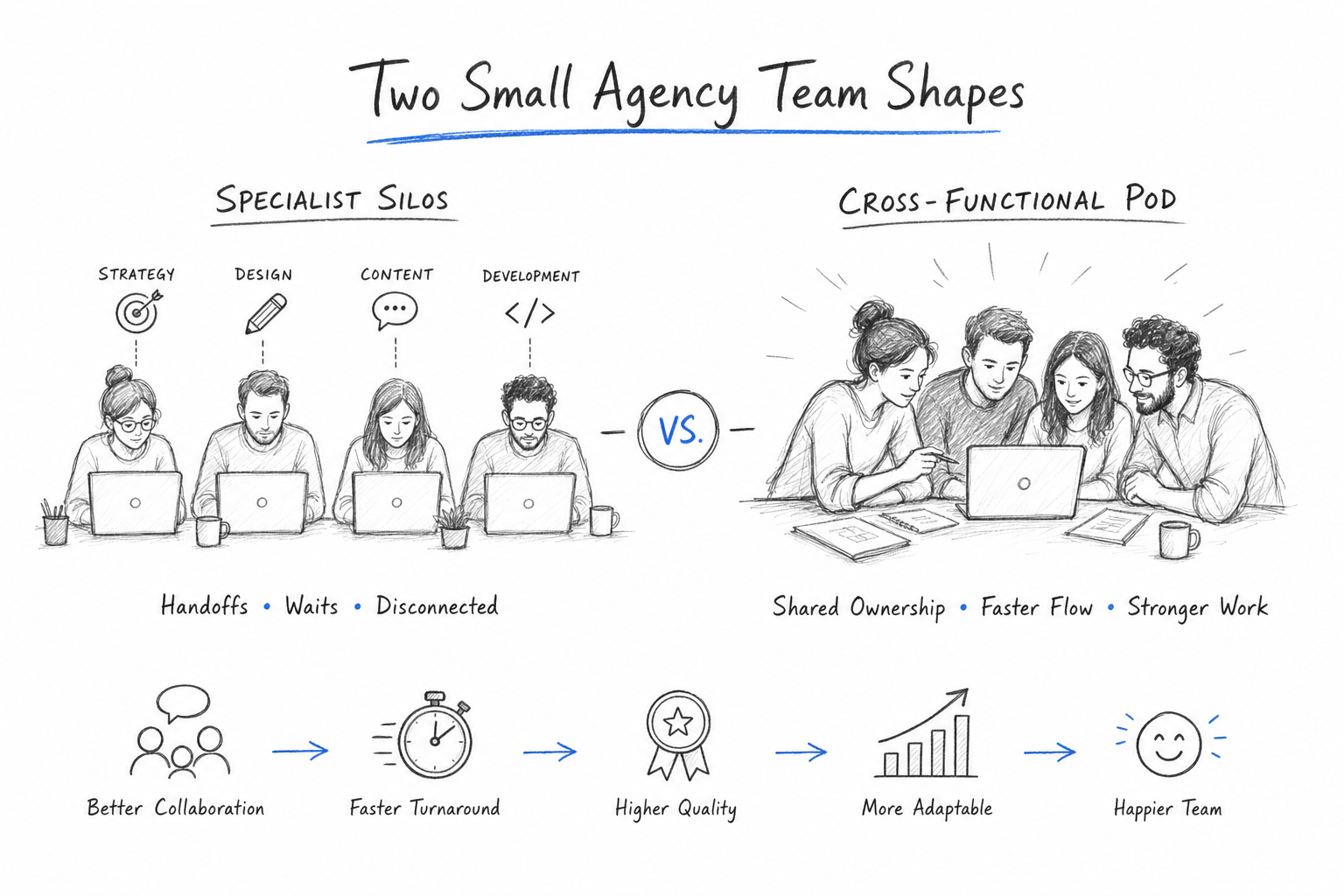
A manual agency content team for ten to fifteen clients usually looks like this: one content lead who plans and reviews, two or three freelance writers, an account manager who handles client feedback, and whoever happens to have the WordPress login. Capacity is bounded by the writers’ hours and by the content lead’s review throughput.
Two structural weaknesses show up fast. First, the content lead becomes the single point of failure: they hold the topic plan for every client in their head, and when they are on holiday the pipeline stops. Second, writers rotate. Each new writer needs the client’s tone, product vocabulary and prohibited claims explained again, and the first three articles are always off-register.
There is also a quieter risk nobody puts on a slide: when writers are paid per piece and briefed thinly, two clients in adjacent verticals get structurally identical articles. Different company names, same skeleton. It is the fastest way to look like a content mill to anyone who checks.
The automated setup and what stays human
With a publishing system in place, the roles redistribute rather than disappear. Planning moves into the system as a topic tree per client — pillar articles that own the main themes, supporting articles that answer narrower questions, and internal links generated automatically between them and toward the pages that sell. Drafting, formatting and uploading move into the system entirely.
What remains for people is approval, brand voice calibration, client strategy conversations and the handful of articles that touch sensitive claims. One editor can review a queue of articles far faster than they can brief, chase and rework them — reviewing is reading plus a yes or no, while coordinating is twenty small decisions spread over days.
The result is a shape most agencies find easier to staff: a strategist who defines each client’s topic tree and positioning, an editor who approves output across all accounts, and account managers who talk to clients. Writers become specialists used where they add most — the thought-leadership pieces, the founder interviews, the technically delicate content — rather than the engine room of weekly volume.
Practically: before you buy anything, write down who does each of the eight steps today. The steps that have no name next to them are the ones already failing.
How to keep quality consistent across fifteen different blogs
Consistency is the real objection agencies raise, and it is the right objection. Volume without quality control is how you lose a client in month four. Three mechanisms do most of the work.
One project per client, never a shared pool
The first rule is isolation. Each client gets its own project: its own topic tree, its own tone of voice, its own language, its own publishing calendar. Articles are planned against what that specific site already covers, so the system builds depth on a theme instead of circling the same three keywords.
This is also what prevents the duplication problem. When two clients compete in the same vertical, their topic trees diverge by design because they are built from different positioning statements, different service pages and different existing content. The articles answer different questions even when the keyword universe overlaps.
Tone of voice defined once, applied every time
The second mechanism is codifying brand voice at project level instead of re-explaining it to each writer. Register, sentence length, vocabulary to use, claims to avoid, how to refer to the product — written once, applied to every article the project produces. This is the step most agencies skip and then regret, because tone is the thing clients notice before rankings move. Getting it right is a setup task, and the practical approach to giving an AI text generator your company’s tone of voice applies identically when the “company” is your client.
Structural checks that run on every piece
The third mechanism is the one humans are worst at doing consistently: technical hygiene. Heading hierarchy, meta title within the character limit, meta description that reads as a complete sentence, image alt text that describes the image rather than stuffing a keyword, FAQ marked up as structured data, a table of contents on long pieces. These checks are boring, they matter, and a system does them identically on article four hundred and on article four. Alt text alone is a good example of a small signal agencies routinely drop — and whether alt texts still affect ranking in 2026 is worth settling before you tell a client it does not matter.
Here is how the two setups compare on the dimensions that decide whether an account stays profitable.
| Dimension | Manual team | Automated with human review |
|---|---|---|
| Realistic cadence per client | One to four articles a month | Three or more a week, held for years |
| Cost driver | Writer hours per article | Flat platform cost per project |
| Main failure mode | Gaps when people are busy | Approval queue left unattended |
| Human time spent on | Briefing and chasing | Reviewing and client strategy |
| Internal linking | Done manually, often skipped | Generated across the topic tree |
The dimension agencies underestimate is the second-to-last row. Chasing is unbillable work; reviewing is close to billable judgment. Shifting your team from one to the other changes the margin on every retainer.
Where a human editor still has to step in
Automation does not remove responsibility, and pretending otherwise is how agencies get burned. Four moments need a person.
Approval before publishing. Someone signs off that the article is accurate, on-brand and safe to attribute to the client. This is a few minutes per piece, and it is the moment that keeps the agency defensible if a client ever questions a claim. The argument for why a human should always review AI articles before publishing applies with more force when you are publishing on someone else’s domain.
Factual claims specific to the client. Certifications, regulatory statements, product specifications, pricing, guarantees. A system does not know which claims your client’s legal team has approved. Flag these topics at project setup so they route to a human every time.
Strategic shifts. When a client launches a service line, enters a new market or repositions, the topic tree has to be rewritten. That is a conversation, not a setting.
Transparency compliance. Content produced with AI assistance should say so, in plain text on the page and in machine-readable structured data, with the approval tracked. Under the AI Act this is a disclosure obligation, and for an agency it is also a client-relationship question: the client needs to know how their content is produced, and they need the record. Treating transparency as something to hide creates a liability on an account you do not control. Treating it as standard practice turns it into a selling point, and the reasoning behind the AI Act’s transparency requirements for published AI content is worth reading before you draft your own client policy.
The operational takeaway: budget review time explicitly. An unattended approval queue is the one failure mode automation introduces, and it is fixed by a calendar slot, not by more software.
What to decide before you change your content operation
Two questions sit outside this article but inside your decision. The first is how a white-label setup should work when the client must never see the machinery — delivery under your brand, your reporting, your relationship. The second is which pricing model fits an agency that adds and loses accounts: per project, per article, or flat. Both deserve their own analysis, and both change the answer depending on whether your accounts are five or fifty.
What does not change is the sequence. Define each client’s topic tree before you automate anything, because automating a bad plan produces consistent mediocrity at speed. Decide who approves and when. Write the transparency policy once and apply it to every account. Then let the system handle briefing, drafting, formatting, linking and publishing, which is the work that was never worth your team’s hours.
Frequently asked questions
How many client blogs can a three-person agency realistically manage?
With manual production, three people typically cap out around eight to twelve clients before quality drops. With publishing automated and humans limited to approval and strategy, the same team can oversee considerably more, because the time per article falls to review time. The real ceiling becomes client communication, not content production.

Will clients object to AI-assisted content on their blog?
Most object to being kept in the dark, not to the method. Declare it upfront, show the review step, and give them the approval record. Under the AI Act, AI-generated content carries transparency obligations anyway, so disclosure is both compliant and commercially cleaner than hoping nobody asks.
How do you stop two clients in the same industry getting similar articles?
Keep one project per client, each with its own topic tree built from that client’s positioning, service pages and existing content. Topics are planned against what the specific site already covers, so coverage diverges even when the keyword universe overlaps. Shared content pools are what create duplication.
How often should an agency publish on a client blog?
At least three articles a week per client, up to one a day on broad topics, held without gaps. One a week is a beginner cadence that builds topic coverage too slowly to compete. Consistency matters more than volume spikes: three a week for a year beats fifteen in a launch month followed by silence.
Is it safe to give a tool publishing access to a client’s WordPress?
It is, provided the connection uses a dedicated application credential with limited permissions rather than an admin password, and every publication is logged. Agree the access method with the client in writing at onboarding, and keep the ability to revoke it instantly without affecting the rest of the site.
How much editor time does an automated blog still require?
Budget a few minutes per article for review, plus a recurring slot for topic tree maintenance per client. The failure mode is an approval queue nobody opens. Treat review as a fixed calendar commitment, the way you treat reporting, rather than something squeezed between client calls.
Does automation work for multilingual client portfolios?
Yes, when each language is handled as its own project with its own topic tree rather than as a translation layer bolted onto the original. Search behaviour differs by market, so the questions worth answering differ too. Treat a second language as a second blog with shared positioning.
The decision underneath the tooling
The agencies that scale content without scaling headcount are the ones that stopped treating article production as creative work to be coordinated and started treating it as a process to be run, with human judgment reserved for the decisions that actually need it. The software is the easy part; the harder part is rewriting your team’s job descriptions around approval instead of chasing. If you want to see how project-based plans map onto a portfolio of client accounts, the plan details and per-project structure are the practical next step.
This article was produced and published automatically with the help of artificial intelligence.
Start today
A blog like this, on your site
This article was written and published by RankGrove, with the method you read about on the site. Try it free on your WordPress: the first article lands in your drafts within ten minutes.
Start free trial