Content ROI & B2B Lead Generation
SEO Agency Software: The White-Label Checklist Before You Resell

White-labelling a blogging platform means you take on your client’s risk: their content ownership, their compliance exposure, their published output. Before you resell, check who owns the articles, whether client projects are truly isolated, how AI-generated content is disclosed, whether the system builds a real internal-link structure or just dumps posts, and what you can hand a client at the end of the month.
An agency that resells a blogging platform is making a promise it cannot easily walk back. The client sees your brand on the reports, your name on the invoice, and your face in the quarterly call. Whatever the underlying tool does — well or badly — becomes your work.
That is why evaluating seo agency software is a different exercise from evaluating a tool for your own blog. On your own site, a weak feature is an inconvenience. Across fifteen client accounts, the same weak feature is fifteen conversations you did not plan for. If a platform cannot separate one client’s context from another’s, you will eventually publish a competitor’s positioning on the wrong domain. If it cannot mark AI-generated content in a machine-readable way, the compliance exposure lands on your client first and on your contract second.
This is a buyer’s checklist, written for the person who has to compare three or four options and defend the choice internally. It covers intellectual property, project isolation, AI transparency, internal-linking structure, publishing reliability, reporting and the commercial model — the criteria that decide whether a tool survives contact with a real client roster. It sits inside a broader argument about how published content turns into pipeline, which we develop in depth in how a company blog becomes traffic, leads and revenue. Read this one as the procurement step that comes before the strategy.
Contents
- Who owns the articles once they are published?
- Does the platform keep client projects genuinely separate?
- How does the tool handle AI disclosure and transparency?
- Does it build a topic structure, or just generate articles in bulk?
- What can you put in front of the client at the end of the month?
- Frequently asked questions
Who owns the articles once they are published?
This is the first question and the one most often skipped. A white-label arrangement where the vendor retains any claim over the generated text is unworkable the moment a client leaves you, or you leave the vendor.

Assignment of rights, in writing
Look for explicit language that the output belongs to the account holder, with the right to sublicense to end clients. Vague wording about a “licence to use the generated content” is the signal to slow down: a licence can be revoked, an assignment cannot. If the terms describe content as something you are permitted to publish rather than something you own, you are renting your client’s blog archive.
What happens at termination
Ask what survives the end of the contract. Articles already published on the client’s own WordPress install should stay published and stay theirs, regardless of your subscription status. Some platforms host content on their infrastructure and inject it into the client site, which means cancelling the plan empties the blog. That is a structural dependency you are selling to your client without telling them.
Exportability
A plain export — articles, metadata, images, internal link map — is the practical test of ownership. If you cannot get the archive out in a usable format, the ownership clause is decorative. The takeaway: get the IP position confirmed in writing before the first client is onboarded, not during an offboarding.
Does the platform keep client projects genuinely separate?
Agencies run parallel accounts that must never leak into each other. A manufacturing client and its direct competitor can both be on your roster; that is normal. What is not normal is a system that pools context across projects.
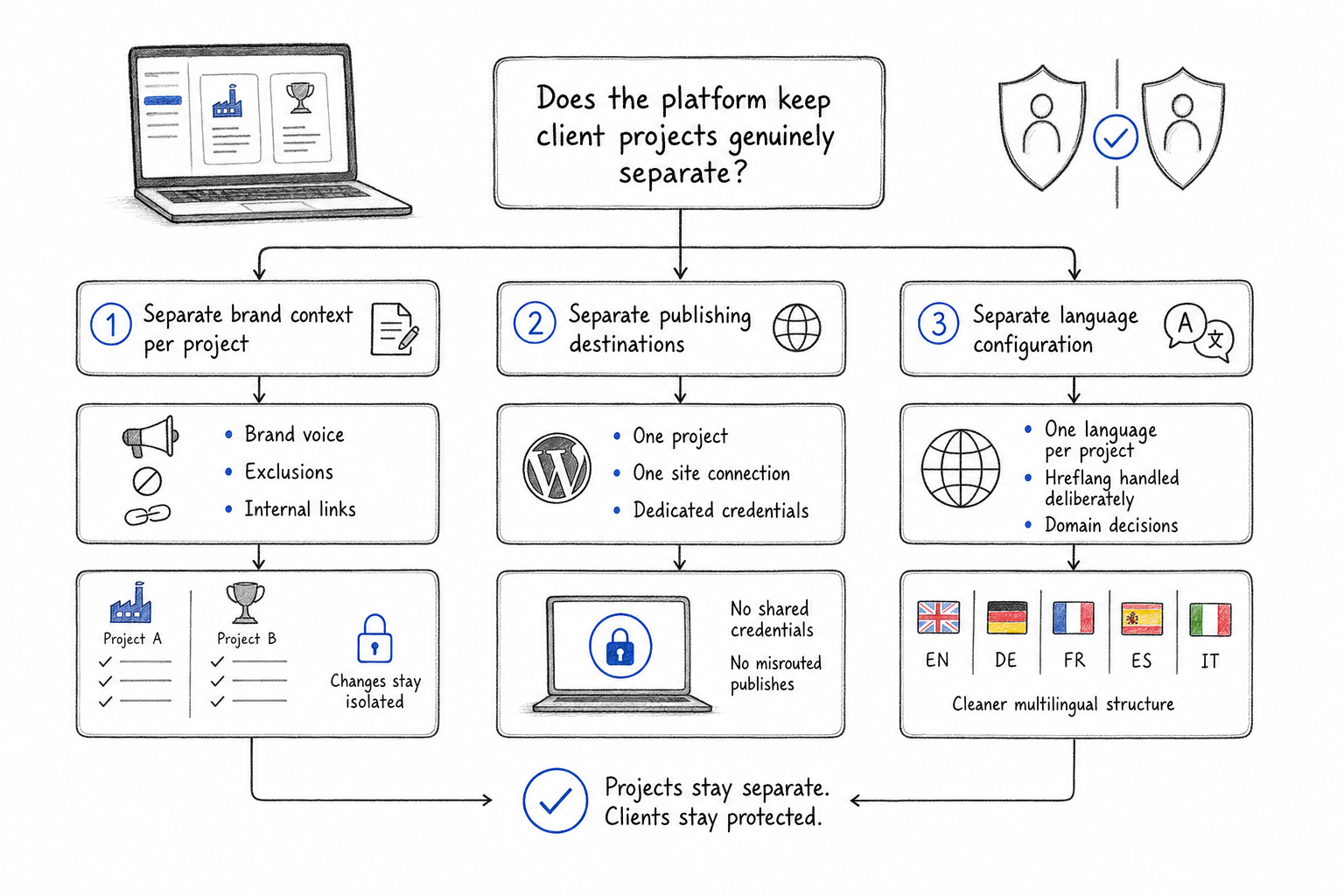
Separate brand context per project
Each client needs its own tone of voice, its own positioning, its own forbidden terms, its own set of pages that sell. A platform where these settings live at account level instead of project level will eventually produce an article that reads like one client and links like another. Check whether brand voice, exclusions and internal link targets are configured per project, and whether changing one leaves the others untouched.
Separate publishing destinations and credentials
One project, one site connection. If credentials are shared or the connection is account-wide, a misrouted publish is a question of when. The connection model matters enough that we treated it separately in whether it is safe to let a tool auto-publish to WordPress — worth reading before you grant a third party write access to client sites.
Separate language configuration
European agencies rarely run one language. A project structure that allows one language per project — with the hreflang and domain decisions handled deliberately — is cleaner than a single project trying to juggle five locales. The technical consequences are covered in the technical side of multilingual SEO. For procurement purposes, the test is simple: can you configure language at project level, and does the platform support the European languages your client base actually needs?
How does the tool handle AI disclosure and transparency?
This is the criterion that has changed most in the last two years, and the one agencies underestimate. If you resell AI-assisted content, the compliance question travels downstream to your client’s published pages — and your client will ask you about it, usually after their legal team has asked them.
Plain-text disclosure on the page
The baseline is a visible statement that the article was produced with the help of artificial intelligence. Not buried in a privacy policy. On the article. Agencies sometimes resist this, assuming disclosure damages credibility. In practice the opposite holds: a dated, signed transparency note alongside a named reviewer reads as editorial control, not as an apology. Transparency is a trust signal, and hiding it is the risk.
Machine-readable marking
A human-readable line is not enough on its own. The content should also carry structured marking that a machine can parse, so that the declaration survives syndication, scraping and AI summarisation. Ask the vendor to show you what the markup looks like on a live page, not what the roadmap says.
Evidence of human approval
Compliance conversations turn on whether a person reviewed the output before publication, and whether that review is recorded. A platform that logs who approved what and when gives you an audit trail you can show a client’s counsel. One that publishes silently gives you nothing to show. The editorial case for that review step — beyond compliance — is set out in why a human should review AI articles before publishing.
Your client’s exposure, your contract
Here is the uncomfortable part for resellers. If the underlying tool offers no disclosure mechanism, you are the one who has to build it manually across every client site, or you are the one who signed off on content that lacks it. Treat disclosure handling as a hard requirement, not a nice-to-have. The takeaway: if a vendor cannot demonstrate both plain-text and machine-readable disclosure today, remove it from the shortlist.
Does it build a topic structure, or just generate articles in bulk?
Volume is easy to demo. Thirty articles appear, they read fluently, the client is impressed for a month. Then nothing ranks, because thirty unconnected posts about loosely related subjects do not tell a search engine that the site owns a subject.
Planned clusters instead of a keyword queue
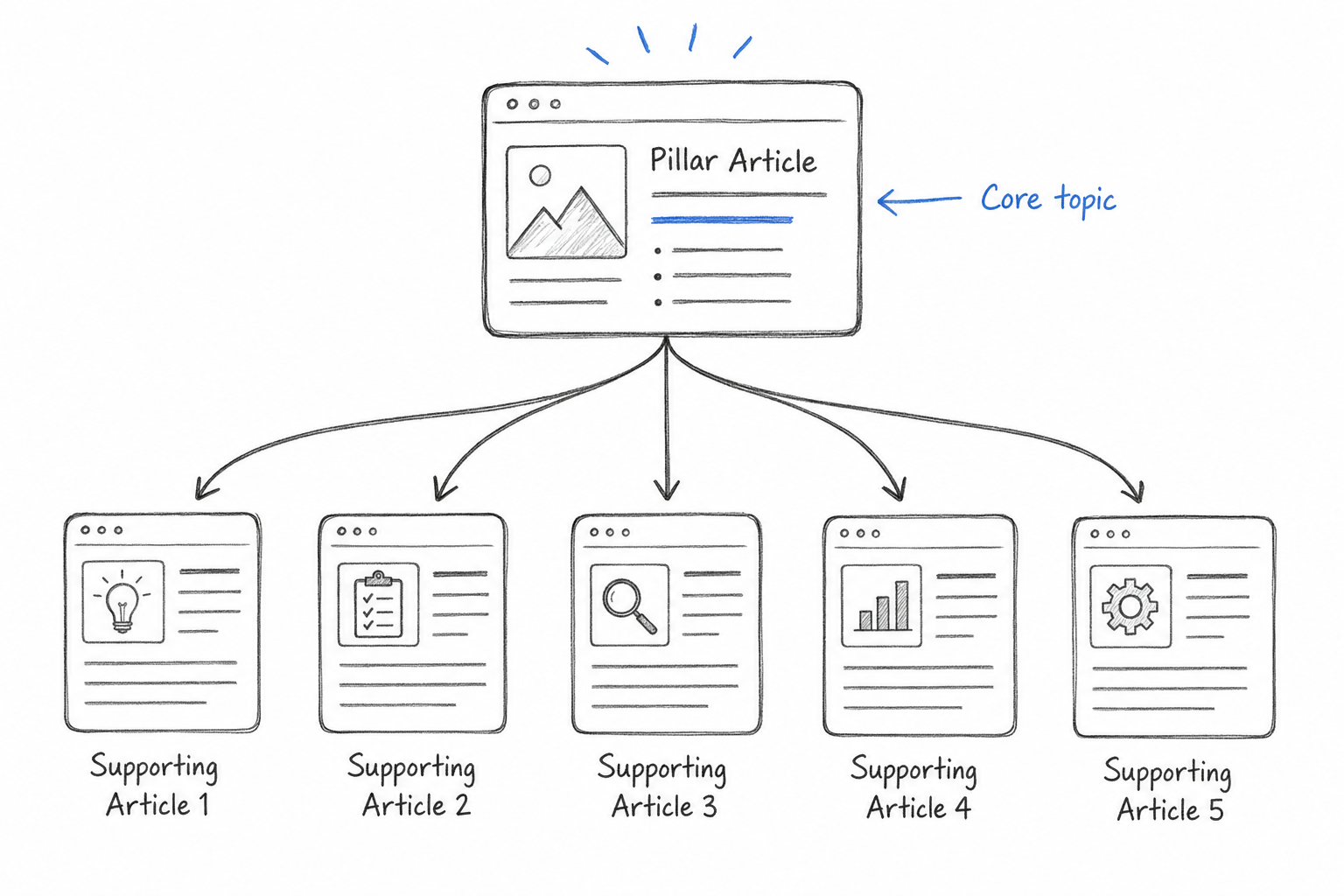
The structural unit that works is a topic tree: a pillar article that claims the main theme, supporting articles that answer the specific questions around it, and links that connect them deliberately. A platform should be planning that tree before it writes, so each new article has a defined place. If the interface is essentially a queue of keywords with a “generate” button, you are buying text, not coverage. We argued the mechanics of this in why random blog posts rarely rank.
Internal links that point at pages that sell
Automatic internal linking is common; useful internal linking is less so. The question to ask in a demo is where the links go. Links that only connect blog posts to blog posts build a closed loop. Links that route readers from informational articles toward service pages, pricing and contact forms are the mechanism by which a blog produces enquiries. For an agency, this is also the easiest thing to show a client: here is the path from article to request.
Publishing cadence that builds coverage
A topic tree only works if it gets filled in. Covering a subject properly means at least three articles a week, and up to one a day on broad subjects, held without gaps. One a week sounds disciplined and is actually a beginner’s pace: at that rate a cluster of forty supporting articles takes most of a year, by which time the competitor who published daily owns the ground. Consistency matters more than intensity — three a week sustained for a year beats fifteen in a launch month followed by silence. Evaluate whether the platform can sustain that rhythm across every client on your roster, not just one showcase account.
GEO features, since AI answers now intercept the click
Being cited inside an AI-generated answer is a separate discipline from ranking tenth on a results page. It rewards content that is easy to extract: a clear summary near the top, a table of contents, FAQ blocks with structured data, unambiguous definitions. Ask whether the platform produces these by default. The comparison criteria are laid out in what actually gets you cited in AI answers.
What can you put in front of the client at the end of the month?
Agencies are paid on demonstrated progress. A platform that produces good content and no evidence creates work for your account managers.
Reporting a non-specialist can read
The client’s marketing lead needs to see what was published, what it covers, where traffic is going and which pages received internal links. Raw keyword exports do not do this. Look for output you can forward without rebuilding it in a spreadsheet.
Expectations about timing
Most friction in agency relationships comes from a mismatch between when content is published and when results appear. Organic compounding is slow at the start and then accelerates; setting that out before the contract is signed prevents the month-three conversation. The realistic curve is described in how long before a blog generates real traffic.
Pricing structure that scales per client
How a platform charges — per project, per article, per seat — determines whether your margin holds at twenty clients or collapses at five. That mechanic deserves its own analysis rather than a paragraph here; treat “does the pricing model scale with my roster” as a checklist item and work the numbers separately before you commit.
Day-to-day operations
Running ten or thirty blogs in parallel is an operational discipline of its own: approval queues, review rotation, who sees what. We cover that workflow in running client blogs without a huge team, so this article stops at the buying decision.
Here is the checklist in compressed form, for the shortlist document.
| Criterion | What to verify | Disqualifier |
|---|---|---|
| Content ownership | Rights assigned to account holder, sublicensable | Vendor-hosted content that vanishes on cancellation |
| Project isolation | Voice, links, credentials set per project | Account-level settings shared across clients |
| AI disclosure | Plain-text note plus machine-readable marking | No disclosure mechanism at all |
| Approval trail | Logged reviewer and timestamp per article | Silent publishing with no record |
| Structure | Planned pillar and supporting clusters | Keyword queue with a generate button |
| Internal links | Routes readers to pages that sell | Blog-to-blog links only |
| Reporting | Client-ready output, forwardable as is | Raw exports requiring manual rework |
Run every candidate against those seven rows before the commercial conversation starts. A tool that fails two of them will fail them loudly, in front of a client.
Frequently asked questions
What is white-label SEO agency software?
It is a platform an agency licenses and presents under its own brand, so the client sees the agency rather than the underlying vendor. For blogging specifically, it covers content planning, writing, internal linking, publishing to the client’s site and reporting. The key difference from a normal tool is that the agency carries responsibility for everything the platform produces.
Do agencies need to disclose AI-generated content to their clients?
Yes, on two levels. The client should know how content is produced, as a matter of contract honesty. And the published article itself should carry a transparency statement in plain text and in structured data, so readers and machines can both see it. Disclosure handled properly reads as editorial control, and it keeps the compliance exposure off your contract.
Who owns content produced by a white-label blogging platform?
It depends entirely on the terms, which is why you read them before signing. Look for an explicit assignment of rights to the account holder with the ability to sublicense to end clients, plus confirmation that published articles remain on the client’s site after cancellation. A usage licence rather than an assignment means you do not own the archive.
How often should an agency publish on a client blog?
At least three articles a week per client, up to one a day where the subject is broad, with no gaps. Below three a week a blog builds topic coverage too slowly to compete for a subject area. Sustained cadence matters more than volume spikes: a year of steady publishing outperforms a crowded launch month followed by silence.
How do I check whether a platform really isolates client projects?
Set up two test projects with deliberately contradictory settings — different tone, different forbidden terms, different link targets — and generate an article in each. If the second inherits anything from the first, isolation is cosmetic. Also confirm that site credentials are stored per project, so a publishing action can never reach the wrong domain.
Will search engines penalise AI-assisted articles published for clients?
Search engines assess whether a page is useful, original and trustworthy, not which tool typed it. Problems arise with thin, duplicated or unreviewed output published at scale with no structure. Articles that are planned into a topic cluster, reviewed by a named person and openly disclosed behave like any other well-made content.
What reporting should an agency expect from a blogging platform?
At minimum: what was published and when, which cluster each article belongs to, which internal links were created and where they point, and how organic traffic is developing per topic area. It should be presentable to a non-specialist without rebuilding it. Reporting that needs manual assembly every month quietly erodes the margin on the account.
An agency that resells a blogging platform is underwriting it. The criteria that matter most are the ones that are hardest to fix later: who owns the archive, whether client contexts stay apart, whether AI involvement is declared in a way a machine can read, and whether the system builds a structure instead of a pile. If you are mapping those requirements against a roster of client blogs, start from the plans built for agencies and test the checklist against a real project before the first client sees anything.
This article was produced and published automatically with the help of artificial intelligence.
Start today
A blog like this, on your site
This article was written and published by RankGrove, with the method you read about on the site. Try it free on your WordPress: the first article lands in your drafts within ten minutes.
Start free trial