Generative Engine Optimization (GEO) & AI Search
SEO AI Tools Compared: What Gets You Cited in AI Answers

Most SEO AI tools are judged on how fast they produce an article. The criteria that actually decide whether a language model quotes your site are different: whether the tool builds a connected topic structure, whether it formats pages so an answer engine can lift a passage, whether it marks AI involvement in a way the EU AI Act accepts, and whether one person can run several client blogs without exporting files by hand. Compare on those four axes and the shortlist shrinks fast.
A buyer comparing SEO AI platforms in 2026 is usually three clicks away from a free trial and stuck on the same question: they all write articles, so what is the difference? The honest answer is that article generation stopped being the differentiator around the time every tool started calling the same frontier models. What separates them now is everything that happens before the draft and after it — how topics are chosen and connected, how pages are marked up, how disclosure is handled, and who approves what.
That shift matters because the destination changed. Ten years of SEO advice assumed a reader clicking a blue link. A growing share of commercial research now ends inside a generated answer, where the model picks a handful of sources and paraphrases them. Getting picked follows rules of its own, which we cover in depth in our guide to Generative Engine Optimization and getting cited by ChatGPT, Google AI and Perplexity. This article is the buying-side companion: a feature-by-feature comparison of the categories of tools on the market, judged on criteria that predict AI citations rather than word output.
Everything below about competing products reflects publicly available positioning as of early 2026. Pricing and roadmaps change; the axes do not.
Contents
- Which criteria actually predict whether AI answers cite you
- How the main categories of SEO AI tools compare
- Where RankGrove is genuinely different, and where it is not
- Reading the comparison as a scorecard
- Choosing by situation rather than by feature count
- Frequently asked questions
- The decision underneath the comparison
Which criteria actually predict whether AI answers cite you
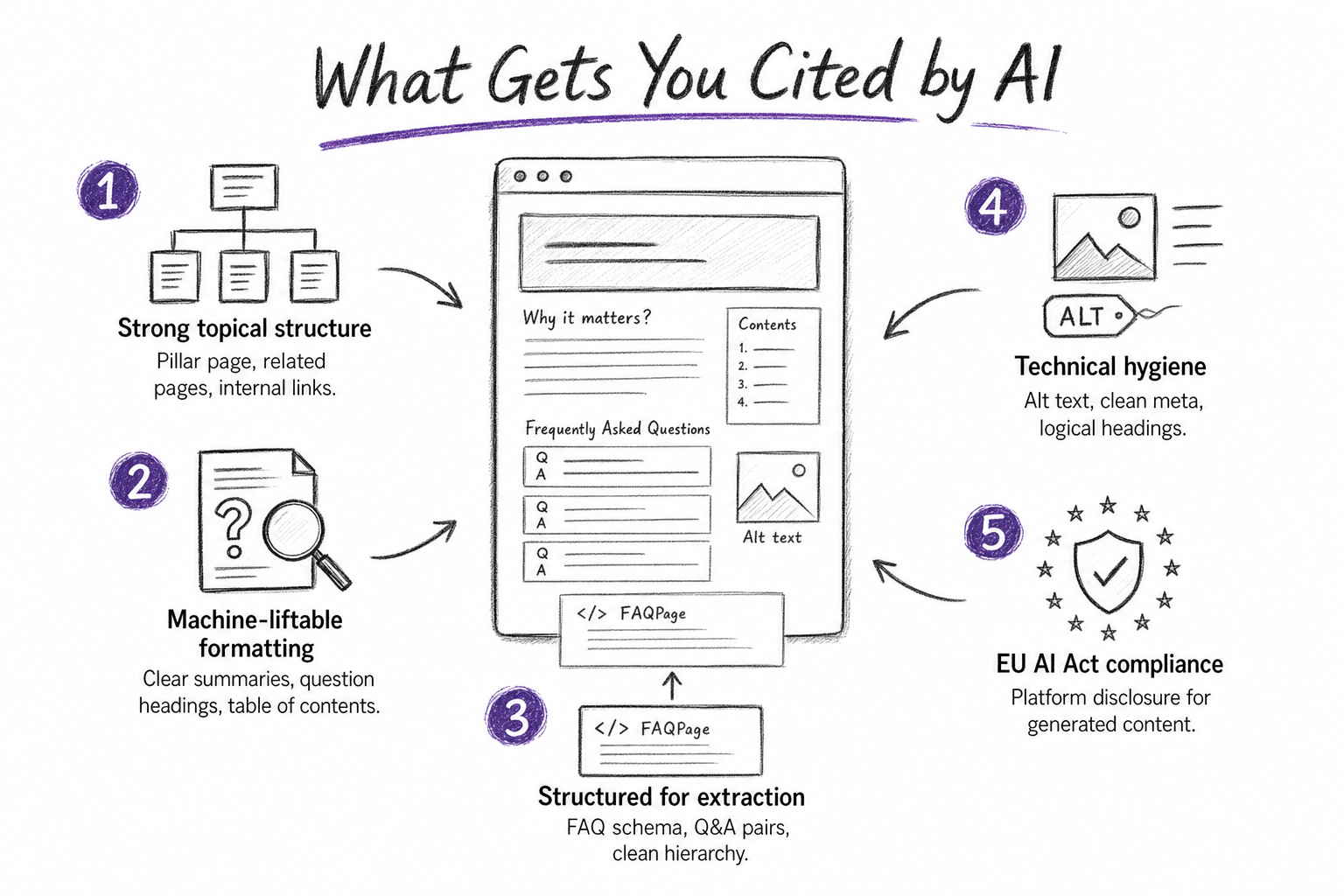
Before comparing anything, fix the yardstick. Five dimensions do most of the explanatory work, and a tool that scores badly on three of them will not be rescued by a better prose model.
Topical structure, or isolated articles
Answer engines reward sites that visibly own a subject. Ownership shows up as a set of pages covering a theme from several angles, linked to each other, with one page acting as the anchor. A tool that generates whatever keyword you typed this week produces a flat pile of posts with no relationship between them. A tool that plans a topic tree — a pillar page owning the theme, satellites answering narrower questions, automatic links between them and toward pages that sell — produces something a crawler and a model can both read as coverage.
This is the single biggest divider in the category, and it is invisible in a demo because a demo shows you one article.
Output formatting a model can actually lift
A model quoting your page needs a passage it can extract without rewriting. That favours a short summary at the top, descriptive headings phrased as real questions, a table of contents, and an FAQ block with FAQPage structured data so the question-answer pairs are machine-readable rather than merely visible. Alt text on images, clean meta, a logical heading hierarchy — the same technical hygiene that always mattered, now with a second consumer.
EU AI Act disclosure handled by the platform
From 2 August 2026 the transparency obligations of the EU AI Act apply to published content generated or substantially modified by AI: it must be marked as such in a machine-readable way, and disclosed to the people reading it. The regulation entered into force on 1 August 2024 with staged application dates; this is the one that touches company blogs. The practical question for a buyer is whether disclosure is a product feature or your homework. We go deeper into the compliance side in what businesses risk when they publish AI articles without saying so.
Multilingual as a project, not a translate button
Running a blog in several European languages is not translation. Each language needs its own keyword research, its own topic tree, its own internal links. Machine-translating an Italian article into German gives you a German-shaped page with Italian search assumptions baked in. The architectural choice — one project per language, researched separately — is covered in how to set up a blog in many languages.
Agency control over many client blogs
For anyone managing more than two blogs, the cost is not writing. It is the per-client overhead: separate logins, separate approvals, separate WordPress credentials, separate reporting. A platform designed for one blog multiplies that overhead linearly.
Takeaway: score every candidate on these five before you look at the sample article. The sample article is the least informative thing in any demo.
How the main categories of SEO AI tools compare
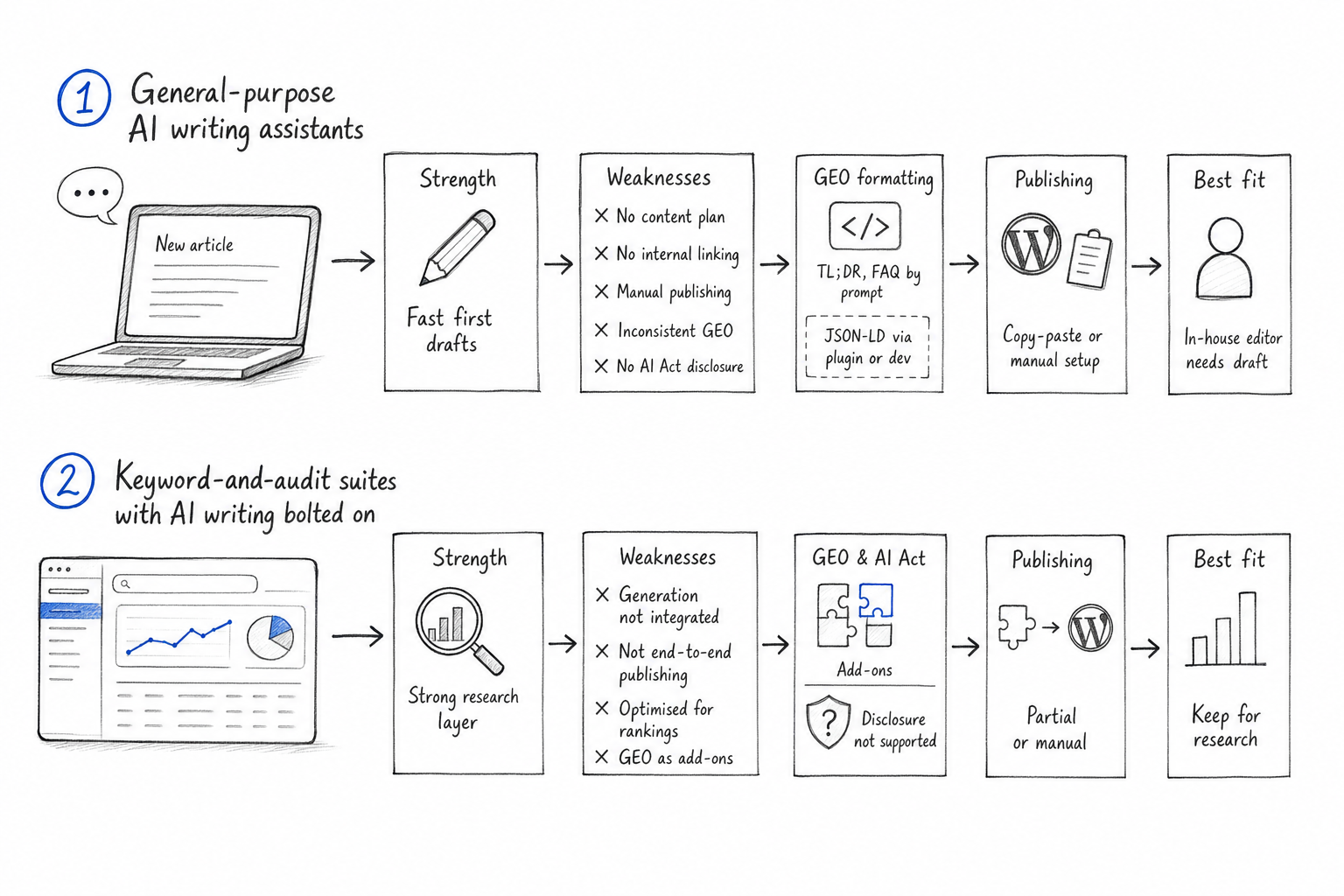
The market sorts into four recognisable groups. Naming the groups is more useful than naming every product, because products move and categories do not.
General-purpose AI writing assistants
The broad writing platforms — the ones that also write emails, ads and social posts — are excellent at drafting and indifferent to everything else. You supply the topic, they supply the prose. There is no plan connecting this week’s article to last week’s, no internal linking logic, and publishing means copy-pasting into WordPress or wiring up an integration yourself.
On GEO formatting they are inconsistent: you can prompt your way to a TL;DR and an FAQ, but the JSON-LD has to come from a plugin or a developer. On AI Act disclosure they typically offer nothing, because the tool does not know whether you published the text or threw it away. Reasonable choice if you have an in-house editor who wants a faster first draft. Weak choice if you want a blog that runs itself.
Keyword-and-audit suites with AI writing bolted on
The established SEO suites added generation to an existing research product. Their strength is the research layer: real search volumes, competitive gap analysis, rank tracking you can show a client. Their weakness is that generation sits beside the research rather than being driven by it, and publishing is rarely end to end.
They also tend to optimise for the old target — position in a list of links — with GEO features arriving as add-ons. If you already pay for one of these, keep it for research. It is not a publishing engine.
AI-first content platforms built around article volume
This is where most direct comparison shopping happens, and where products like outrank.so and lovarank.com sit based on public positioning. The pitch is coherent: connect your site, pick keywords, get articles published automatically. For a founder with no marketing team, that already solves the hardest problem, which is that nothing gets published at all.
Where they differ from each other, and from what we build, is depth of planning and compliance. Some publish article by article from a keyword list; the relationships between articles are left to whatever internal-link heuristic runs after the fact. Some expose structured data, some do not. Disclosure of AI involvement is generally treated as the customer’s decision rather than a built-in artefact, which is a defensible product choice and an awkward one for an EU company after August 2026. Multi-client management exists in places as seat counts rather than as a genuine agency console.
None of that makes them bad tools. It makes them tools optimised for a buyer whose main constraint is output, not for a buyer whose main constraint is structure plus accountability.
Platforms built around a planned topic tree
The fourth group starts from the opposite end: decide what the site should own, map it as a tree, then fill the tree on a schedule. RankGrove is built this way. A project begins with research that produces a pillar article per theme and a set of satellites around it, each satellite assigned a question the pillar does not answer in depth, with internal links generated from the plan rather than guessed afterwards — including links to the pages that actually sell.
The practical consequence is visible after two months, not after one article. Thirty posts chosen from a keyword list are thirty posts. Thirty posts filling a planned tree are three or four themes a search engine can attribute to you.
Takeaway: if two tools publish the same number of articles, the one with a plan behind them compounds and the other accumulates.
Where RankGrove is genuinely different, and where it is not
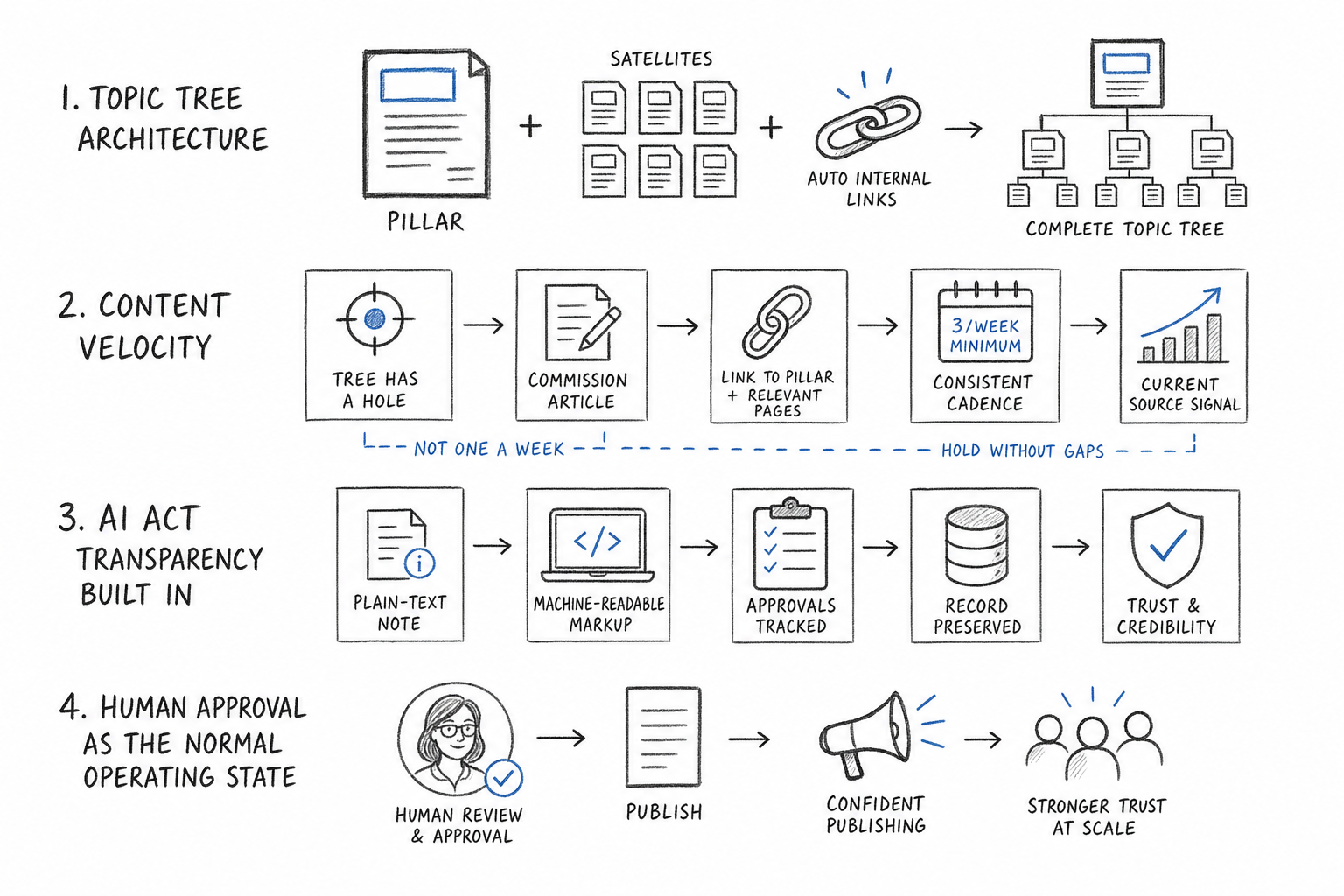
Claiming to be best at everything is how comparison pages lose credibility. Three differentiators hold up; the rest is table stakes.
The topic tree is the product
Pillar plus satellites plus automatic internal links is the architecture, not a feature toggle. Every article is commissioned because the tree has a hole, and every article links to its pillar and, where relevant, to a commercial page. That is why we argue against the common advice that one post a week is a healthy cadence: a tree with forty nodes takes most of a year to fill at that rate, and the first nodes go stale before the last ones exist. Three articles a week is the floor, up to one a day on wide themes, held without gaps. The reasoning behind that number is laid out in why random blog posts rarely rank.
Consistency beats bursts here more than anywhere. Fifteen articles in launch month followed by silence tells a model the site was abandoned. Three a week for twelve months tells it the site is a current source.
AI Act transparency built in rather than bolted on
Every article carries a plain-text transparency note and machine-readable marking, approvals are tracked, and the record exists whether or not anyone ever asks for it. We treat this as a selling point. A company that states plainly how its content is produced reads as more trustworthy, not less — the opposite of the instinct most teams have. The connection between disclosure and perceived credibility is explored in making AI articles read trustworthy.
Human approval as the normal operating mode
Automated publishing with a person who approves is how a company blog should run in 2026. Not a draft queue nobody opens, and not fully unattended publishing either. The review step is where domain knowledge, legal sensitivity and brand judgment enter the pipeline, and it takes minutes per article rather than hours. The case for keeping that step is made in whether a human should always review AI articles before publishing.
What we are not the right answer for
If you need rank tracking dashboards, backlink analysis or technical site audits, this is not that product — pair it with a research suite. If you want a single ghostwritten thought-leadership piece per quarter with heavy founder input, a freelance writer is cheaper and better. If your constraint is one landing page that converts, a blog platform is the wrong purchase entirely.
Honesty about the boundaries is part of the comparison.
Reading the comparison as a scorecard
Having argued the dimensions, here is the same material compressed. Treat each row as a question to put to any vendor during a trial.
| Criterion | What to verify in the trial | Why it decides AI citations |
|---|---|---|
| Topic structure | Is there a pillar-and-satellite plan before article one? | Coverage of a theme is what models read as authority |
| Internal linking | Are links generated from the plan or guessed after? | Connected pages signal a subject owned, not touched |
| GEO formatting | TL;DR, TOC, FAQ with JSON-LD, alt text, clean headings | Gives the model an extractable passage |
| AI Act disclosure | Machine-readable marking and tracked approvals, by default | Obligation applies from 2 August 2026 in the EU |
| Multilingual | One researched project per language, or translation? | Translated keywords miss local search intent |
| Agency management | Several client blogs under one console and one bill | Per-client overhead is the real agency cost |
| Publishing cadence | Can it hold three or more articles a week indefinitely? | Freshness and coverage both compound |
Run that list against two or three candidates during a free trial and the decision usually makes itself within a week. The rows that most buyers skip — disclosure and internal linking — are the two that cost the most to retrofit later.
Choosing by situation rather than by feature count
Feature tables flatten context. Three common situations point in different directions.
A startup with no marketing team
The binding constraint is that nothing gets published. Any platform that connects to WordPress and publishes on a schedule beats a better tool nobody operates. Pick the one that gets to three articles a week fastest and whose approval step fits into a founder’s evening. More on running this without headcount in keeping a blog alive without a marketing team.
An established company with a stalled blog
Here the archive already exists and the problem is incoherence: forty posts about nothing in particular. The right tool is the one that maps what you already have onto a tree, identifies the gaps, and starts filling them while linking old posts into the new structure. Raw generation speed is secondary; planning is everything.
An agency running several client blogs
The question is operational, not editorial. Can one account manager run eight blogs, each with its own language, tree, approval chain and WordPress connection, without eight separate logins and eight separate invoices? If the answer is no, the tool caps how many clients you can serve regardless of how good the articles are.
Takeaway: match the tool to your binding constraint. Buying for a constraint you do not have is the most common way these purchases go wrong.
Frequently asked questions
Does using an SEO AI tool get your site penalised by Google?
Search guidelines target low-value content, not the method of production. An AI-assisted article that answers a real question, is accurate, well structured and reviewed by someone accountable competes normally. Thin, duplicated, unreviewed output underperforms whether a human or a model wrote it. The practical risk is quality and oversight, not the tool itself.
What makes an article likely to be quoted inside an AI answer?
Three things together: the site visibly covers the theme across several linked pages, the specific page answers the question directly near the top, and the formatting lets a model extract a clean passage — a short summary, question-shaped headings, an FAQ block with structured data. Depth without structure rarely gets lifted; structure without depth rarely gets trusted.
When do EU AI Act transparency rules apply to blog content?
The transparency obligations covering AI-generated or substantially AI-modified published content apply from 2 August 2026, under a regulation that entered into force on 1 August 2024. In practice you need machine-readable marking of AI involvement plus a disclosure readers can see. Choosing a platform that produces both automatically removes a recurring manual task.
Is one article per week enough to compete?
For owning a topic, no. A planned topic tree typically needs dozens of pages, and at one a week the earliest pieces age before the structure exists. Three a week is a realistic floor, up to daily on broad themes, held without gaps. Consistency matters more than volume spikes: a steady year beats a loud month.
Should AI-written articles always be reviewed by a person before publishing?
Yes, and the review should be fast. A person checks factual claims, brand positioning, legal sensitivity and anything specific to your market that a model cannot know. That usually takes minutes per article. Tracked approvals also create the accountability record that transparency obligations and client relationships both benefit from.
Can one platform run blogs in several languages properly?
It can, if each language is a separate project with its own keyword research and its own topic tree rather than a translation of the original. Search intent, phrasing and competition differ by market. Translated articles read fine and target the wrong queries, which is why per-language projects outperform translation pipelines.
What should an agency look for that a single business does not need?
Multi-client management: separate projects with isolated settings, per-client WordPress connections, approval chains that can be delegated, consolidated billing, and the option to present output under the agency’s own brand. Without these, every new client adds fixed overhead and the margin on content retainers disappears into administration.
The decision underneath the comparison
Comparing SEO AI platforms on output quality is comparing the same underlying models with different wrappers. The wrapper is where the value sits: whether it plans a structure your site can own, whether it formats pages so an answer engine can quote them, whether it handles disclosure on your behalf, and whether it scales past one blog. A buyer who scores candidates on those four questions will pick well even if the sample articles look identical — and they usually do.
If you want to see what a planned topic tree looks like for your business before committing to anything, start with the research step and see the structure proposed for your site.
This article was produced and published automatically with the help of artificial intelligence.
Start today
A blog like this, on your site
This article was written and published by RankGrove, with the method you read about on the site. Try it free on your WordPress: the first article lands in your drafts within ten minutes.
Start free trial