Generative Engine Optimization (GEO) & AI Search
SEO AI: Why You Never Appear in Google AI Overviews

Ranking first and getting cited in an AI Overview are two different competitions, judged on different signals. Generative answers pull from pages that sit inside a dense, interlinked body of content on the same theme, expose clear machine-readable structure, and answer the whole cluster of related questions — not just the one query. This article names the specific structural elements missing from a page that ranks well and still never gets quoted.
You check the keyword. Position one, featured snippet some days, steady clicks. Then you ask Google the same question in AI mode, or type it into an assistant, and the answer cites three other companies. None of them outrank you. One of them has a domain you had never heard of.
This is the most common complaint we hear about seo ai work right now, and the frustration is legitimate: the page won the ranking competition and lost a different one. Classic ranking answers a narrow question — which document best matches this query. Generative answers ask something broader: which sources can I assemble a multi-part answer from, with enough confidence to attribute a claim to them by name. A single strong page rarely qualifies, because the system is not picking a winner, it is picking material it can stitch together and credit.
That distinction has structural consequences, and they are the subject of this article. We cover why thin topical coverage disqualifies a strong page, which entity signals let a machine be confident about who you are, what structured data and summary blocks actually change in extraction, and how internal linking either proves or fails to prove topical depth. The general mechanics of getting cited by generative systems are covered in our pillar on Generative Engine Optimization and how to get cited by ChatGPT, Google AI and Perplexity; here we stay narrow and diagnostic.
Contents
- Why ranking first and getting cited are two different competitions
- Thin topical coverage: one article cannot carry a theme
- Which entity signals make a machine confident about who you are
- Structured data, TL;DR blocks and FAQ markup: what actually changes extraction
- How internal linking proves topical depth instead of just spreading authority
- A diagnostic checklist for pages that rank but never get cited
- Frequently asked questions
- What to do with this
Why ranking first and getting cited are two different competitions
A ranked result is a destination. A cited source is an ingredient. That single difference explains most of the confusion.
When a generative system builds an answer, it decomposes the question into parts. Ask it about pricing for a service and it will want the price range, the variables that move the price, the typical contract length, what is included, and how it compares to the alternatives. It then looks for passages it can lift for each part, preferably from sources that cover several parts at once. A page that nails one part and says nothing about the other five is usable for one sentence and ignorable for the rest.
Retrieval also runs on passages, not documents. The unit of selection is a paragraph or a block, scored on whether it answers a sub-question cleanly and on its own. A paragraph that only makes sense after reading the three paragraphs above it is a paragraph that cannot be extracted. Your page may rank because the whole document is strong; it goes uncited because no single block inside it stands alone.
Then there is the confidence problem. Attributing a claim by name is a commitment, and systems hedge toward sources they can identify and corroborate. If your company appears once, on one page, with no corroborating content elsewhere on your own site and no consistent naming across the web, the safer choice is to cite someone the system recognises. Strong rank does not resolve that hesitation.
The practical takeaway: stop treating the ranked page as the finished asset. Treat it as one node that needs neighbours, internal structure, and identity signals around it.
Thin topical coverage: one article cannot carry a theme
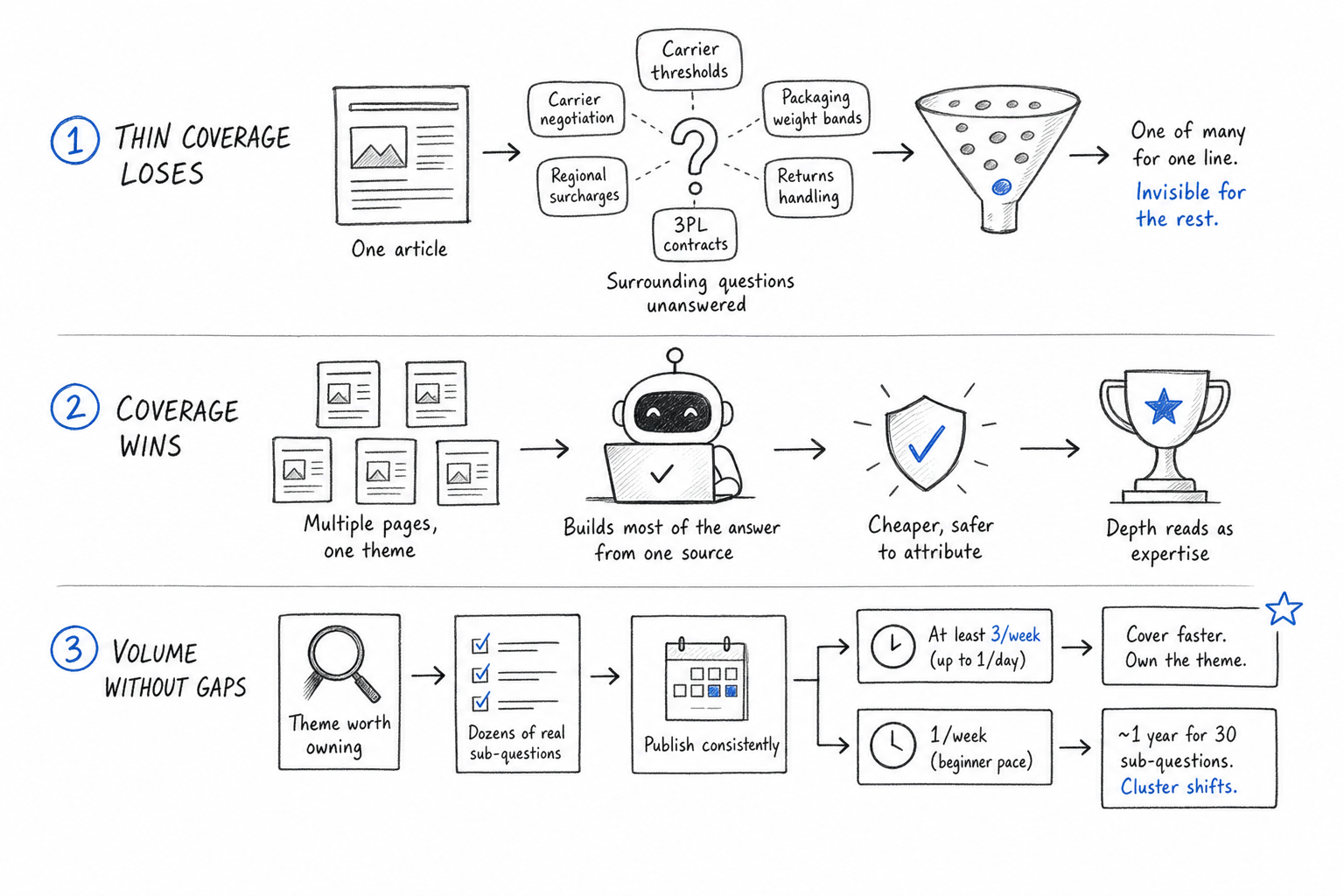
This is the single biggest reason a page-one page never gets quoted, and it is structural rather than qualitative. The article can be excellent and still lose.
The surrounding cluster of questions goes unanswered
Take a query like how to reduce shipping costs for a small retailer. A good ranking article answers exactly that. The generative answer, though, will pull in carrier negotiation thresholds, packaging weight bands, returns handling, regional surcharges, and when a third-party logistics contract starts making sense. If your site has one page on the headline question and nothing on the adjacent five, you are one source among many for one sentence, and invisible for the rest of the answer.
Coverage is what turns a site from a candidate into a default. When a system finds four or five pages on the same domain, each handling a different facet, it can build most of the answer from one place — and single-source answers are cheaper and safer to attribute. Depth on a theme reads as expertise to a machine in a way that a single article never can.
Volume without gaps is what builds coverage
Building that depth is an arithmetic problem before it is a creative one. A theme worth owning has dozens of real sub-questions, and each needs its own extractable page.
A blog that intends to own a topic publishes at least three articles a week, up to one a day on the widest themes. Anything slower is a beginner’s cadence: at one a week you need most of a year to cover thirty sub-questions, and the cluster will have shifted underneath you before you finish. Reason in weeks, not in months — monthly counts flatter a schedule that is too slow to compete.
Continuity matters as much as the number. Three a week held for a year beats fifteen in a launch month followed by silence, because a site that stops publishing stops reading as a live source. Sustaining that rhythm is why automated publishing with human review is now the normal way to run a company blog: a system that drafts, illustrates and publishes on schedule, with a person who approves each piece before it goes out. That is an operating model, not a shortcut — and every piece produced with AI assistance says so in plain text and in structured data, which is both what the AI Act requires and a trust signal worth having. We go deeper into cadence in our analysis of how many blog posts a small business actually needs.
Pick one theme, list every question a buyer asks around it, and count. If the list is thirty questions and your calendar produces four a month, the calendar is the problem.
Which entity signals make a machine confident about who you are
Generative systems reason about entities — named things with attributes and relationships — before they reason about documents. If your company is not a resolvable entity, it is a string of text the system would rather not put in quotation marks.
Consistent naming and a single canonical description
Entity resolution fails on ambiguity. The legal name in the footer, the trading name in the title tags, an abbreviation in the author bios, a different formulation in the about page: each variant is a separate candidate to a machine trying to decide who is speaking. Fix one name, one description, one category of what you do, and repeat it identically everywhere.
This is unglamorous and it moves the needle more than most on-page work. A company that describes itself three different ways is three weak entities instead of one credible one.
Organization and author markup that connects the page to the entity
Structured data is where you state, in machine-readable form, that this article was published by this organization and written by this person, and that the person has this expertise. Without it, the system infers. Inference under uncertainty produces hedging, and hedging produces a generic answer with no names in it.
The markup that matters here is the organization schema on your site, author schema on articles, and consistent linkage between them. It costs a developer an afternoon and it changes whether your name is available to be cited at all.
Corroboration across your own site
One page claiming expertise is an assertion. Fifteen pages on the same theme, cross-linked, published under the same author and organization, is a pattern. Systems weight patterns. This is also where topical coverage and entity strength reinforce each other: the cluster proves the entity, and the entity makes the cluster citable.
Audit your own naming this week. It is the cheapest fix on this list and it blocks everything else until it is done.
Structured data, TL;DR blocks and FAQ markup: what actually changes extraction
Formatting is not cosmetic in generative retrieval. It determines whether a passage can be lifted with confidence.
A summary block gives the system a pre-extracted answer
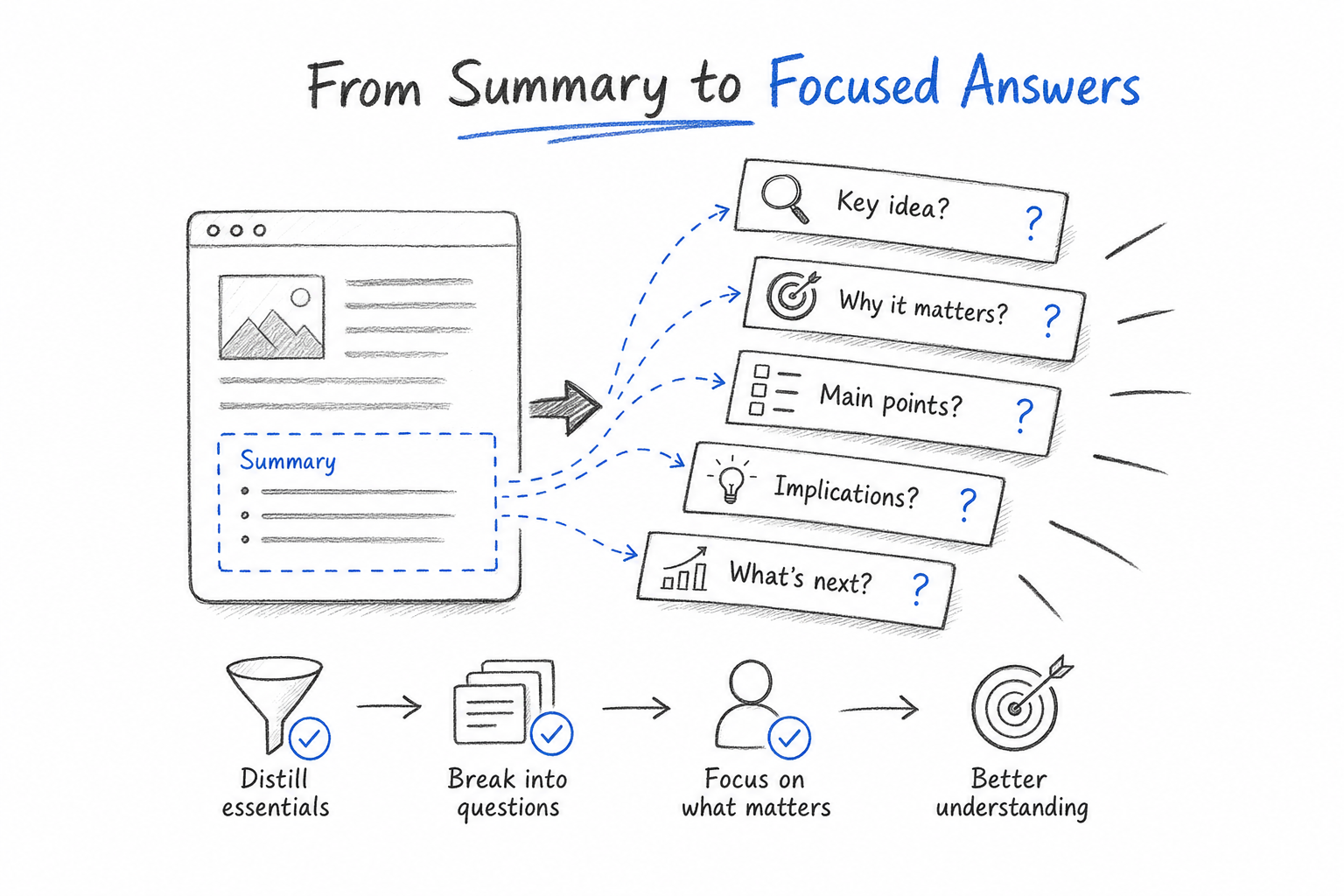
A short, self-contained summary at the top of an article — two or three sentences that state the conclusion before the argument — is the block most likely to be quoted. It requires no context, it contains the claim, and it is easy to attribute. Pages that bury the conclusion in paragraph nine force the system to do the summarising itself, which it will do using a source that did the work for it.
The same logic applies section by section. Open each section with the point, then support it. Extractability is a writing decision, not a plugin.
FAQ with JSON-LD turns questions into addressable units
An FAQ section marked up with JSON-LD does something specific: it declares, in machine-readable form, that this exact question has this exact answer on this page. That is the cleanest possible mapping between a sub-question and a citable passage. A prose paragraph containing the same information has to be found, parsed and trusted; a marked-up FAQ item arrives pre-labelled.
The questions have to be real ones, phrased the way people ask them, and the answers have to be complete in forty to eighty words. Marked-up filler gets ignored like any other filler.
Alt text and headings as semantic scaffolding
Headings tell a system what each region of the page is about, which is how it decides which region answers which sub-question. Vague headings — overview, key concepts, our approach — describe nothing and make the whole document one undifferentiated blob. Question-shaped headings map directly onto the sub-questions a generative answer decomposes into.
Alt text and other technical fundamentals do the same job for non-text elements. Our guide to technical on-page SEO for headings, meta tags and alt text covers the implementation detail.
Rewrite your headings as questions and put a summary block at the top of your five most important articles. Both changes take an hour and change what is extractable.
How internal linking proves topical depth instead of just spreading authority
Internal links have a second job in generative retrieval, separate from the link-equity story most people know. They tell the system which pages belong to the same theme.
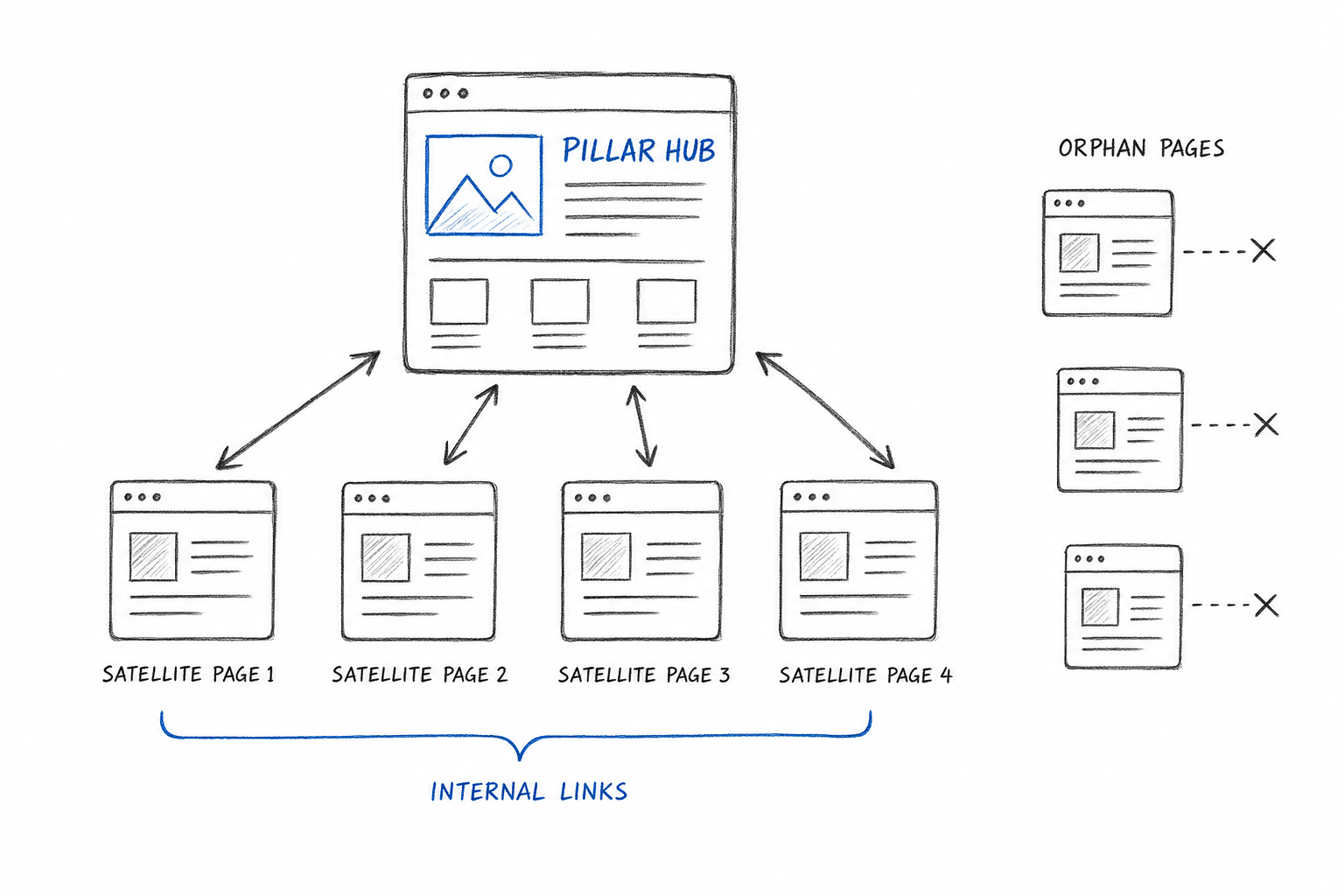
A pillar article that links out to fifteen satellites, each linking back, is a declared map: here is the theme, here are its parts, here is how they relate. A machine crawling that structure can see the shape of your coverage without having to infer it from text similarity alone. The same fifteen articles, published with no links between them, are fifteen unrelated pages that happen to share vocabulary.
Orphan pages are invisible depth
Pages with no internal links pointing at them are the most common waste in company blogs. They exist, they may even rank for a long-tail query, and they contribute nothing to the topical signal because nothing connects them to the theme. If you have been publishing for two years without a linking discipline, you probably have dozens.
Anchor text as a topical label
The anchor text you use to link internally is a label you are applying to the destination. Generic anchors like read more or click here label nothing. Descriptive anchors that name the sub-topic tell the system what the destination page covers, which is exactly the signal that helps it decide whether that page answers a sub-question. Our piece on whether pillar and supporting pages need internal links works through the mechanics.
Maintaining this by hand across a growing blog is where most teams quietly give up. Every new article should be linked from the pillar, from two or three relevant siblings, and out to the pages that sell — which means revisiting older articles every time you publish. At three articles a week, that is a permanent editorial task, and it is why we build the linking into the publishing step rather than leaving it as cleanup. The structured content and internal linking features exist precisely because manual link maintenance fails at volume.
Run a crawl and list your orphan pages. Linking them into the relevant cluster is the highest-return hour of work available on most established blogs.
A diagnostic checklist for pages that rank but never get cited
Having walked through the causes, here is the compressed version to run against a specific page. Take the article you are frustrated about and check each row honestly.
| Symptom | Likely cause | Action |
|---|---|---|
| Cited for nothing, ranks well | Single page on the theme | Publish satellites on the adjacent questions |
| Company name never appears | Weak entity signals | Unify naming, add organization and author schema |
| Answer paraphrased, no attribution | No extractable summary block | Add a self-contained TL;DR at the top |
| Competitors quoted on sub-questions | Cluster of related questions unanswered | Map the sub-questions, one article each |
| Long article, one sentence used | Paragraphs depend on prior context | Rewrite openings so each block stands alone |
| Depth exists but goes unrecognised | Orphan pages, generic anchors | Link every article to pillar and siblings with descriptive anchors |
| Visibility flat after a strong start | Publishing stopped | Return to at least three a week, held without gaps |
Most pages fail on three or four rows at once, which is why single fixes rarely change the outcome. The rows compound: coverage makes the entity credible, the entity makes the passage citable, the structure makes it extractable, and the linking makes the whole thing legible as one body of work. For the wider picture of what decay does to an established blog, see what happens to organic performance when you stop posting.
Frequently asked questions
Why does my page rank first but never appear in Google AI Overviews?
Ranking answers one query; a generative answer assembles several sub-answers from sources it can identify and quote. A page usually fails because it is the only page on your site covering that theme, its paragraphs need surrounding context to make sense, or your organization is not a resolvable entity the system feels safe attributing a claim to.
How many articles do I need on a topic before AI systems treat my site as a source?
Think in sub-questions rather than a fixed number: list every question buyers ask around the theme and give each one an extractable page. In practice that means dozens, which is why the working cadence is at least three articles a week, up to one a day on the widest themes, held without gaps.
Does FAQ schema markup actually help with AI citations?
It helps because it declares a machine-readable mapping between a specific question and a specific answer on your page, which is the cleanest unit a generative system can pick up and attribute. The markup only works with real questions and complete forty-to-eighty-word answers; marking up filler changes nothing.
What is a TL;DR block and why do generative systems favour it?
It is a short summary at the top of an article that states the conclusion in two or three self-contained sentences, before any argument. Retrieval works on passages, so a block that carries the full claim without needing prior context is the easiest thing on the page to lift and credit to you.
Can internal linking influence whether AI answers cite my site?
Yes, because links declare which pages belong to the same theme rather than leaving the system to infer it. A pillar linking to satellites that link back makes your coverage legible as one body of work. Orphan pages and generic anchors like read more contribute nothing to that signal.
Do I need to disclose that articles were written with AI assistance?
Yes, in plain text and in structured data. Transparency marking for machine-generated content is an AI Act requirement, and disclosure has never been the reason a page failed to get cited. Automated publishing with human approval is the standard way company blogs run in 2026, and saying so openly is a trust signal.
Where should I start if my blog ranks well but is never quoted?
Start with three things in order: unify how your company names and describes itself and add organization plus author schema; add a self-contained summary block and question-shaped headings to your top pages; then map the sub-questions around your main theme and publish a satellite for each, linking them into the pillar.
What to do with this
The gap between ranking and being cited is not a content quality gap — it is a structural one, and it closes when a theme is covered in depth, published under one recognisable entity, formatted so individual passages can be lifted, and linked so the coverage is visible as a single body of work. One excellent article cannot satisfy four conditions at once.
If you want to see how a topic tree gets planned and maintained at that cadence, with transparency marking built in, take a look at how we research and structure a cluster.
This article was produced with the help of artificial intelligence and reviewed by our editorial team before publication.
Start today
A blog like this, on your site
This article was written and published by RankGrove, with the method you read about on the site. Try it free on your WordPress: the first article lands in your drafts within ten minutes.
Start free trial