Company Blog Strategy & Automation
How Many Blog Posts Per Month Does a Small Business Need for SEO

For most small businesses, three well-made posts a week — a dozen or more a month — is the point where a blog holds a niche and starts behaving like a search asset instead of a side project. Broad, competitive sectors pay off with five or more a week, and on the widest topics daily publishing is what pays best. What decides the outcome is whether the same cadence is still running in month nine, far more than the peak volume in month one.
“How many blog posts per month?” is almost never a curiosity question. People search it when they are staring at a quote from an agency, at a freelancer’s rate card, or at the calendar of a team that already has no spare hours. The real question underneath is what is the smallest commitment that still produces results — and, increasingly, whether that commitment can be handled by automated seo optimization rather than by someone in the company who already has a full job.
The honest answer has a range, and the range depends on variables you can actually check: how competitive your keywords are, how much content your site already has, how large the topic space in your sector is, and whether you are chasing classic organic rankings, citations inside AI-generated answers, or both.
This article gives you the numbers and the reasoning behind them. You will see what monthly, weekly, several-a-week and daily cadences realistically produce in terms of time-to-traction and crawl behaviour, which factors shift the threshold up or down, and why an uninterrupted cadence outperforms a burst followed by silence. If you want the wider picture — why blogs stall, what that costs over time, and how to structure the whole thing — that belongs to the broader discussion of company blog strategy. Here we stay on the number.
Contents
- What “enough posts per month” actually means for a search engine
- Comparing cadences honestly, from monthly to daily
- Which variables move the number up or down
- Why consistency outperforms volume
- Making the cadence a decision instead of an aspiration
- Frequently asked questions
- The number that matters is the one you are still hitting next year
What “enough posts per month” actually means for a search engine
There is no threshold in any search engine that flips a switch at a given number of articles. What exists is a set of consequences that follow from publishing regularly, and those consequences are what people are really buying when they ask about frequency.
Coverage: the number of questions your site can answer
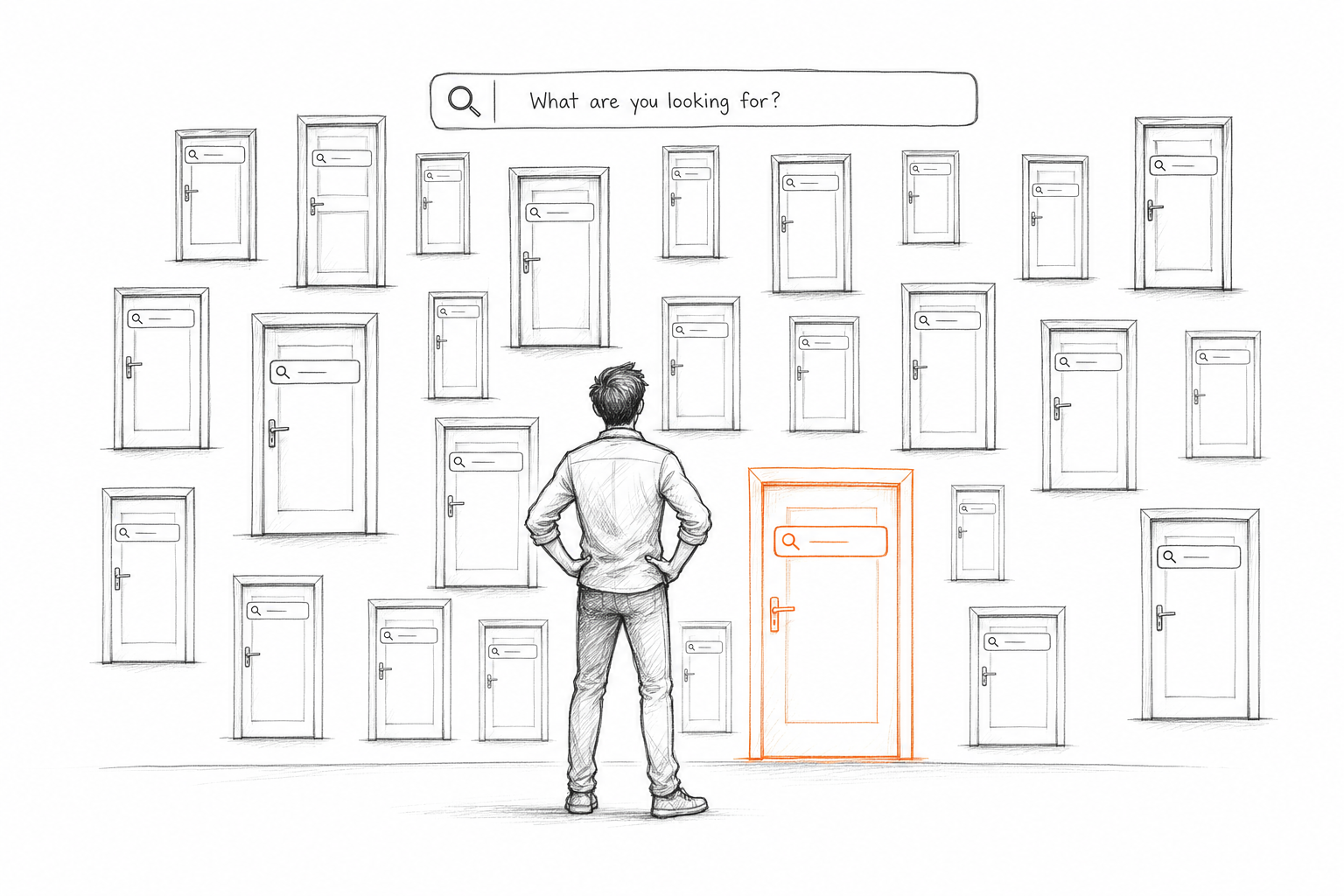
Every article is a door. A site with twelve articles can be found for a handful of query variations; a site with sixty covering one coherent theme can be found for hundreds, including the long, specific phrasings that convert best. Coverage compounds — and coverage is a direct function of how many pieces you publish over how long.
This is why the monthly number matters less than the annual one. Three posts a week is about a hundred and fifty in a year. One a week is fifty-two. The gap looks small in any single week and enormous after eighteen months.
Crawl behaviour: how often a bot bothers to come back
Search engines allocate attention. A site that changes rarely gets revisited rarely; a site that publishes something new several times a week trains crawlers to check in more often. That does not “boost rankings” by itself, but it shortens the delay between publishing and being indexed — which matters enormously when you are trying to build momentum in year one.
Topical authority: being the site that keeps talking about one thing
Search systems, and the AI models that summarise them, favour sources that demonstrate sustained depth on a subject rather than scattered one-offs. Ten articles that circle the same theme from ten angles read very differently, to both a human and a machine, than ten articles about ten unrelated things. Cadence is what lets you build the theme out fast enough to be recognised as its owner.
Takeaway: the number you pick is really a decision about how quickly you want coverage, crawl frequency and topical depth to accumulate.
Comparing cadences honestly, from monthly to daily
Below is the practical difference between the cadences small businesses actually consider. These are structural expectations, not guarantees — search outcomes depend on competition, site history and content quality, and anyone promising you rankings on a schedule is selling something.
| Cadence | What it realistically produces | Where it breaks down |
|---|---|---|
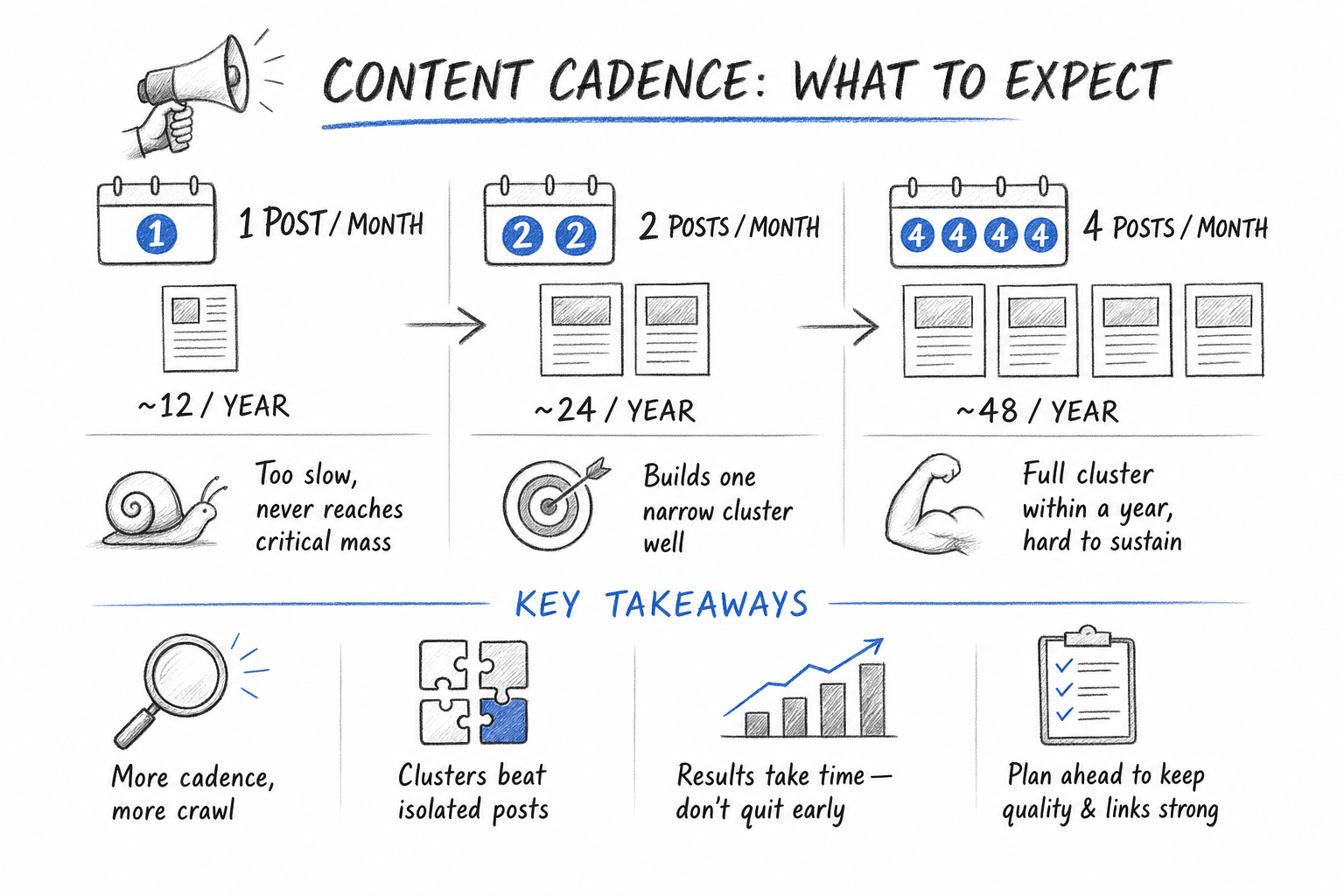
| 1–2 posts/month | 12–24 articles a year; a slow trickle of long-tail entries | Too thin to cover a topic cluster; crawlers revisit rarely; results arrive so late that motivation dies first |
| 1 post/week | 52 a year; enough to build one narrow cluster properly | Enough only in very quiet niches with a small topic space |
| 3+ posts/week (about 13 a month) | ~150 a year; a full cluster, its supporting articles and room for more themes within 12 months | Hard to sustain manually — this is where most in-house blogs quietly stop |
| Daily (about 30 a month) | ~365 a year; fast coverage of broad and competitive topics | Quality and internal linking degrade quickly unless the plan is structured in advance |
One or two posts a month
One or two articles a month is a legitimate choice only in a very quiet niche where competitors publish nothing. Everywhere else it produces a site that looks maintained and stays below critical mass. The bigger problem is psychological: with twelve to twenty-four pieces a year, meaningful traffic movement can take so long that the project gets cancelled before the evidence arrives.
One post a week
Fifty-two articles a year is enough to cover one narrow theme thoroughly — a single service, a single buyer question set — if every piece is planned to fit together. It is a reasonable floor for a business with a specific offer and a very small keyword universe. It falls short as soon as you sell three different things to two different audiences, or compete on terms other sites already cover well.
Three or more posts a week
Three well-made articles a week is the cadence where a blog holds a niche and starts to behave like infrastructure. Within a year you can build a pillar article, the full set of supporting pieces around it, and a second and third theme. Crawlers settle into a rhythm. Internal linking has enough nodes to actually mean something. This is the point where the blog stops being a cost line and starts being an asset, and it is why three a week is the default cadence worth defending. Broad, competitive sectors pay off with five or more.
Daily publishing
On the widest topics daily publishing is what pays best, but only when the plan exists first. Publishing thirty unplanned articles a month produces overlap, cannibalisation between pages targeting the same query, and an internal link structure nobody can maintain. Volume without a topic map is expensive noise. It is also why RankGrove publishes at most one article a day per site: consistency beats volume.
Takeaway: if you can only commit to one number, commit to three a week and hold it. If you cannot hold three, hold what you can for twelve months rather than doing ten a week for a quarter and nothing after.
Which variables move the number up or down
The three-a-week benchmark is a starting point. Four factors legitimately shift it.
Keyword competitiveness
If your queries are contested by large publishers with deep archives, you need more coverage to be visible at all, and you need to attack the specific, lower-volume phrasings first. In a technical B2B niche where the competing content is thin and outdated, fewer, better articles can outperform a larger volume of generic ones.
The size of your existing site
A site that already has eighty relevant pages has authority to lend to new content; new articles get indexed and evaluated faster. A brand-new domain with six pages is starting from zero and needs both more content and more patience. Realistically, a new site should expect the first meaningful movement over a horizon measured in several months, not weeks — and the cadence has to survive that entire waiting period.
How wide your topic space is
Count the genuine questions your customers ask before buying. If there are fifteen, three articles a week cover them in five weeks, and the plan moves on to the supporting questions around them. If there are a hundred and twenty — common in regulated, technical or multi-product sectors — three a week cover the space within a year, and daily publishing gets there in four months.
Whether you are optimising for search results or AI answers
Being cited inside AI-generated answers rewards slightly different things: unambiguous definitions, structured summaries, tables of contents, FAQ blocks marked up so machines can parse them. Generative engine optimisation rewards fresh content and demands that each piece is structured, and a haphazard cadence makes that structure impossible to maintain across a growing archive.
Takeaway: count your buyer questions and check who currently answers them. That count, spread over the months you are willing to wait, gives your real number, and in most sectors it lands at three a week or more.
Why consistency outperforms volume
The most common failure pattern in small business blogging is not publishing too little. It is publishing eight articles in six weeks, then nothing for five months.
That pattern hurts twice. Crawlers recalibrate downward, so when you eventually return, the delay between publishing and indexing stretches again. And a visitor who lands on an archive where the newest post is from last spring reads it as a signal about the company, not about the blog — the same way an unattended shopfront reads.
Steady cadence also produces something less obvious: a plan that can be corrected. When you publish several times a week, you get feedback every few weeks about which topics attract impressions and which fall flat, and you can redirect the next month’s articles accordingly. When you publish in bursts, you spend the plan before you learn anything from it.
The real cost of holding a cadence manually
It helps to put a number on it. Suppose an internal marketing person costs the company around 40,000 euros a year fully loaded, and suppose a decent researched article takes five hours end to end — briefing, drafting, editing, uploading, internal links, meta fields. On roughly 1,600 working hours a year, that is about 25 euros an hour, so each article costs somewhere in the region of 125 euros of internal time, and three a week — about thirteen a month — costs around 1,600 euros a month plus whatever else that person is not doing meanwhile. Those are illustrative figures with the assumptions stated — swap in your own salary and hours and the arithmetic still holds. The point is that a steady cadence has a real cost: at three a week it takes roughly half of that person’s working time, which is exactly why the cadence collapses in month four.
Making the cadence a decision instead of an aspiration
Once you accept that three a week is the target, the question changes from how many to how do we make sure it still happens in month nine. Three things decide that.
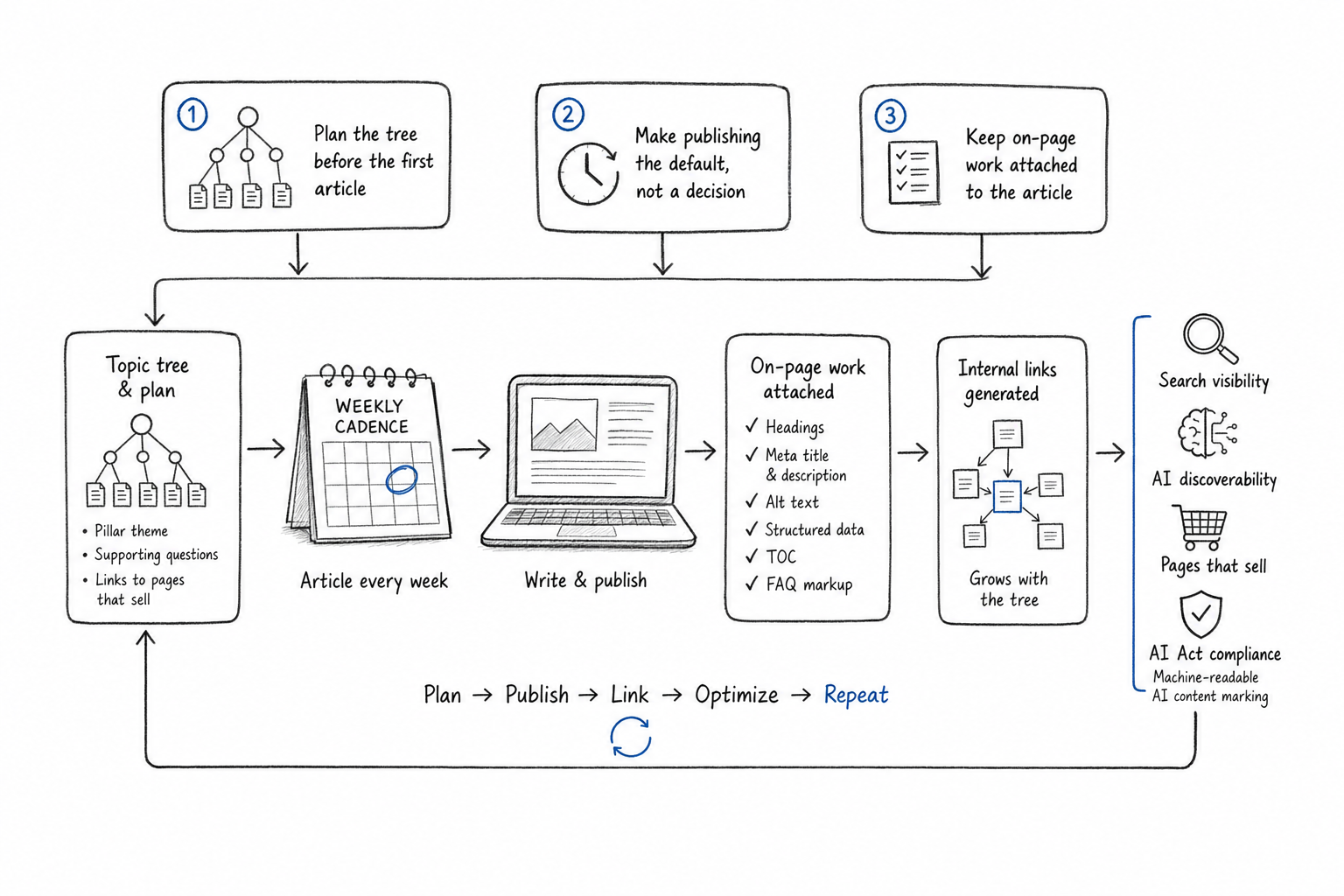
Plan the tree before the first article
Decide the pillar theme, the supporting questions around it, and how they link to each other and to the pages that actually sell. When the plan exists in advance, no one has to invent a topic on a Monday morning, and internal linking follows the structure instead of being retrofitted.
Make publishing the default, not a decision
Anything that requires a human to decide “shall we publish this week” eventually resolves to no. The cadence has to run unless someone stops it, rather than run only when someone starts it.
Keep the on-page work attached to the article
Headings, meta title and description, alt text, structured data, table of contents, FAQ markup — these are what turn a decent article into a page that search engines and AI systems can use. When they are a separate manual chore, they are the first thing dropped under pressure. Automated seo optimization earns its place precisely here: it applies the same technical standard to every piece, at week one and at week forty.
This is the logic behind publishing on autopilot: a planned topic tree, up to one article a day on the days you choose, internal links generated as the tree grows, and the on-page and transparency requirements — including machine-readable marking of AI-generated content under the AI Act — handled as part of the process rather than as an afterthought. If you want to see how that cadence is set up and supervised in practice, see how it works.
Frequently asked questions
How many blog posts per month does a small business need for SEO?
Three well-made posts a week — a dozen or more a month — is the practical benchmark to hold a niche. It produces around a hundred and fifty articles a year, enough to cover a topic cluster properly, keep crawlers returning regularly and build internal linking with real depth. Broad, competitive sectors pay off with five or more a week, and on the widest topics daily publishing is what pays best.
Is it better to publish one long article or four short ones per month?
Four well-researched articles that answer four distinct buyer questions generally outperform one long piece covering the same ground, because they can rank for separate queries and link to each other. Length matters only insofar as it lets you answer a question completely. A thin article helps nobody, however often it is published; a complete one answering a specific question does.
How long before blog posts start bringing traffic?
On an established site with existing authority, individual articles can gain impressions within weeks. On a new domain, meaningful movement typically takes several months of consistent publishing before the pattern becomes visible. The cadence has to survive that entire waiting period, which is why sustainability matters more than the volume you manage in the first month.
Does publishing more often improve crawl frequency?
Yes, indirectly. Search engines revisit sites in proportion to how often they find something new. A site publishing several times a week gets checked more frequently than one publishing quarterly, which shortens the delay between publishing and indexing. It does not create rankings by itself, but it removes a bottleneck that slows momentum during the first year.
What happens if we stop publishing for a few months?
Existing articles keep their positions for a while, so the damage is not immediate. What degrades is crawl frequency, the pace at which you add coverage, and the impression the archive gives visitors when the newest post is months old. Restarting also means rebuilding the crawl rhythm, so the pause costs more than the missed articles alone.
Does the number of posts change if we want to be cited by AI assistants?
The volume requirement is similar, but the structural requirement rises. Generative engines favour content with clear definitions, summaries, tables of contents and FAQ sections marked up in a machine-readable way. That structure has to be applied consistently across the whole archive, which is harder to maintain manually as the number of published articles grows.
Can automated seo optimization replace a content strategy?
No — it executes one. The topic tree, the pillar themes and the pages you want traffic to reach still have to be decided. What automation reliably handles is the part that fails manually: keeping the cadence, up to one article a day, applying the same on-page standard to every article, generating internal links as the archive grows, and documenting AI-generated content for transparency obligations.
The number that matters is the one you are still hitting next year
Three posts a week is the benchmark worth aiming at, and it is meaningful as an annual commitment: a hundred and fifty articles built around a planned topic structure will outperform the same number published in one enthusiastic quarter and then abandoned. Count your buyer questions, check who currently answers them, pick the cadence you can genuinely hold — and then remove every point in the process where a human has to choose to publish.
Start today
A blog like this, on your site
This article was written and published by RankGrove, with the method you read about on the site. Try it free on your WordPress: the first article lands in your drafts within ten minutes.
Start free trial