Company Blog Strategy & Automation
Automated SEO Optimization: What It Does and When It Works

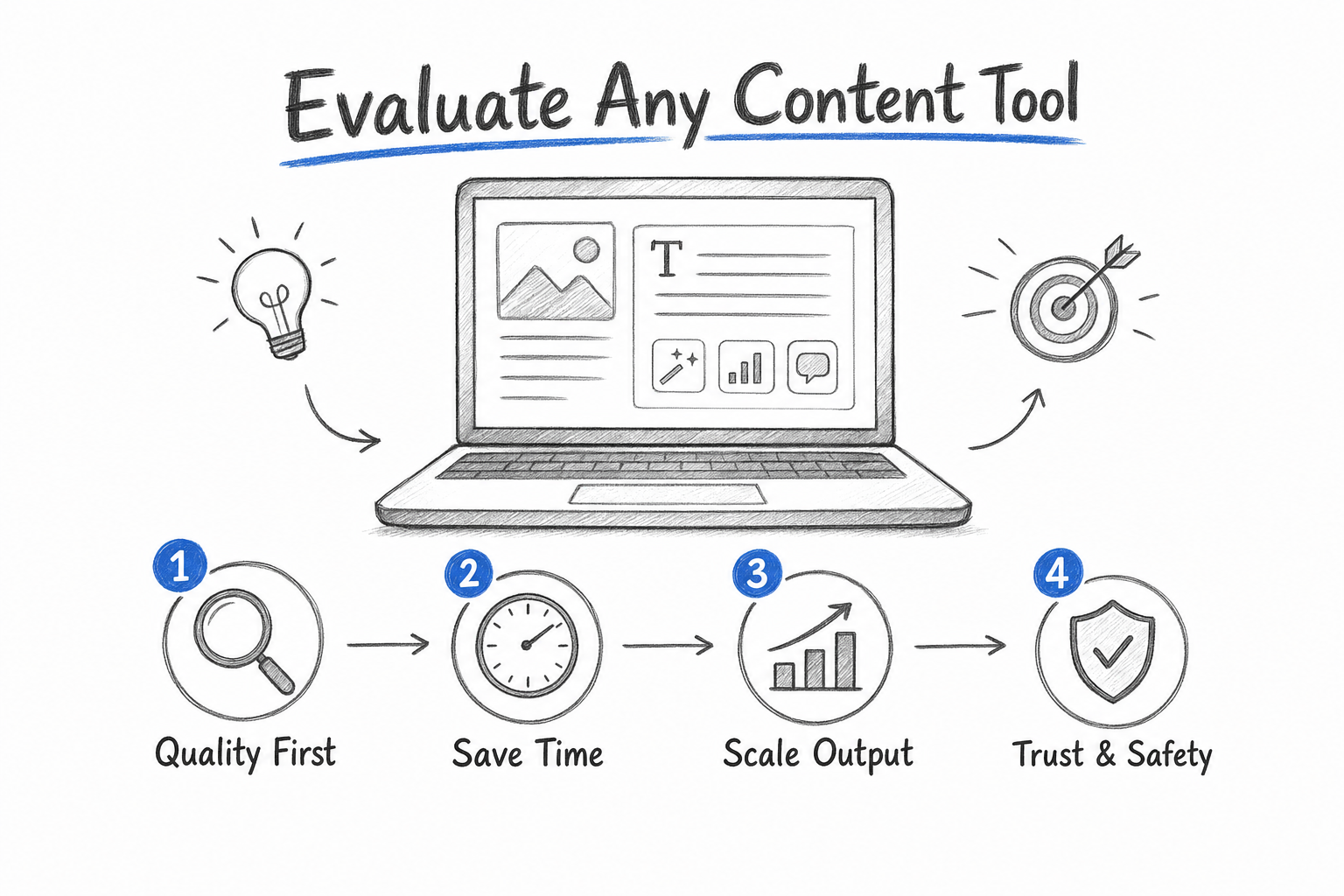
Automated SEO optimization is the part of blog work a machine can repeat correctly every time: topic planning, heading and metadata structure, internal links, publishing. What it cannot replace is your judgment on what is true about your business. The difference between a structured system and a generic article generator is visible in four places: whether it plans a topic tree, whether it links articles to each other and to pages that sell, whether it publishes on its own, and whether it declares AI involvement in plain text and structured data.
If you run a business and someone tells you a machine can write your blog, your first instinct is probably correct: most of what gets sold under that promise is junk. Text that reads fine and says nothing. Fifty articles that repeat the same four paragraphs with different adjectives. Content that no one asked for, answering questions no customer has.
That instinct is worth keeping. But it describes a category of tools, not a category of work. Automated SEO optimization covers a specific set of repeatable tasks — keyword mapping, heading hierarchy, metadata, internal linking, scheduling, structured data — that have measurable right and wrong answers. Those tasks are exactly where machines outperform a busy human doing them at 7pm on a Friday. The part that needs you is narrower than vendors admit and more important than they let on.
This article does three things. It defines what gets automated and what does not. It gives you four concrete tests to tell a structured system from a text generator, the kind you can apply during a free trial without being technical. And it describes the compliance side, because in Europe published AI-assisted content now carries transparency obligations that a serious tool handles for you. If you want the wider frame first, the company blog strategy guide covers how the whole system fits together.
Contents
- What automated SEO optimization actually automates
- Four tests that separate a structured system from a text generator
- How a structured system works, step by step
- The AI Act side: why transparency is an asset
- A checklist for evaluating a tool during the trial
- Frequently asked questions
- What to do with this
What automated SEO optimization actually automates
Automated SEO optimization is the systematic execution of the structural and technical parts of content publishing — topic planning, on-page markup, internal linking, scheduling — by software, with a human approving what goes live. That definition rules out two things people assume it includes: it does not mean nobody reads the article before publication, and it does not mean the software invents your expertise.

Think about what producing one blog article actually involves. Deciding what topic it should cover and whether you already covered it. Checking how people phrase the question in search. Writing it. Giving it a title, a meta description, an H1, a sensible heading tree. Adding alt text to images. Linking it to the three other articles on your site that relate to it, and to the page that sells the relevant service. Adding structured data so search engines and AI assistants can parse it. Scheduling it. Publishing it to WordPress without breaking the layout.
Of that list, exactly one step requires knowing your business: the substance of what you claim. Everything else is procedure. Procedure is where consistency beats talent — a mediocre internal link placed every single time beats a brilliant one placed once a quarter.
The tasks machines do better than you
Metadata is the clearest case. A meta description has a character budget, needs the keyword, and needs to be a complete sentence. You will get this right when you are focused and wrong when you are rushed. Software gets it right at the same rate on article one and article three hundred.
Internal linking is the second. Most small-business blogs have a link graph that looks like a pile of leaves: every article sits alone, reachable only from the archive page. A machine that knows which articles exist and what each covers can place contextual links in both directions as new pieces appear — and can go back and link older articles to newer ones, which almost nobody does manually.
The third is cadence. A blog that publishes when someone remembers is a blog that stops. Software does not forget, does not go on holiday, and does not deprioritise the blog when a big client calls.
The judgment that stays with you
What the machine must never decide is what is true about your work. Prices, turnaround times, guarantees, technical claims about your process, anything a customer could hold you to. This is why approval before publication is the structural safeguard, not an optional extra. A review pass of a few minutes per article — reading for factual claims, not for commas — is what turns generated text into content you can stand behind.
The practical takeaway: automate the procedure, keep the claims. If a tool asks you to trust it with claims, it is selling you the wrong thing.
Four tests that separate a structured system from a text generator
Here is where the skepticism pays off. Most tools in this space do one thing: you type a keyword, it returns an article. That is a text generator. It is useful the way a calculator is useful, and it produces exactly the blog you are afraid of — a pile of unrelated pages with no architecture.
A structured system is defined by what it does around the writing. Four tests, all of which you can run during a trial.
Does it plan before it writes?
Ask the tool what it intends to publish over the next three months. If the answer is “whatever keyword you type”, you are holding a text generator. A structured system builds a topic tree: one pillar article that owns a broad theme, a set of supporting articles that each answer one specific question inside that theme, and a map of how they connect.
The reason this matters is how search engines and AI assistants assess authority on a subject. One good page about a topic is an opinion. Twenty connected pages covering the question from every angle is a body of work. The second is what gets recommended when someone asks an AI assistant for a supplier in your sector.
Does it link articles to each other and to the pages that sell?
Open an article the tool produced. Count the internal links. Then check where they go. If every link points to another blog post and none points to a service or product page, the blog is a reading room with no exit.
The links that matter commercially are the ones that move a reader from “I understand my problem” to “here is who solves it”. A system that knows your site structure places those automatically, in context, where the argument naturally leads there. A generator does not know your service pages exist.
Does it publish, or does it hand you a document?
This is the test most people skip and most regret. A tool that produces a Word file has automated about forty percent of the job. Someone still has to paste it into WordPress, fix the formatting, set the featured image, write the alt text, check the slug, and hit publish. That someone is you, every time, forever — and it is the step that gets dropped first when the week is busy.
A system that connects directly to your site and publishes on schedule removes the failure point. Your job shrinks to reading and approving.
Does it declare AI involvement, in text and in code?
A tool that quietly generates content and says nothing is handing you a compliance problem and calling it a feature. More on this below, but the short version: transparency should be built in, not something you bolt on later.
Run these four tests and the market sorts itself out fast. Most offerings fail at least two.
How a structured system works, step by step
Understanding the mechanics makes the output easier to judge. The sequence below is what distinguishes planned publishing from keyword-by-keyword generation.
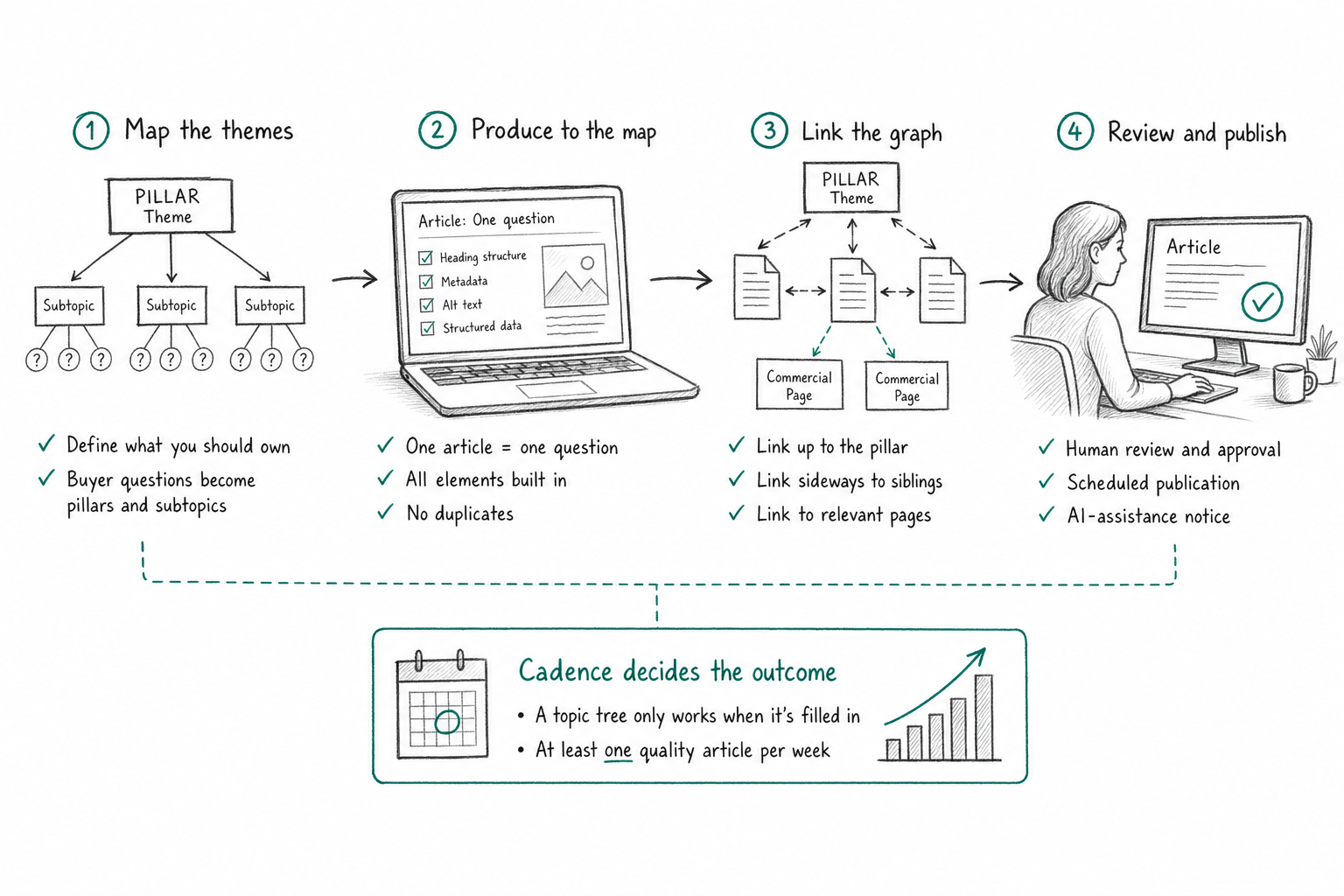
It starts with the map. Before anything is written, the system defines the themes your business should own — the questions a buyer asks in the weeks before they contact a supplier like you. Each theme becomes a pillar with a set of supporting questions underneath it. This is a plan you can read and argue with, which is itself a useful filter: if you cannot read the plan, there is no plan.
Then comes production against that map. Each article is written for one specific question, with the heading structure, metadata, alt text and structured data generated as part of the article rather than added afterwards. Because the system knows the whole tree, it knows what already exists and does not write the same piece twice under a different title.
Then linking. New articles link upward to their pillar and sideways to siblings; the pillar is updated to point down at the new piece; and where the subject touches a commercial page, the link to that page goes in. The graph tightens with every publication instead of fraying.
Then review and publication. The article appears for approval. A person reads it, fixes anything factually off, approves. It goes live on the schedule, with the AI-assistance notice attached.
Why cadence is the variable that decides the outcome
Here is the part owners underestimate. A topic tree only works when it is filled in. Half a tree is a few orphan pages.
At least three articles a week is the working floor for a blog that intends to own a topic, up to one a day on broad subjects. Below that, you are adding coverage more slowly than competitors are adding theirs, and the tree takes years to close. Reason in weeks, not months: one a week means roughly four pieces of coverage a month against a competitor’s twelve or more.
And the pattern matters as much as the number. Three a week sustained for a year beats fifteen articles in launch month followed by silence — the second pattern tells visitors the company lost interest and tells search engines there is nothing fresh here. Consistency is the only input you fully control.
The practical takeaway: before judging content quality, judge whether the thing can keep going at three a week without you. If it cannot, quality is a theoretical question.
The AI Act side: why transparency is an asset
If you publish in Europe, AI-assisted content carries disclosure expectations. The direction of regulation is clear and the practical requirement is simple: content generated or substantially assisted by AI should be identifiable as such, both to humans reading it and to machines parsing it.
The instinct is to hide it. That instinct is wrong on two counts.
First, operationally: a declaration in plain text at the foot of an article, plus machine-readable marking in the page’s structured data, costs nothing and closes the question permanently. The alternative is a growing archive of undeclared content and a retrofit later, article by article.
Second, commercially: a published note saying an article was written with AI assistance and reviewed by a named person is a quality signal in 2026, not an apology. It tells the reader a human took responsibility for the claims. Companies that publish this cleanly look more organised than companies that pretend their output is artisanal.
What to check in a tool: does it insert the transparency note automatically on every piece, does it mark it in structured data, and does it keep a record of who approved what and when. That approval log is the part people forget and the part that matters if anyone ever asks.
A checklist for evaluating a tool during the trial
You have read the criteria. Here they are in the order you can apply them, from fastest to check to most revealing.
| What to check | What a structured system shows | Warning sign |
|---|---|---|
| Content plan | A readable topic tree, pillars and supporting pieces | “Enter a keyword” and nothing else |
| Internal links | Links to siblings, pillar and commercial pages | Links only to other posts, or none |
| Publishing | Direct connection to WordPress, scheduled | Exports a document you paste yourself |
| Cadence | Three or more per week, sustained | “A few quality articles a month” |
| AI transparency | Plain-text note plus structured data marking | Nothing, or a buried disclaimer |
| Approval flow | Human review before publication, logged | Auto-publish with no gate |
| Multilingual | One language per project, correct technical setup | Machine translation dropped into one site |
Run this during a free trial rather than from the sales page. The gap between what a tool claims and what it does appears within the first week of actual publishing, and that week costs you nothing.
Frequently asked questions
Does Google penalise AI-generated blog content?
Search engines assess whether a page is useful, accurate and well structured, not how the first draft was produced. Thin, duplicated content performs badly regardless of authorship. The risk with automation is volume without structure or oversight: unchecked claims, repeated topics, no internal architecture. Human review before publication and a planned topic tree address exactly those risks.
What does automated SEO optimization cover that I would otherwise do manually?
Topic planning against an existing content map, keyword mapping, heading hierarchy, title and meta description, image alt text, structured data, internal links to related articles and commercial pages, scheduling, and publication to your CMS. What stays manual is reviewing factual claims about your business and approving the piece before it goes live.
How many articles a week should a company blog publish?
At least three a week, and up to one a day on broad topics. Below three, topic coverage accumulates too slowly to compete with anyone working seriously on the same subject. The pattern matters as much as the number: three a week sustained for a year outperforms a burst of fifteen followed by months of silence.
Do I have to declare that an article was written with AI?
For content published in Europe, transparency about AI involvement is the expected standard and the direction of regulation is clear. Practically: a plain-text note on the article plus machine-readable marking in structured data, with a record of who approved the piece. Handled automatically it costs nothing; retrofitted across an archive it becomes real work.
How much time does the review step take per article?
Reading for factual accuracy rather than for style takes a few minutes per piece. You are checking claims about your services, prices, timelines and technical process — anything a customer could hold you to. You are not rewriting sentences. At three articles a week, that review load stays within a short weekly slot.
What is a topic cluster and why does it beat individual articles?
A topic cluster is a pillar article covering a broad theme plus supporting articles each answering one specific question, all linked together. Search engines and AI assistants weigh depth of coverage when deciding who to recommend on a subject. Twenty connected pages on one theme signal authority that one isolated page cannot.
Can an agency use the same system across several client blogs?
Yes, and that is where automation pays off hardest. Each client gets its own project with its own topic tree, language and publishing schedule, while review stays with the account manager. The limiting factor in agency content work is production capacity, so removing the manual formatting and publishing steps raises how many blogs one person can run.
What to do with this
The question worth asking is not whether a machine can write. It can, and that has stopped being interesting. The question is whether the thing in front of you has a plan, connects what it publishes, gets it live without you, and tells the truth about how it was made. Those four properties are what turn published volume into visibility instead of noise — and they are observable in a week, not a quarter.
If you want to see how the planning, linking, approval and publishing steps fit together in practice, see how the process works and run the four tests against a real blog of your own.
This article was produced and published automatically with the help of artificial intelligence.
Start today
A blog like this, on your site
This article was written and published by RankGrove, with the method you read about on the site. Try it free on your WordPress: the first article lands in your drafts within ten minutes.
Start free trial