SEO Content Structure & Topic Clusters
Organic SEO: Why Random Blog Posts Rarely Rank

Organic SEO rewards two things most company blogs never supply: depth on a specific topic and a publishing rhythm that does not stop. Twelve unrelated posts written over two years do not add up to authority on anything, which is why they sit on page five. The fix is structural, not stylistic — connected articles on the same theme, published at least three times a week, without gaps.
You wrote the posts. You paid for some of them. The blog looks respectable from the outside — a dozen articles, decent writing, your logo at the top. And the traffic report says almost nothing happened.
The usual explanation you get is that the writing needs work, or the keywords were wrong, or SEO just takes time. Those answers are comfortable because they suggest a small adjustment. The real diagnosis is less comfortable and more useful: a blog made of unrelated one-off posts is structurally incapable of ranking, no matter how well each individual piece is written. Search engines are not grading your prose. They are trying to work out whether your site is a credible place to send someone asking a question about a specific subject, and a scattered archive gives them no basis for that judgment.
This article explains what organic SEO actually measures, why isolated posts fail even when they are good, and why a blog that goes quiet for six months does more damage than one that was never started. It stays at the level of strategy and diagnosis. The structural prescription — how pillar articles and supporting pieces fit together — belongs to the companion guide on how to structure an SEO blog with topic clusters and pillar pages, which picks up exactly where this one stops.
Contents
What organic SEO actually rewards
Organic SEO is the practice of earning placement in unpaid search results by making a site the most credible available answer to a defined set of questions. The word that does the work in that definition is set. Not a question. A set.
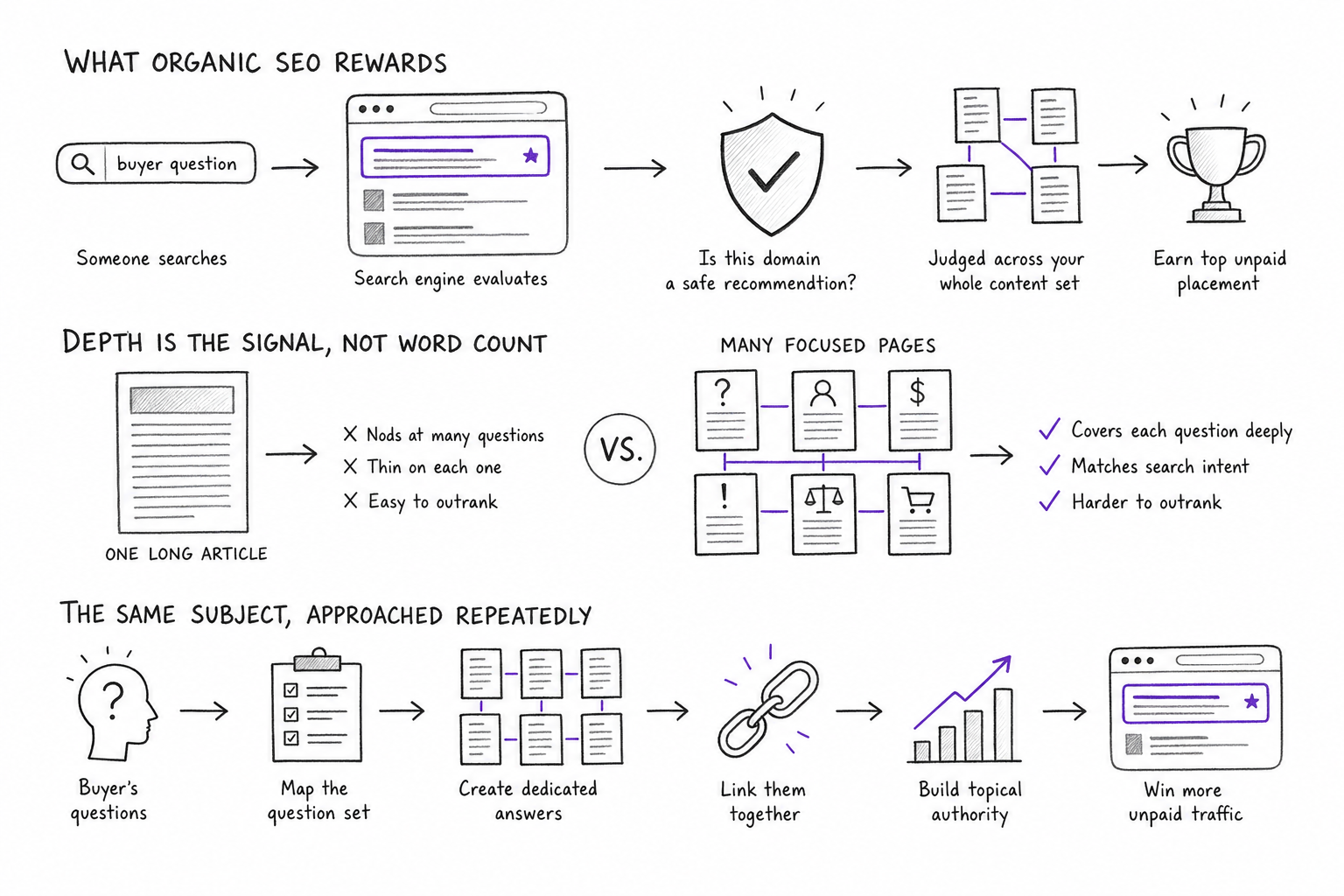
A search engine evaluating your site is answering an internal question: if someone asks about this subject, is this domain a safe recommendation? That judgment is made across your whole body of content on the theme, not post by post. One article on a topic reads as an accident. Eighteen connected articles covering the main question, the objections, the comparisons, the edge cases and the practical consequences read as a site that works on this subject.
Depth is the signal, not word count
Business owners often hear “depth” and reach for length. They commission a 3,000-word monster and expect it to carry the whole topic. It rarely does, because depth in organic search means coverage of the question space, not characters on a page.
Think about what a buyer actually asks over a purchase cycle. What is this thing. Does it apply to my situation. What does it cost. What goes wrong. How does it compare to doing nothing. What happens after I buy. That is six distinct searches, often more, each with its own wording and its own intent. A single long article can nod at all six. It will be beaten, on every one of them, by a site that gave each question its own dedicated page and linked them together.
The same subject, approached repeatedly
There is a reason the sites that dominate a niche look obsessive. They publish on the same narrow theme again and again, from different angles, for years. From the outside that looks like repetition. From a search engine’s point of view it is the clearest possible evidence of specialisation.
The practical takeaway: before writing another post, decide which single subject you want to be the obvious answer on. Everything you publish for the next three months should serve that decision.
Why twelve good posts over two years produce nothing
Here is the arithmetic most blogs run without noticing. A post every few weeks, chosen by whatever seemed interesting that month, produces roughly twelve to twenty articles a year across eight or nine unrelated subjects. That is two articles per topic. Two articles is not coverage of anything. It is a sample.
Randomness destroys topical weight
Each unrelated post resets the counter. An article about hiring, one about a trade fair, one about a product update and one about industry regulation share nothing — no vocabulary overlap, no natural internal links, no accumulated authority passing between them. The site ends up with nine shallow topics instead of one credible one.
Competitors who picked a lane got twenty articles deep on a single subject in the same period. When a relevant query appears, they have a page built for it and eighteen neighbouring pages reinforcing it. You have one post that mentions the subject in passing.
Internal links need something to connect
Links between your own articles are how you tell a crawler which pages belong together and which one is the centrepiece. A blog of disconnected posts has nothing to link. You cannot build a meaningful internal structure between a piece on office relocation and a piece on raw material prices — the connection would be artificial and the crawler would read it as such.
This is the quiet cost of random publishing: it forecloses the structural work that makes organic SEO function. Every post written off-theme is not neutral. It consumes budget and produces an orphan.
The one-off post that did get traffic
Occasionally a scattered blog produces a hit — one article that picks up real visits. Owners read this as proof the approach works and keep going. It usually proves the opposite: the article ranked because the query happened to be uncontested, and because nothing surrounds it, the traffic converts poorly and decays as soon as someone with real topic coverage notices the gap.
The takeaway: judge the blog by whether the topic as a whole is gaining ground, not by whether one post got lucky.
Why a stale blog hurts more than no blog
A dormant blog is one of the most damaging things a company website can carry, and almost nobody treats it as urgent.
What a visitor reads from an old date
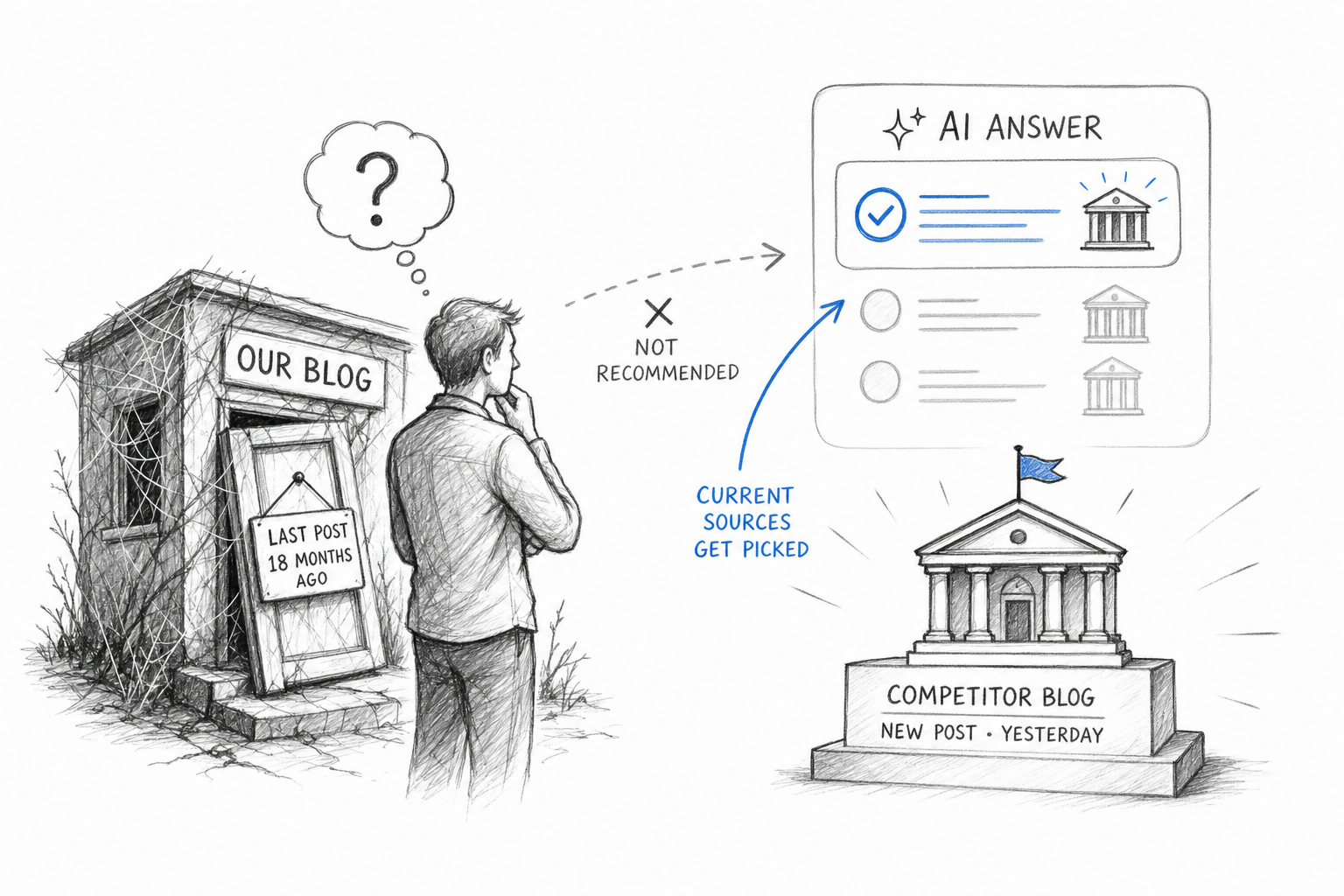
A prospect lands on your article, finds it useful, scrolls up and sees a date from eighteen months ago. Then they check the archive and the newest piece is from the same period. The inference is immediate and unflattering: this company stopped bothering. If the blog stopped, maybe the support does too. The content did its job on quality and then undid it on neglect.
An empty blog section says nothing. A visibly abandoned one says something specific and negative, and it says it to exactly the people closest to a decision.
Freshness is a recommendation signal
Search engines and AI answer systems both have a bias toward sources that are currently maintained. They are deciding what to recommend right now, and a domain that has published nothing for a year is a riskier recommendation than one that published yesterday. The information might be stale, the company might be gone.
This matters more for AI-generated answers than for classic blue links. Generative systems assemble responses from sources they consider reliable and current. Being absent from that pool is invisible — you will not see a ranking drop, because there was never a ranking. You simply stop being mentioned while competitors get named.
Recovery costs more than maintenance
Restarting a blog after a long gap is not a matter of picking up where you left off. Crawl frequency has dropped, the old articles have aged against fresher competition, and the topic has moved on. You spend months rebuilding a position you already had.
The takeaway: the decision that matters is not should we write an article but can we sustain this every week for a year. If the honest answer is no, change the production model before writing anything.
The cadence that actually builds a topic
This is where most advice is quietly wrong. The common benchmark — one post a week, or four a month — is a beginner’s cadence, not a competitive one. Do the arithmetic again: one a week gives you fifty-two articles a year. Spread across even three subtopics, that is seventeen per theme, and it takes a full year to get there while competitors keep moving.
Three a week is the working floor
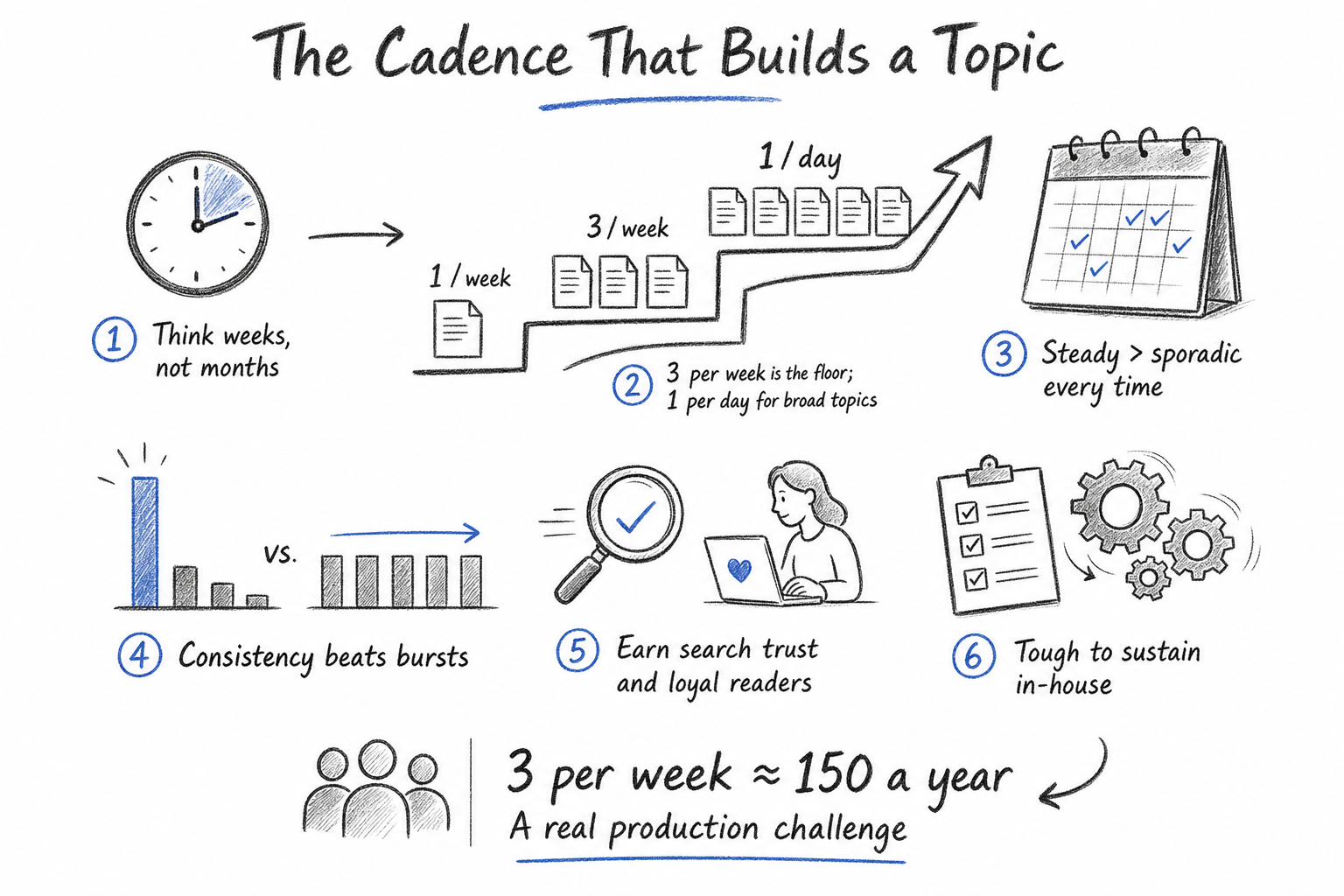
At least three articles a week is the threshold where a blog starts covering a topic faster than the topic evolves. On broad subjects with many sub-questions, one a day is defensible. At three a week you reach meaningful coverage of a focused theme within a quarter rather than a year, and each new piece has existing articles to link to from day one.
Reason in weeks, not months. “We publish monthly” describes a rhythm so slow that the question space grows faster than you cover it.
Consistency beats bursts, always
Fifteen articles in launch month followed by silence is worse than three a week held for twelve months, even though the burst looks more impressive in the first thirty days. Search engines calibrate to your pattern. A steady signal earns regular crawling and sustained trust. A spike followed by nothing teaches them to stop checking.
The same holds for the human reader. A reader who finds you in month three and sees consistent recent publishing treats the site as a live resource. A reader who finds a burst and a gap treats it as an abandoned campaign.
Why internal production usually fails at this rate
Three articles a week is roughly 150 a year. Run the cost honestly: if a competent person spends five hours per article — research, drafting, editing, images, publishing — that is 750 hours a year, close to half a full-time role. At a loaded cost of around 40,000 euros a year for that person, each article lands somewhere in the region of 130 to 150 euros before you count the management time. Those are illustrative figures with the assumptions on the table; substitute your own and the conclusion rarely changes.
This is precisely why company blogs go quiet. The cadence is not unreasonable — the manual production model is. Something urgent arrives, the blog is the first thing dropped, and the gap begins.
The takeaway: pick the cadence first, then choose a production method that can hold it. Choosing the method first guarantees you drift down to whatever is easy, which is nothing.
Diagnosing your own blog before writing anything else
Before commissioning the next article, run your archive against the three failure modes described above. The table below pairs each symptom with its actual cause and the change that addresses it.
| Symptom | Real cause | What to change |
|---|---|---|
| Decent posts, almost no traffic | Topics too scattered to build authority | Pick one theme, commit the next 30 articles to it |
| One article ranks, the rest nothing | Lucky uncontested query, no supporting content | Build the surrounding questions around that page |
| Traffic declining slowly | Archive aging, publishing stopped | Restore a weekly rhythm before writing anything new |
| Never cited in AI answers | Site reads as inactive or shallow | Sustained publishing plus clear topic coverage |
| Blog restarted several times | Manual production cannot hold cadence | Change the production model, not the writers |
The pattern across all five rows is the same. None of these problems is solved by writing a better article. They are solved by deciding what the blog is about and by never letting it stop.
Frequently asked questions
How many blog posts do I need before organic SEO starts working?
Volume alone does not trigger results — connected volume on one theme does. Expect meaningful movement once you have covered the main question and its surrounding sub-questions, typically twenty to thirty linked articles on a focused subject. At three articles a week that is roughly a quarter. Scattered across unrelated topics, the same count produces nothing.
Is one blog post a week enough for organic SEO?
It is a starting cadence, not a competitive one. One a week gives you around fifty-two articles a year spread across whatever topics you chose, which builds coverage more slowly than most topics evolve. Three a week is the working floor for owning a subject, with one a day justified on broad themes.
Does Google penalise a blog that stopped publishing?
There is no explicit penalty, but the practical effect resembles one. Crawling becomes less frequent, existing articles age against fresher competing content, and the domain becomes a less attractive recommendation. Visitors also read an old publication date as neglect, which damages conversion independently of ranking.
Why do my well-written articles still not rank?
Writing quality is necessary but not decisive. Ranking depends on whether your site looks like a credible authority on the whole subject, judged across your body of content. A single excellent article on a topic competes against sites with twenty connected pieces and loses on topical weight, not on prose.
Should I delete old blog posts that are off-topic?
Usually no. Off-topic posts dilute focus but rarely cause active harm, and deleting them removes whatever small signals they carry. The better move is to stop adding to the problem: direct all new publishing to one defined theme and let the proportion of on-topic content grow until the site reads as specialised.
How does organic SEO relate to being cited by AI assistants?
Both depend on the same underlying judgment: is this source reliable and current on this subject. Generative answer systems draw on content they assess as trustworthy and maintained. A site with deep topic coverage and recent publishing qualifies for both classic rankings and AI citations; a dormant site qualifies for neither.
Can AI-written articles work for organic SEO?
Yes, when they are genuinely useful, reviewed by a person before publication and clearly declared as AI-assisted in plain text and structured data. What search systems reward is usefulness and consistency, not authorship method. Automated production with human approval is how most sustained publishing rhythms are realistically maintained in 2026.
The decision that fixes both problems
Organic SEO fails for scattered blogs for two linked reasons: the posts do not build on each other, and the publishing stops. Writing better articles addresses neither. What addresses both is a planned structure — a defined theme with its questions mapped and its articles linked — combined with a publishing rhythm that holds through busy quarters and holiday periods without anyone having to remember.
That is a production problem as much as an editorial one. If you want a blog that plans its topic tree in advance, publishes several times a week without gaps, links the articles to each other and to the pages that sell, and marks AI-assisted content transparently as the AI Act requires, see how the platform handles it and connect your WordPress site to test the rhythm on your own topic.
This article was produced and published automatically with the help of artificial intelligence.
Start today
A blog like this, on your site
This article was written and published by RankGrove, with the method you read about on the site. Try it free on your WordPress: the first article lands in your drafts within ten minutes.
Start free trial