Content ROI & B2B Lead Generation
How Long Before a Blog Generates Real Website Traffic

A company blog rarely produces meaningful website traffic before the third month, and leads usually arrive after the traffic, not with it. The decisive variable is cadence: a blog publishing three or more times a week without gaps builds topic coverage fast enough to compete, while a blog that stops for a month hands back the ground it took to gain.
“We tried a blog for three months and got nothing.” It is the most common objection to content marketing, and it is almost always accurate as a description of what happened. It is almost never accurate as a conclusion about whether blogging works.
Three months is roughly the point at which a new blog stops being invisible. Pages are indexed, a handful of long-tail queries start showing impressions, and the first clicks trickle in. Calling that moment “nothing” is like judging a hiring decision in week two. The problem is that most companies budget attention for three months, see a flat line, and shut it down just as the curve is about to bend.
This article sets expectations honestly. You will see what actually happens month by month — indexing, first impressions, position climb, then the lead trickle — why publishing gaps are more damaging than low article quality, and what a realistic growth dashboard looks like in the first year. The broader question of how that traffic converts into pipeline and revenue is covered in the pillar on content marketing ROI for a company blog; here the focus is time.
No guaranteed positions, no promised numbers. Ranges, mechanisms, and the signals worth watching before the traffic chart looks impressive.
Contents
- Why website traffic from a blog arrives later than from ads
- What happens month by month in the first year
- Why gaps in publishing cost more than slow articles
- What a realistic growth dashboard looks like
- How to start the clock without hiring a content team
- Frequently asked questions
- The honest conclusion
Why website traffic from a blog arrives later than from ads
Paid traffic is a transaction: you pay, the click appears the same day, it stops when the card stops. Organic traffic is an accumulation: search engines and AI answer systems have to find your pages, decide what they are about, test them against competing pages, and only then send people your way. Each of those steps takes real time, and none of them can be bought.
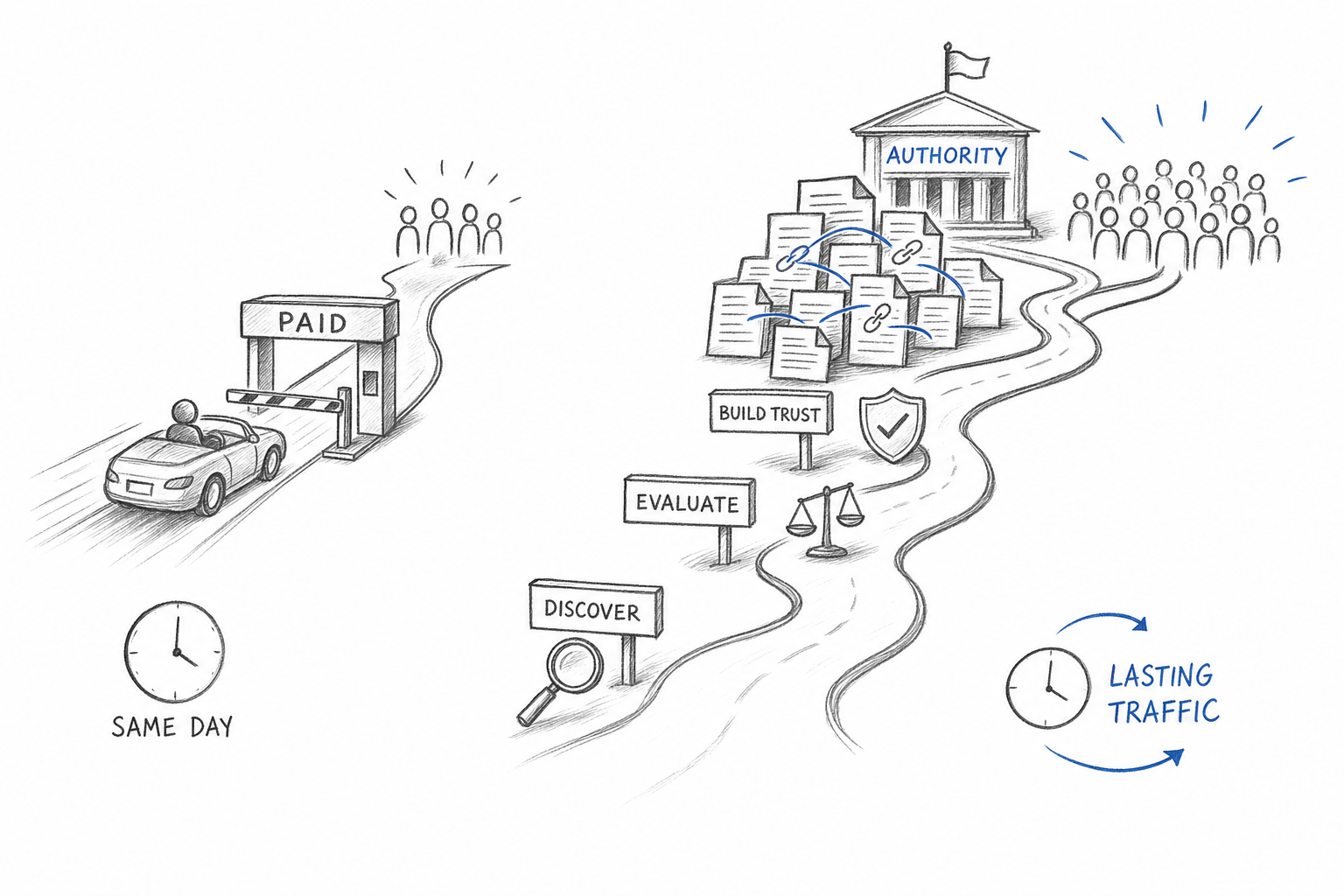
A new page has to be discovered before anything else. Then it has to be evaluated — which means the system compares it against pages that have already been ranking, collecting signals, and earning clicks for years. Early on, your page has no behavioural history, no citations, and belongs to a site the engine has not yet learned to trust on that subject. The rational default is to rank it low and see what happens.
What shortens that evaluation is coverage. A site with four articles on a topic looks like an experiment. A site with sixty articles that interlink, answer adjacent questions, and keep getting new siblings looks like a publication that owns the subject. The engine does not need to trust a single page; it needs to see a pattern. Patterns are built by frequency, not by effort per article.
The practical takeaway: if you need results in four weeks, run ads. If you want an asset that keeps producing website traffic after you stop paying, start the clock today and plan for a year.
What happens month by month in the first year
The timeline below is a typical shape, not a promise. Competitive niches run slower; narrow technical topics with little competition can run faster. Treat it as a map of phases, not a schedule.
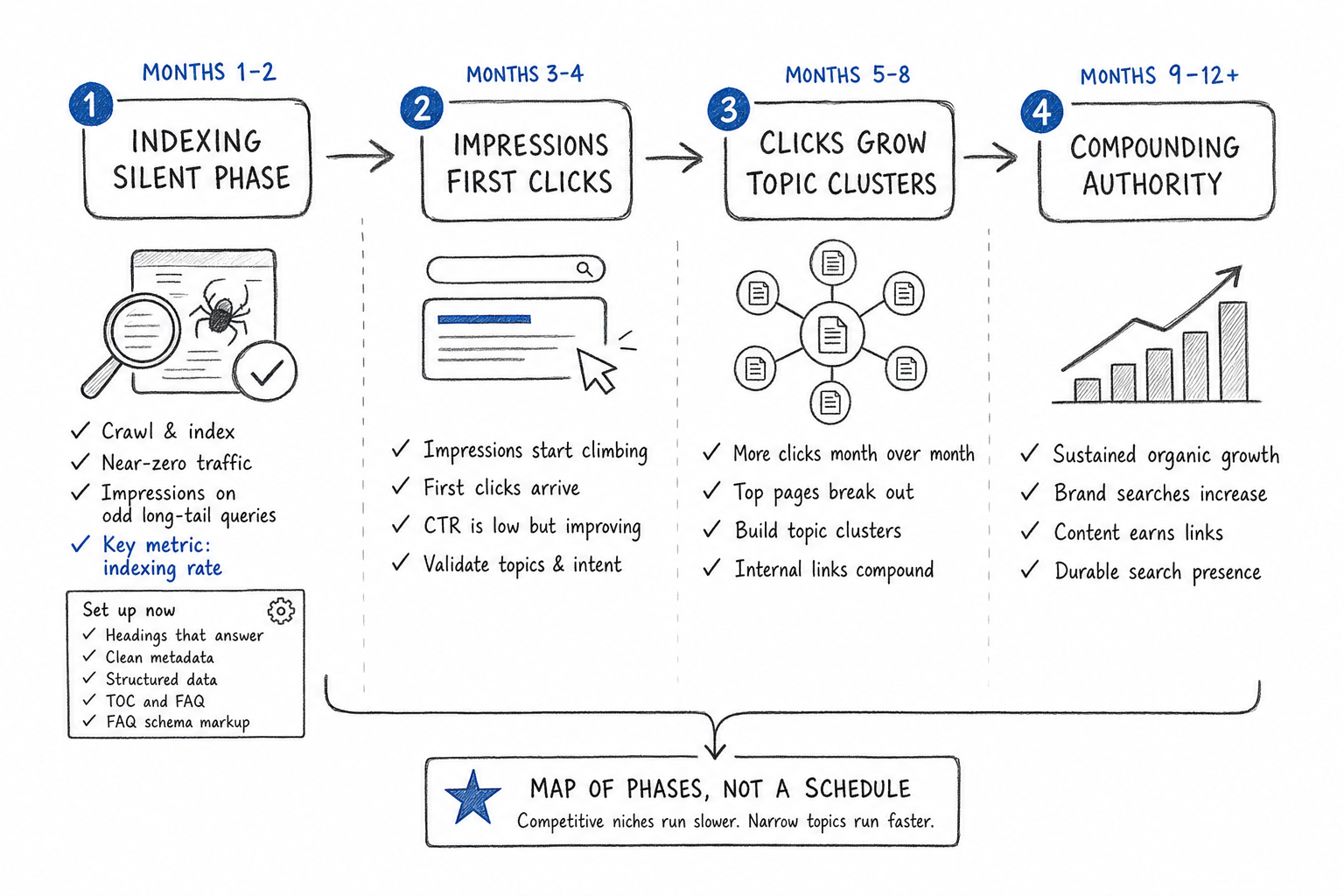
Month one and two: indexing and the silent phase
Nothing visible happens, and that is normal. Pages get crawled and indexed over days or weeks. Analytics shows near-zero sessions. Search Console starts recording impressions on queries you did not target — odd long-tail phrasings where the competition is thin enough that a brand-new page can surface.
The mistake in this phase is judging quality by traffic. There is no traffic to judge. The correct metric for months one and two is the indexing rate: what share of published articles has actually entered the index. If articles are being published and indexed, the machine is working. If half of them never get indexed, you have a technical problem — thin pages, duplicate structures, broken internal linking — and that is worth fixing immediately.
This is also when structure pays off later. Headings that answer real questions, clean metadata, structured data, a table of contents, and an FAQ block are cheap to add now and expensive to retrofit across two hundred articles. Setting up FAQ schema markup and structured data from the first article costs a few minutes and changes how machines read every page you publish afterwards.
Month three and four: first impressions turn into first clicks
This is the phase most companies never reach because they quit at the end of month three. Impressions start climbing visibly. Average position for your early articles moves from somewhere invisible to the second or third page. A few queries break into positions where real humans actually click.
Traffic in this window is small and it feels underwhelming. Dozens of sessions a week, not thousands. But the composition matters more than the volume: these visitors arrived by typing a specific question, which means their intent is sharper than anything a display campaign delivers. A handful of high-intent visitors is a better early signal than a spike of untargeted ones.
Something else begins here: AI answer systems start having enough material to cite. Generative engines pull from pages that answer a question cleanly and are structured well enough to be parsed. A site with thirty well-structured articles on one theme becomes a plausible source. A site with five does not.
Month five to eight: the climb and the first leads
Older articles are now the ones doing the work. Pages published in month one, which produced nothing for ninety days, start ranking on terms with actual volume. Newer articles get indexed faster because the site has credibility. Internal links from new pieces push authority toward older ones. This is the compounding phase, and it only exists if you kept publishing during the silent months.
Leads begin here, and they arrive as a trickle before they arrive as a flow. The pattern is usually the same: readers who found an informational article return later through a branded search, then convert. That lag breaks naive attribution — last-click reporting will credit the brand search and tell you the blog did nothing. It is worth looking at assisted paths before drawing conclusions.
Month nine to twelve: coverage becomes defensible
By the end of the first year a blog that published consistently has enough articles to cover a topic from several angles: the broad question, the specific variants, the objections, the comparisons, the operational details. That coverage is what makes rankings stable rather than volatile. A single article can be outranked next quarter. A cluster of eighty interlinked articles is far harder to displace.
The practical takeaway for the first year: judge months one and two on indexing, months three and four on impressions and average position, months five to eight on sessions and first conversions, and only from month nine on absolute traffic volume.
Why gaps in publishing cost more than slow articles
A blog that publishes three articles a week for six months and then stops for two months does not resume where it left off. It resumes lower.
Part of the reason is mechanical. Crawl attention follows publishing patterns: a site that updates daily gets checked daily, a site that went quiet gets checked rarely, so when you restart, your new pages wait longer to be discovered. Part of it is competitive: the queries you were climbing toward do not freeze while you pause. Competitors keep publishing, and the ranking you were approaching gets taken.
And part of it is human. A visitor who lands on a blog whose most recent post is five months old reads one thing: this company stopped caring. That impression transfers to the product.
The arithmetic of cadence
Coverage is the number of distinct questions you have answered well. At one article a week you add roughly fifty-two answers in a year. At three a week you add about a hundred and fifty-six. At one a day you add three hundred and sixty-five. Those are not three speeds of the same strategy — they are three different outcomes. The site with a hundred and fifty-six articles has entered dozens of query families the site with fifty-two never touched, and it has three times the internal links reinforcing each cluster.
This is why one post a month is not a cadence, it is a gesture. If the topic is worth owning, three articles a week is the floor, and the widest topics justify one a day. The detail of how that maps to a small business situation is covered in the piece on how many blog posts per month a small business needs.
Consistency beats bursts, every time
Fifteen articles published in launch month followed by silence performs worse than three a week held for a year, even though the launch burst looks more impressive on a slide. The burst produces a spike of nothing — fifteen unindexed or barely-ranked pages with no siblings to link to them — and then decay. The steady cadence produces a curve that keeps rising while you sleep.
The practical takeaway: before you plan the first article, decide how you will still be publishing in month ten. If the answer depends on someone finding spare time, the blog will stop. Build the cadence into a system, with a person approving rather than a person writing from scratch.
What a realistic growth dashboard looks like
Most blog dashboards measure the wrong thing at the wrong time, which is why they trigger premature shutdowns. The metric that matters changes as the blog matures, and reading month two with month-ten metrics guarantees a false negative.
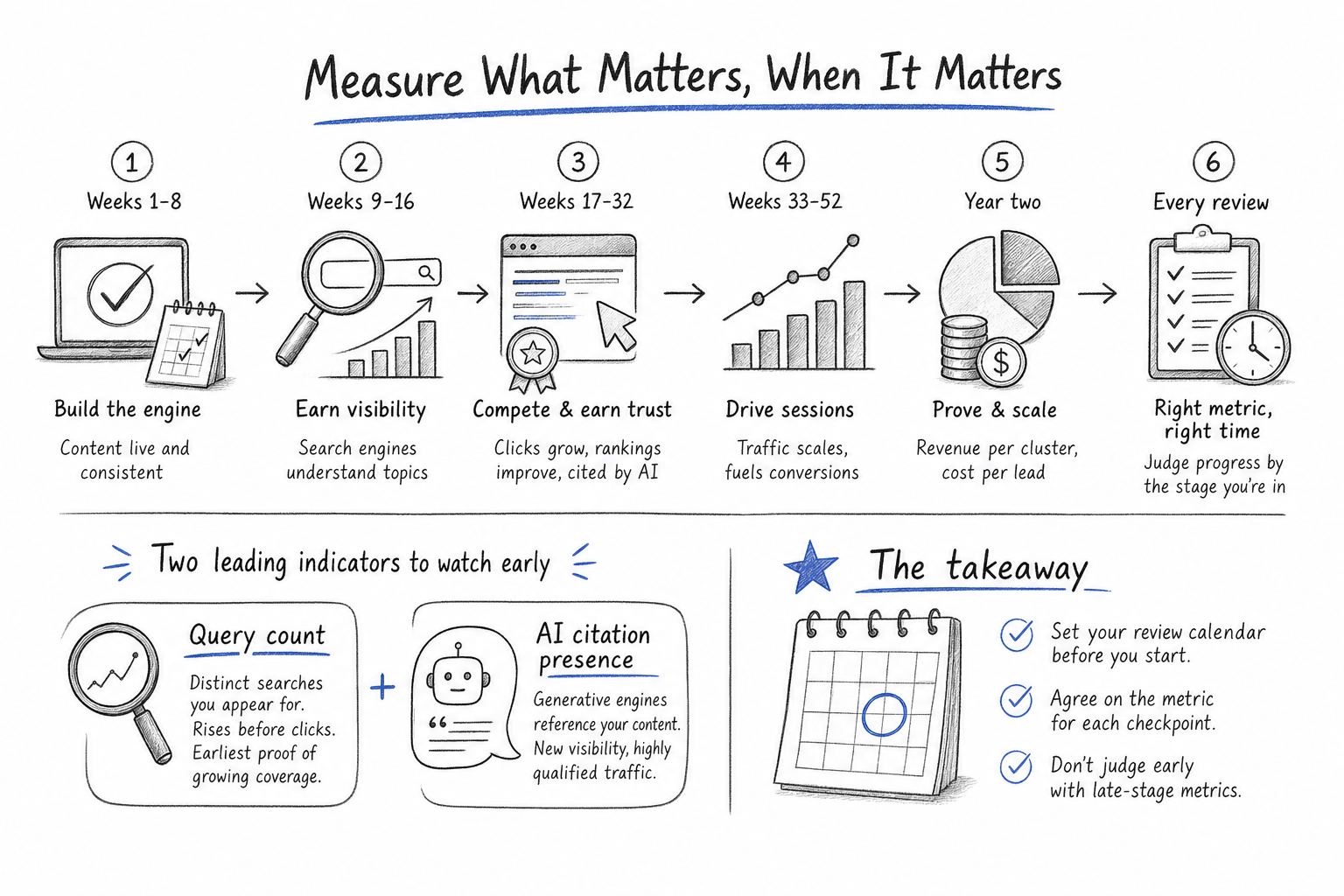
Here is the sequence worth tracking, with the question each phase actually answers.
| Phase | Metric that matters | What it tells you |
|---|---|---|
| Weeks 1-8 | Indexed pages, publishing streak | The machine is running |
| Weeks 9-16 | Impressions, query count | Search engines understand your topics |
| Weeks 17-32 | Clicks, average position, AI citations | You are entering competitive territory |
| Weeks 33-52 | Sessions, assisted conversions | The asset is producing pipeline |
| Year two | Revenue per cluster, cost per lead | The channel can be scaled or pruned |
Two numbers deserve more attention than they usually get. The first is query count — how many distinct searches your site appears for. It rises before clicks do, and it is the earliest honest proof that coverage is growing. The second is AI citation presence: whether generative answer engines reference your pages when someone asks a question in your domain. That visibility behaves differently from classic rankings and increasingly brings qualified readers who never saw a results page.
The practical takeaway: set the review calendar before you start, agree which metric you will judge at each checkpoint, and refuse to evaluate month three on a month-twelve metric.
How to start the clock without hiring a content team
The timeline in this article has one uncomfortable implication: the earliest possible result is a function of when you start, and every week of deliberation pushes the whole curve to the right. There is no way to compress months one and two later. You can only begin them earlier.
The second implication concerns capacity. Three articles a week is roughly a hundred and fifty a year. Written by hand at five hours each, that is seven hundred and fifty hours — the better part of a full-time role. Most companies cannot staff that, which is exactly why their blog stalls in month three. The realistic model in 2026 is a system that plans the topic tree, writes, illustrates and publishes on schedule, with a person reviewing and approving before anything goes live. Human judgement at the decision points, machine consistency at the cadence.
That model also carries an obligation worth getting right from the first article: content produced with AI assistance should say so, in plain text and in machine-readable form. Transparency is a trust signal for readers and a compliance requirement under European rules. The mechanics are explained in the piece on AI Act obligations for AI-written business blogs, and the disclosure is better designed in than bolted on.
If you want month three to arrive in three months rather than next year, the honest move is to start publishing now at a cadence you can sustain. You can see the plans and start a free trial to put the first articles in the index this week instead of debating the calendar.
Frequently asked questions
How long does it take for a new blog to get organic website traffic?
Expect near-zero traffic for the first two months, first meaningful clicks around months three to four, and a visible upward curve between months five and eight. Competitive niches take longer. The variable you control is cadence: a blog publishing three or more times a week reaches each phase sooner than one publishing weekly.
Is three months long enough to judge whether a blog works?
No. Month three is typically the point where impressions appear and the first clicks arrive — the beginning of traction, not the result. Judging at three months means measuring the phase where the system is still being evaluated by search engines. A fair verdict needs nine to twelve months of uninterrupted publishing.
What should I measure in the first two months if there is no traffic?
Track indexing rate and publishing streak. If most published articles enter the index within days and the cadence holds, the system is healthy. If articles fail to index, investigate thin content, duplicate structures or internal linking before publishing more. Impressions and query count become the relevant metrics from roughly week nine.
Does pausing publishing for a month hurt rankings?
It costs more than people expect. Crawl frequency follows publishing patterns, so new pages wait longer to be discovered after a gap. Competitors keep publishing on the queries you were climbing toward. And visitors who see a stale blog read it as neglect. Resuming after a pause starts lower than where you stopped.
How many articles per week does a blog need to compete?
Three a week is the practical floor for owning a topic, with up to one a day on broad subjects. At three a week you add roughly a hundred and fifty answered questions a year versus fifty-two at weekly cadence — three times the coverage and three times the internal linking inside each cluster.
When do blog leads actually start arriving?
Usually after traffic, not with it, typically from months five to eight. The common pattern is a reader finding an informational article, leaving, then returning later through a branded search and converting. Last-click reporting credits the branded search, so review assisted conversion paths before concluding the blog produced nothing.
Do AI answer engines follow the same timeline as Google rankings?
Partly. Generative engines need enough well-structured material on a topic before treating a site as a plausible source, so coverage still takes months to build. Clean headings, structured data, FAQ blocks and concise definitions make pages easier to parse and cite, which can bring qualified readers who never saw a results page.
The honest conclusion
A blog is a slow asset with a fast failure mode: it fails by stopping. The timeline is not the obstacle — three to six months to early traction is survivable for any company that planned for it. What kills blogs is budgeting three months of patience for a twelve-month mechanism, then interpreting a normal silent phase as proof of failure.
Decide the cadence you can hold for a year, build the system that holds it without depending on anyone’s spare afternoon, and set review checkpoints that ask the right question at the right month. The website traffic will follow the coverage, and the coverage follows the calendar.
This article was produced and published automatically with the help of artificial intelligence.
Start today
A blog like this, on your site
This article was written and published by RankGrove, with the method you read about on the site. Try it free on your WordPress: the first article lands in your drafts within ten minutes.
Start free trial