SEO Content Structure & Topic Clusters
Multilingual SEO: How to Set Up a Blog in Many Languages

Multilingual SEO works when each language market gets its own topic tree, its own keyword research and its own publishing cadence — not a machine translation of one blog. This guide covers how to choose which languages to launch first, how to structure a separate project per language, and what to expect in the first months of each market.
A German prospect searching for your category does not use the translated version of the phrase your Italian customers use. They use a different word, with a different volume, in a different competitive field, and they read a different set of sites before deciding. Translation moves words across languages; multilingual SEO moves a market position. The two are not the same job.
Most European companies discover this the slow way. They build a blog that works in their home language, add a translation plugin, and watch the new language versions attract traffic that never converts — or no traffic at all. The pages exist, they are indexed, and they rank for nothing anyone searches. The underlying reason is structural: a translated blog inherits the topic priorities of the original market, including the questions nobody asks in the target country.
This guide is written for the person who has to decide the structure before any content exists: a founder expanding into two or three countries, a marketing lead inheriting a one-language blog, an agency onboarding a client with four markets. It stays at the planning level. You will see how to prioritize languages, why a separate topic tree per language preserves relevance, how to size the editorial effort per market, and which mistakes cost the most time to undo. The reasoning builds directly on how topic clusters and pillar pages structure a blog that actually ranks — multilingual work is that same structure, repeated per market, with local inputs.
Contents
- What multilingual SEO actually means for a company blog
- How to choose which languages to launch first
- Why a separate topic tree per language beats translating one blog
- How to set up a multilingual blog, step by step
- Step one: fix the market order and the commercial endpoint
- Step two: run keyword research natively per language
- Step three: build the tree for that language as a standalone project
- Step four: set a cadence you can hold for a year
- Step five: assign review and transparency per language
- Step six: measure per market, never in aggregate
- Common mistakes that cost the most to undo
- What to expect in the first months of each language
- Frequently asked questions
- The structural choice, made once
What multilingual SEO actually means for a company blog
Multilingual SEO is the practice of building a separate, independently researched content structure for each language market you sell in, so that each market ranks for the terms its own users search. It is not a translation layer applied to an existing blog. The distinction decides everything that follows.
Consider what a search engine evaluates when it ranks a page for a Spanish query. It looks at the page, and it looks at the site’s demonstrated coverage of that subject in that language. A site with forty Spanish articles mapping a topic from every angle reads as an authority on the topic in Spanish. A site with four translated Spanish pages reads as a site that happens to have Spanish pages. Coverage in one language does not transfer authority to another: the signals are language-scoped.
The same applies to generative engines. When an AI assistant answers a question in Dutch, it assembles that answer from sources it can read and attribute in context. Your excellent English pillar page is largely invisible to that process. Citation in AI answers follows the language of the query, which means every market you care about needs its own citable body of work.
The three structures companies actually choose between
The first is the single blog with on-the-fly translation, usually a plugin or a browser-level translation. It costs almost nothing and produces almost nothing: the translated text is not indexed as original content in the target language, and nobody researched whether the topics matter locally.
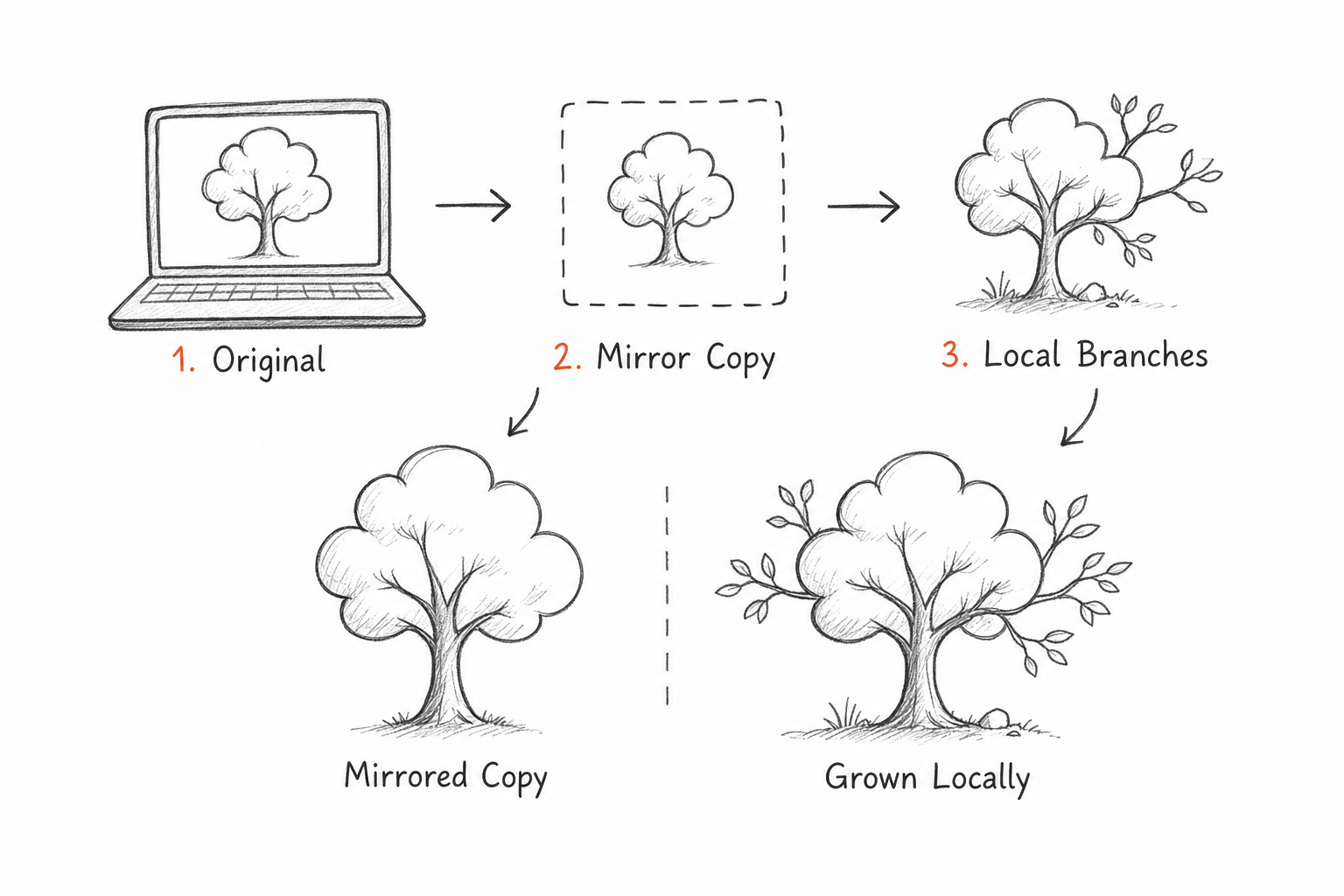
The second is the translated mirror: one editorial plan, professionally translated into each language, published on parallel paths. This is a real improvement and it is where most mid-size European companies stop. It ranks for some terms, usually the ones that happen to translate cleanly, and misses the local long tail entirely.
The third is one topic tree per language: each market gets its own keyword research, its own pillar themes, its own supporting articles and its own internal link structure. Some topics overlap with other markets, some exist only locally, and the priority order differs. This costs more to plan and, with the right production system, roughly the same to run. It is the only one of the three that competes with local players.
The takeaway: decide between these three before you commission a single article, because migrating from the second to the third means rewriting, not editing.
How to choose which languages to launch first
Nobody launches twenty-two markets at once and does any of them well. The sequencing decision matters more than the total count, and it rests on four inputs you can assess in an afternoon.
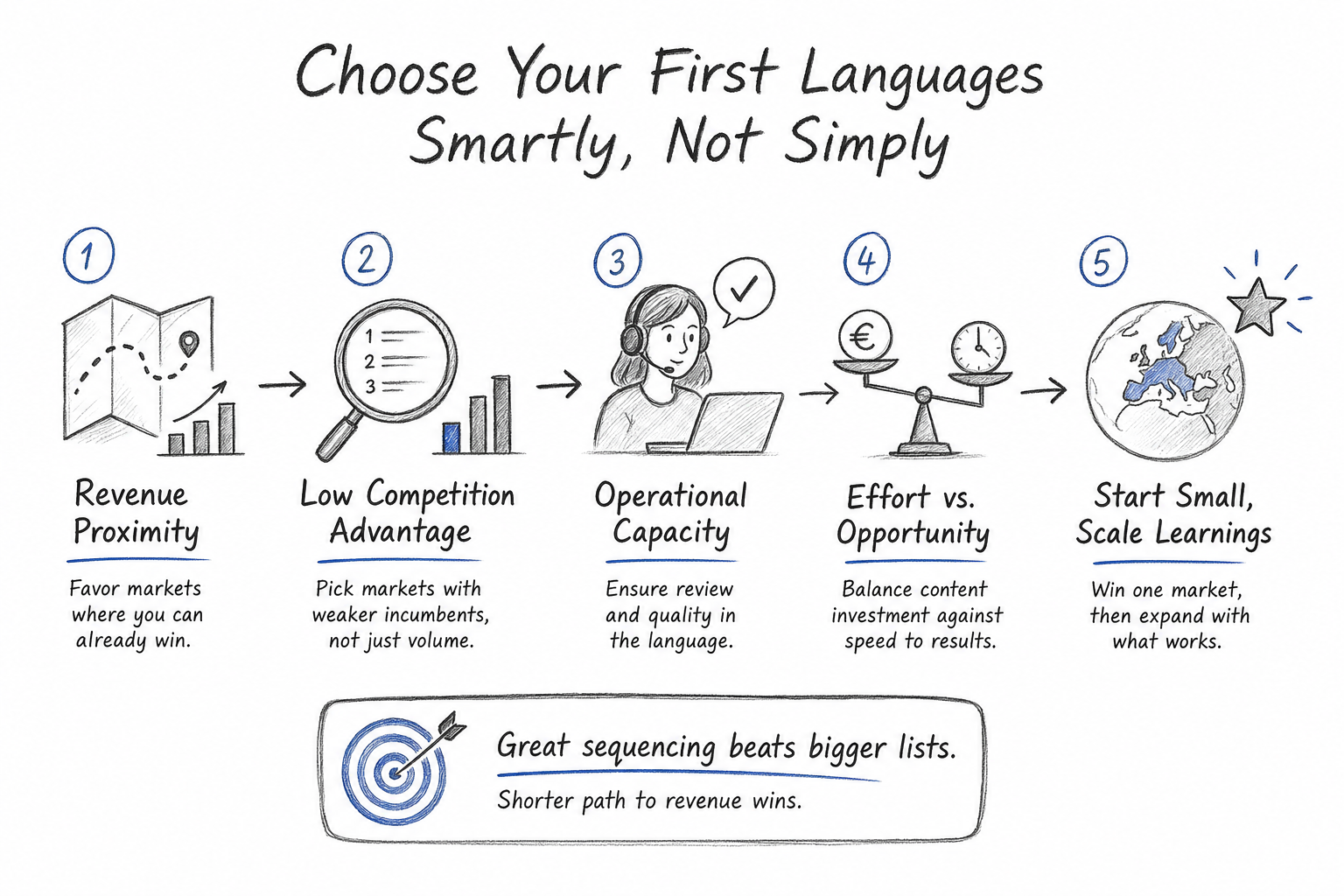
Revenue proximity
Start with where you already have signals. Inbound requests in a language you do not publish in, existing customers in a country, a partner or distributor already selling there, a sales team member who speaks the language. A market where you can already close a deal converts blog traffic; a market where you cannot just accumulates visitors. Rank your candidate languages by how short the path from reader to revenue is, not by population size.
Competitive density of the local search results
Search volume is a weak input on its own. What matters is who currently holds the results for your category in that language. In some European markets, a category is owned by two or three large publishers and breaking in takes a long, deep topic tree. In others — particularly smaller language markets — the same category is covered by thin, outdated pages, and a well-structured blog becomes visible fast.
This is the asymmetry most companies ignore. A market with a tenth of the search volume and a twentieth of the competition is often the better first move. Smaller language markets are frequently the cheapest organic visibility available in Europe, precisely because large international competitors deprioritize them.
Operational capacity to review the language
Under the transparency logic that now governs AI-assisted publishing, somebody has to approve what goes out. If you launch a language nobody in the company can read, you are publishing unreviewed content and you lose the ability to catch errors of tone, claim or fact. Before adding a language, identify who signs off on it — an employee, a partner, a freelance reviewer. If the answer is nobody, that language waits.
Regulatory and commercial fit
Some claims you make in one country cannot be made in another. Pricing, guarantees, professional qualifications and sector-specific wording vary across the single market. A market where your core message needs heavy legal rework is a market that costs more per article than its traffic justifies at the start.
Practical sequencing: launch one language beyond your home market, hold it for a full quarter at real cadence, and only then add the next. The second language teaches you what your process actually costs; the third and fourth become mechanical.
Why a separate topic tree per language beats translating one blog
Here is the core argument, and it is worth being precise about it, because this is the decision that determines whether the investment returns anything.
Keyword realities diverge, not just vocabulary
In every language, a category has a dominant commercial term, a set of informational phrasings and a long tail of problem-shaped questions. These three layers do not map one-to-one across markets. A term that carries high commercial intent in French may be an academic term in Italian, where buyers use a colloquial phrase instead. English loanwords are standard vocabulary in some Northern European markets and read as jargon in others.
When you translate an editorial plan, you inherit the source market’s term hierarchy. The result is a set of pages optimized for phrases that exist grammatically in the target language and carry no search demand. The keyword research has to be done natively, per language, from local search behaviour — and once you accept that, the structure of the plan changes too, not just the words in it.
The questions buyers ask differ by market
Buying behaviour varies across Europe in ways that show up directly in search. In some markets the dominant pre-purchase question is about price and contract terms; in others it is about compliance and documentation; in others about integration with a tool that is locally dominant and unknown elsewhere. Procurement habits, typical company size, and the level of in-house expertise all shift the mix.
A topic tree built natively captures those questions. A translated tree answers the home market’s questions in a foreign language, which is a strange document to land on: technically readable, obviously not written for you. Readers notice, and so does the bounce rate.
Internal linking only works inside a language
The engine of a topic cluster is the internal link structure: supporting articles pointing to the pillar, the pillar routing to the pages that sell, related articles cross-referencing each other. That structure has to be complete within each language. A Polish supporting article that links to an English pillar sends the reader out of their language and sends the search engine a confused signal about which page owns the topic.
So each language needs not only its own articles but its own complete link graph, including its own links to the localized commercial pages. This is why one project per language is the cleaner mental model: the unit of work is a self-contained tree, not a column in a translation spreadsheet.
Overlap is fine, duplication is not
None of this means starting from zero intellectually. The underlying expertise is the same, the pillar themes often rhyme across markets, and your strategic positioning does not change by border. What changes is which branches of the tree you grow, in what order, and with which local examples, regulations and references. Treat the home-market tree as a source of ideas to test locally, never as a template to replicate.
| Approach | Where it works | What it costs you |
|---|---|---|
| Plugin or browser translation | Short-term accessibility for existing visitors | No original-language indexing, no local keyword fit |
| Translated editorial mirror | Markets where your category vocabulary maps cleanly | Misses the local long tail and local buying questions |
| Native topic tree per language | Any market you intend to compete in | More planning upfront, local review per language |
| Native tree, staggered launch | Companies adding one or two markets a year | Slower total coverage, far higher per-market quality |
The table compresses a decision you only make once per market. If a language is worth selling in, it is worth its own tree.
How to set up a multilingual blog, step by step
What follows is the planning sequence. The technical side — how the language versions are addressed, signalled to search engines and connected at the domain level — is a technical setup with its own considerations and deserves its own treatment; decide the structure first, then handle the implementation with someone who owns that layer.
Step one: fix the market order and the commercial endpoint
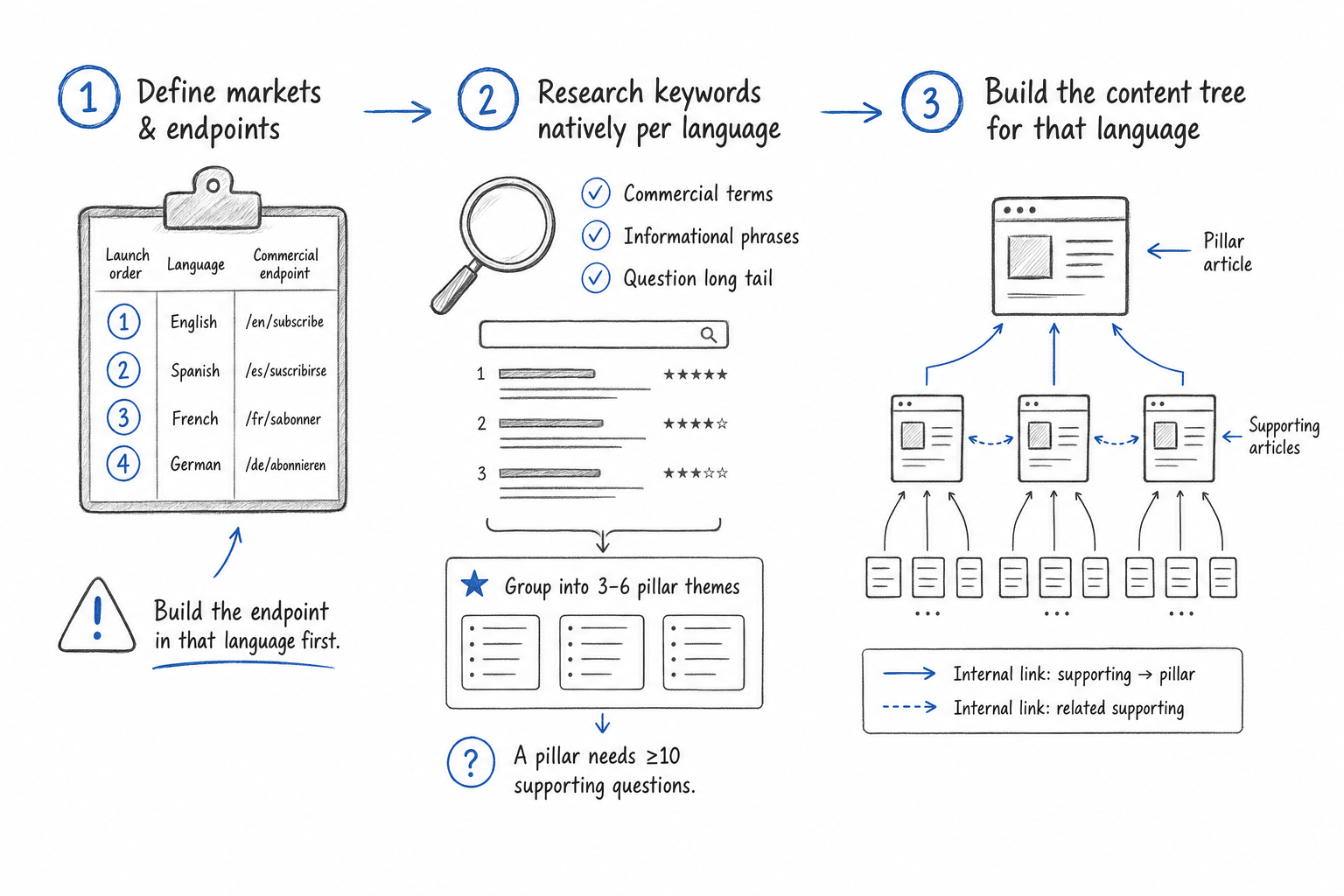
Write down the languages in launch order, using the four criteria above. For each one, name the page a reader should land on when they are ready to act, in that language. If the destination page does not exist in the target language yet, that is the first thing to build — a blog that routes readers to a page they cannot read wastes every click it earns.
Step two: run keyword research natively per language
Research the target language using local search data, not translated seed terms. Collect the commercial head terms, the informational phrasings people actually type, and the question-shaped long tail. Check what currently ranks and read it: the quality of the incumbent pages tells you how much depth you need to beat them.
Group the findings into three to six pillar themes per language. A pillar theme earns its place only if you can name at least ten supporting questions underneath it. If you cannot, it is a supporting article, not a pillar.
Step three: build the tree for that language as a standalone project
Map the pillar articles, the supporting articles beneath each, and the internal links connecting them — supporting to pillar, pillar to commercial page, related supporting articles to each other. Keep the whole graph inside the language. Treat it as a separate project with its own plan and its own backlog, even when it shares a brand and a strategy with the others.
Step four: set a cadence you can hold for a year
This is where multilingual projects fail quietly. A tree with thirty planned articles and one publication a week takes seven months to exist, by which point the earliest pieces are stale and the market has moved. Plan at least three articles a week per language you are serious about, and up to one a day on the broadest themes, because coverage speed is what separates a tree from a scattering of pages.
Three a week held for a year beats fifteen in a launch month followed by silence. A dormant language version is worse than no language version: it tells visitors the market is not a priority and gives search engines nothing fresh to prefer over a competitor. If you cannot sustain three a week in a language, do not launch that language yet — launch the one you can sustain.
Step five: assign review and transparency per language
Name the approver for each language before the first article. Decide the disclosure wording for AI-assisted articles in that language, and make sure it appears both in readable text and in machine-readable form, as the transparency obligations around AI-generated content require. Disclosure is market-specific text, so it belongs in the per-language setup, not as an afterthought bolted on later.
Step six: measure per market, never in aggregate
Aggregate traffic hides everything that matters. Track impressions, clicks, ranked queries and conversions separately per language, and compare each market against its own baseline. A language that grows slowly against dense local competition can be performing better than one that grows fast in an empty niche. Review each market on a quarterly rhythm and reallocate publishing volume toward the trees that are gaining ground.
Common mistakes that cost the most to undo
The expensive errors in multilingual SEO are structural, which is why they surface six months in, when fixing them means republishing rather than editing.
Launching every language at once produces thin trees everywhere and authority nowhere. Four languages with ten articles each lose to one language with forty, in every one of those markets.
Letting one language run and the rest stall is the most common pattern. The home market has momentum and an owner; the others have good intentions. Within two quarters, the secondary languages look abandoned — because they are.
Translating the commercial pages but not localizing the offer breaks the funnel at the last step. Readers arrive in their language and hit pricing, terms or case references that clearly belong to another country.
Skipping local review to save time is the one that creates real exposure. Unreviewed content in a language nobody at the company reads means nobody is checking the claims, and under current AI transparency expectations, approval is not optional housekeeping.
Treating smaller languages as a rounding error leaves the cheapest visibility in Europe on the table. The markets with less competition are where a well-structured tree moves fastest.
What to expect in the first months of each language
Set expectations by market, not by calendar quarter across the board. A new tree in a low-competition language typically starts showing impressions on long-tail queries within weeks, and begins collecting meaningful clicks once enough supporting articles exist to cover a theme properly. In a dense market, the same tree spends longer in the impressions-only phase before the pillar starts holding positions.
What stays constant is the shape of the curve: nothing for a while, then long-tail queries, then the pillar themes, then the commercial terms. The variable you control is how fast you complete the tree, and that is a function of publishing volume and continuity, not of cleverness in any single article.
Visibility inside AI answers follows a similar logic with a tighter requirement: assistants cite sources that answer a specific question cleanly and are structured enough to be parsed. Clear headings, direct definitions, question-shaped sections and structured FAQ data help — in each language, since the citation decision happens per query language.
The practical read: judge a language by whether its tree is filling in on schedule, and only then by its traffic.
Frequently asked questions
Is multilingual SEO just translating my blog into other languages?
No. Translation reproduces your home market’s topic priorities in another language. Multilingual SEO means researching each language market separately and building its own topic tree, because search demand, buying questions and competitive density differ by market. Translated pages often rank for phrases nobody locally searches, which is why they attract little qualified traffic.
How many languages should a small European company publish in?
Start with one language beyond your home market and hold it at full cadence for a quarter before adding another. Choose it by revenue proximity: where you can already close deals, where someone can review the content, and where local search results are weakly covered. Two well-built languages outperform five thin ones in every market.
Should each language have a separate blog or one blog with language versions?
Strategically, treat each language as a separate project with its own topic tree, keyword research and internal links kept inside that language. How those versions are addressed and signalled to search engines is a technical setup with its own considerations, and should be decided with whoever owns your site architecture after the content structure is fixed.
How often should I publish per language to compete locally?
At least three articles a week per language you intend to compete in, up to one a day on your broadest themes, held without gaps. Below that, a tree takes so long to complete that the early articles age before the structure exists. If you cannot sustain three a week in a language, delay launching it.
Does AI-generated multilingual content need a disclosure in each language?
Yes. Transparency obligations around AI-assisted content apply to the published article as the reader encounters it, so the disclosure has to appear in the article’s own language, in plain readable text, and in machine-readable form alongside it. Plan the wording per language during setup rather than retrofitting it across markets later.
Can I reuse the same editorial plan across all my language markets?
Use it as a source of hypotheses, not a template. Pillar themes often overlap because your expertise does not change by border, but the priority order, the supporting questions and the local examples do. Validate each theme against native keyword research before committing articles to it in a new language.
Which European language markets are easiest to rank in?
Generally the smaller ones, because large international competitors deprioritize them and the incumbent pages are often thin or outdated. Volume is lower, but so is the depth of tree needed to become visible. Weigh that against whether you can sell and review content in that language — easy rankings in a market you cannot serve produce no revenue.
The structural choice, made once
Multilingual SEO rewards companies that treat each language as a market with its own questions, and punishes the ones that treat it as a translation job. The decision is structural and you make it once per language: a self-contained topic tree, researched locally, published at a cadence you can hold, reviewed by someone who reads the language.
RankGrove is built around exactly that unit of work: one topic-tree project per language, across 22 European languages, each with its own plan, its own internal links and its own AI transparency marking, publishing to WordPress on a continuous cadence with a person approving. See how the per-language project structure works in practice, and if you manage several clients across different markets, the setup for agencies running multiple blogs handles the multiplication of languages and projects without multiplying the editorial overhead.
This article was produced and published automatically with the help of artificial intelligence.
Start today
A blog like this, on your site
This article was written and published by RankGrove, with the method you read about on the site. Try it free on your WordPress: the first article lands in your drafts within ten minutes.
Start free trial