Content ROI & B2B Lead Generation
Organic Traffic vs Paid Ads: The Real Dollar Value for a Small Business
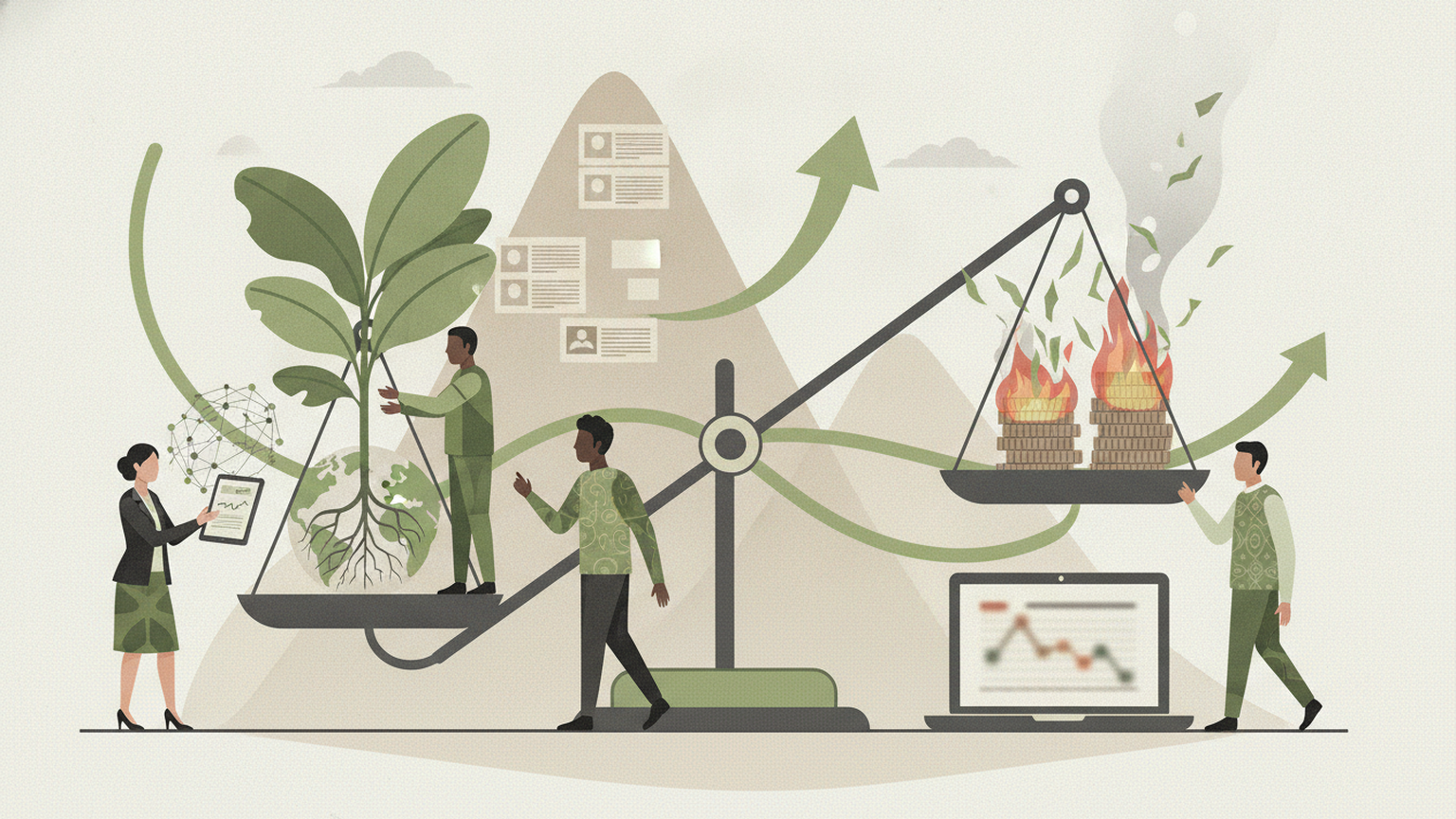
Paid ads buy website traffic you rent by the click: the flow stops the day the card stops. Organic articles cost money once and keep producing impressions for months, but they ramp up slowly and lose value if nobody maintains them. For a small business with a limited budget, the sane split is organic as the base layer and paid as the accelerant on queries where someone is ready to buy today.
Most small business owners do not have a theoretical problem with marketing. They have an arithmetic problem: a fixed amount of money per month, and two ways to spend it that behave in completely different ways over time.
Paid search and paid social give you website traffic on the same day you fund the account. Stop funding it and the traffic goes to zero within hours. Organic content works the other way round: you pay the production cost once, nothing much happens for a while, and then the same page keeps appearing in search results and in AI-generated answers for months or years without a new invoice attached to every visit.
Both of those statements are true at the same time, and that is exactly what makes the decision hard. The question is never “which channel is better”. It is “given a budget that cannot do both at full strength, which one is the floor and which one is the extra push”.
This article compares the two on the things that actually move the decision: how cost behaves over time, what kind of risk each one carries, how fast each one pays back, and what happens to each channel when you stop paying attention to it. The broader economics of how content turns into revenue sit in the pillar on content marketing ROI for a company blog; here the focus is narrower and more practical — where the next thousand euros of marketing budget should go.
Contents
- What a click actually costs you in each channel
- How the two cost curves behave over twelve months
- Which channel carries more risk, and what kind
- Side by side: the comparison that drives the budget decision
- How a small business should actually split the budget
- Frequently asked questions
- The decision in one line
What a click actually costs you in each channel
The fairest way to compare the two is to stop looking at the channel and look at the unit: one visit from a person who was searching for something you sell.
Paid: a price set by an auction you do not control
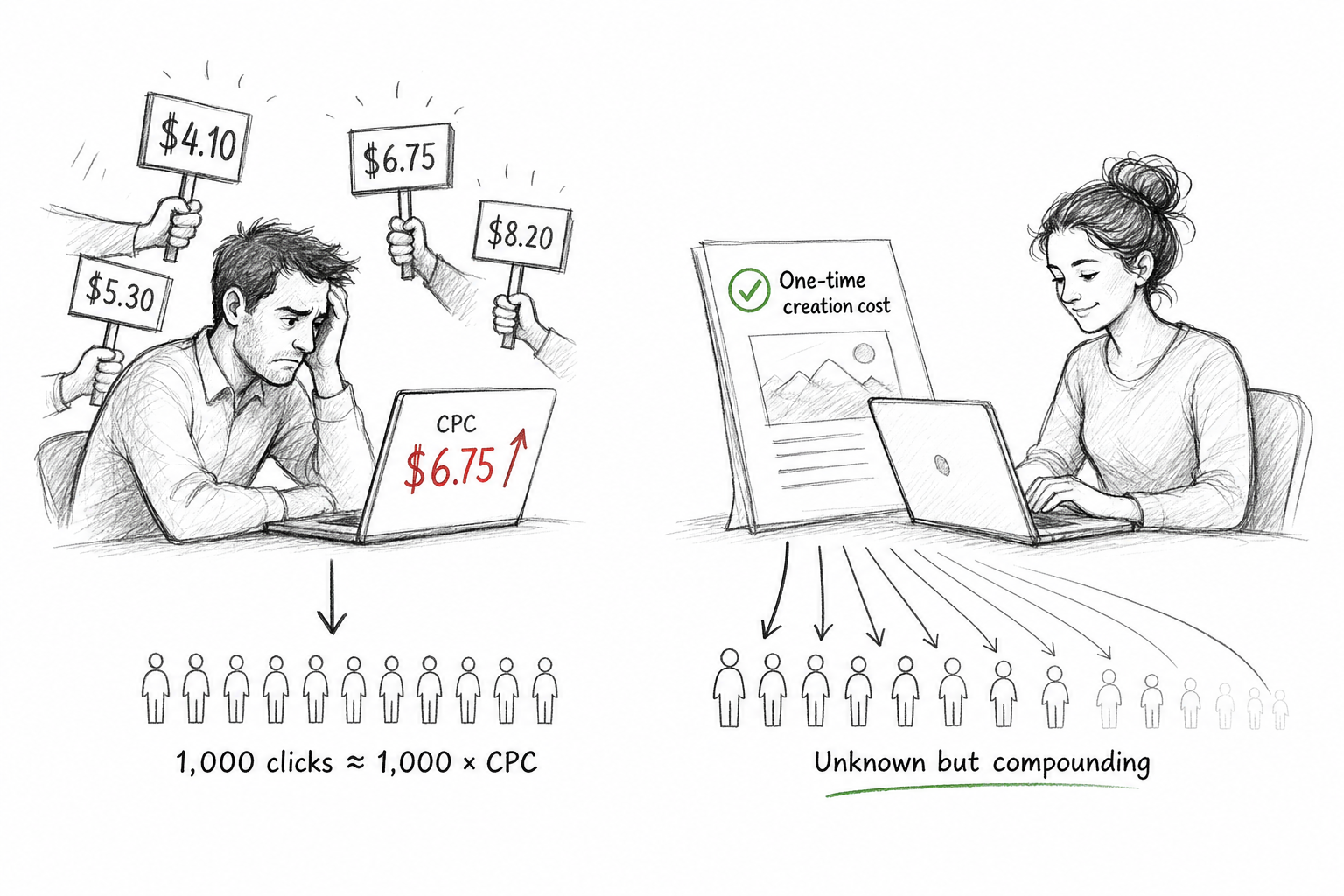
In paid search you bid against everyone else who wants the same query. The price per click is set by the auction, not by you, and it moves with demand. Competitors entering your category, a seasonal spike, a well-funded national brand deciding to test your niche — any of these can raise your cost per click without you changing a single setting.
The cost structure is linear and transparent: a thousand clicks cost roughly a thousand times one click. That linearity is the channel’s biggest strength when you need volume fast, and its biggest weakness when you need volume cheaply. There is no version of paid where visit number 5,000 is cheaper than visit number 50 unless the auction itself gets cheaper.
Organic: a fixed production cost spread over an unknown number of visits
An article has a production cost that is known up front and does not change afterwards. Whether that piece ends up bringing twenty visits or twenty thousand, the cost stays what you paid to write, illustrate and publish it.
Here is the calculation that matters, and you can redo it with your own numbers. Suppose an in-house marketer costs the business 45,000 euros a year all-in, and a decent researched article takes five hours of their time end to end. At roughly 1,600 working hours a year, that is about 28 euros an hour, so one article costs somewhere around 140 euros of internal time. If that article settles at 100 visits a month and keeps that level for two years, the cost per visit is under 6 cents. If it flops and brings 5 visits a month, the same article costs about 1.20 euros per visit — worse than many paid clicks.
That spread is the whole organic story. The average cost per visit of a content programme is not a channel property, it is an outcome of how many of your articles land. Which is why volume and topical coverage matter more than polish on any single piece.
Practical takeaway: price paid traffic per click and organic traffic per published asset, then divide by the visits that asset actually produced. Comparing a monthly ad bill to a monthly content bill without that denominator tells you nothing.
How the two cost curves behave over twelve months
Draw both channels over a year in your head and the shapes are opposites.
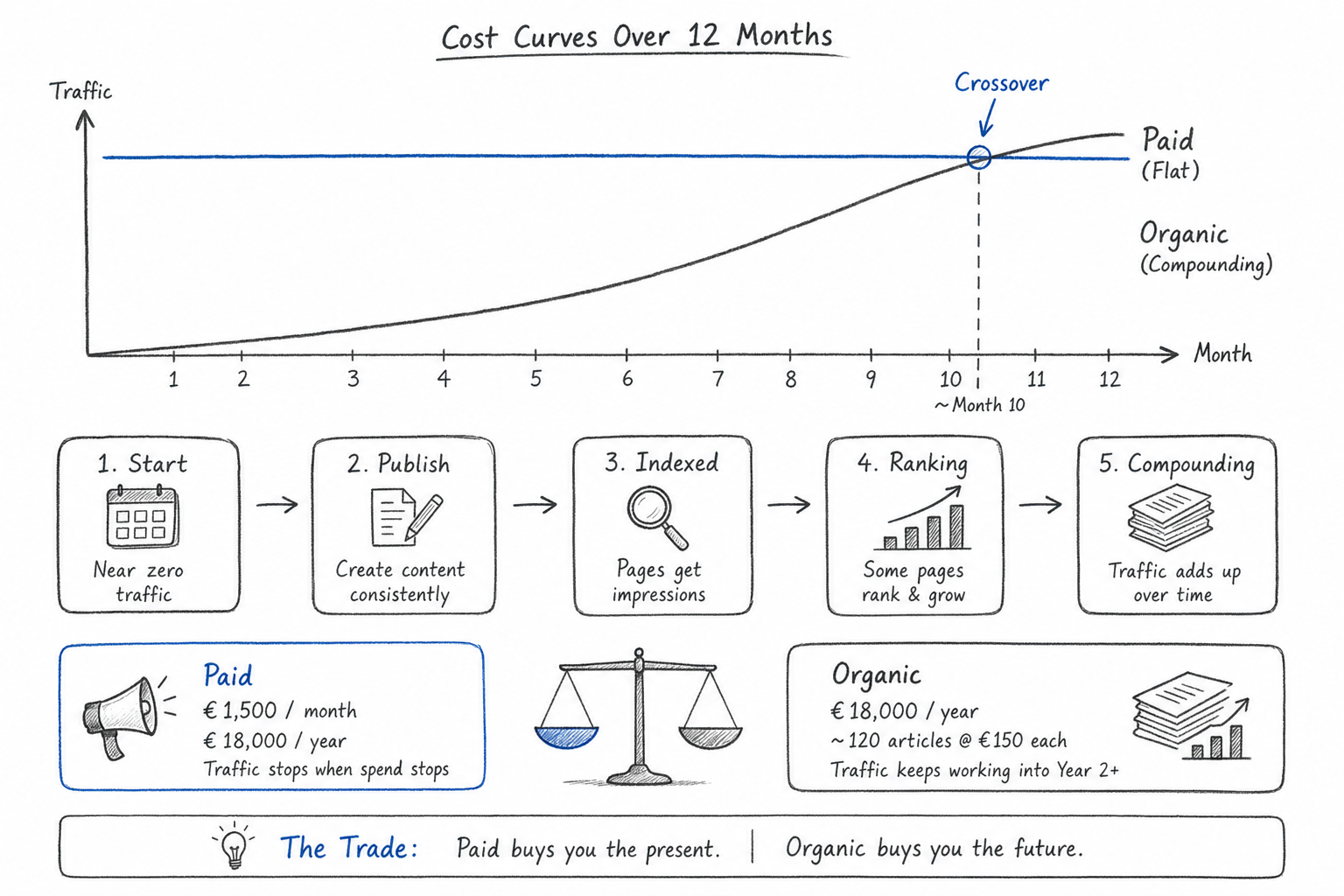
Paid is a flat line. Month one looks like month twelve: same spend, roughly the same traffic, give or take auction drift. There is no accumulation. The money you spent in January buys you nothing in December. The only thing that compounds in paid is your learning — better creatives, tighter targeting, cleaner landing pages — and that compounding is real but modest compared to the cost line.
Organic is a curve that starts near zero. The first weeks produce almost nothing visible. Then indexed pages begin to pick up impressions, a few of them start ranking, and the traffic from month one’s articles adds to the traffic from month two’s, and so on. Nothing you publish ever disappears from the stack unless you delete it. The timeline specifics — how long the ramp actually takes and what the intermediate milestones look like — are covered in the pillar; the point here is the shape, not the dates.
The crossover is the number small business owners actually need. If your paid programme costs 1,500 euros a month, that is 18,000 euros a year for traffic that ends when the year ends. The same 18,000 euros spent on content at, say, 150 euros an asset would buy around 120 articles — a serious topical footprint that keeps working into year two with no additional spend. The catch is that for the first few months of that year, the ad budget would have been bringing visitors and the content would not.
That is the real trade: paid buys you the present, organic buys you the second year. A business that cannot survive a quiet first quarter should not put everything into content, and a business that funds only ads is buying the present over and over again at full price.
Which channel carries more risk, and what kind
Both channels can disappoint you. They disappoint you differently, and the difference matters when the budget is small enough that one bad quarter hurts.
Price volatility: the paid risk
In paid media your unit cost is a market price. You can be profitable at 1.20 euros a click and underwater at 2.40, and the move from one to the other can happen because of decisions made by other companies. You have no contractual protection against it. The levers you keep are quality of landing page, match type discipline, negative keywords and bid caps — useful, but they manage the symptom rather than the price.
There is a second paid risk that gets underestimated: platform policy and account risk. Ad accounts get suspended, creatives get disapproved, categories get restricted. When the channel is your only source of website traffic, a suspension is a revenue outage.
Depreciation and neglect: the organic risk
Content does not have a price risk. It has a depreciation risk. An article written three years ago about a product that changed, a regulation that was replaced, or a method that is no longer best practice loses rankings slowly and quietly. Search engines and AI answer systems both reward freshness signals, and a site whose newest post is from eighteen months ago reads as abandoned to both of them.
The other organic risk is the one nobody budgets for: stopping. Company blogs rarely fail because the writing was bad. They fail because the person who was writing got busy in March and nobody noticed until September. A blog that publishes in bursts — fifteen pieces in launch month, then silence — performs worse than one that publishes three pieces a week for a year, because topical authority is built by sustained coverage, not by a spike.
So the honest risk comparison is: paid risk is external and immediate, organic risk is internal and gradual. You can hedge the first with budget caps and channel diversity. You hedge the second with a publishing system that does not depend on anyone remembering.
Practical takeaway: if a 40% rise in your cost per click would break the business, you are too exposed to paid. If your last published article is more than three weeks old, you are already paying the organic risk.
Side by side: the comparison that drives the budget decision
Everything above condenses into a handful of criteria. The table is a summary of the reasoning, not a substitute for it.
| Criterion | Paid ads | Organic content |
|---|---|---|
| Time to first visit | Same day | Weeks to months |
| Cost behaviour | Linear, per click, forever | Fixed per asset, amortised over time |
| What stops it | Budget pause | Neglect, outdated content |
| Main risk | Auction price and account policy | Slow ramp, depreciation |
| Residual value after 12 months | None | The whole published archive |
| Best fit | Urgent-need and bottom-funnel queries | Research, comparison and problem queries |
Read the last row carefully, because it is where most budget mistakes happen. Paid is unbeatable on immediate-need queries: emergency plumber, same-day delivery, a product someone already decided to buy and is now price-checking. Those searches convert on the spot, the auction price reflects that, and paying it is usually rational.
Organic owns everything that happens before the decision. The person who searches “why does my X keep breaking” is not buying today, and bidding on that query is often an expensive way to buy a reader. Writing the article that answers it costs you once and puts your name in front of that person at the exact moment they start forming an opinion — and increasingly in front of the AI assistant that is summarising the topic for them.
How a small business should actually split the budget
The default advice to “do both” is useless without a sequence. Here is a sequence that respects a limited budget.
Fund the base layer first, at a cadence that compounds
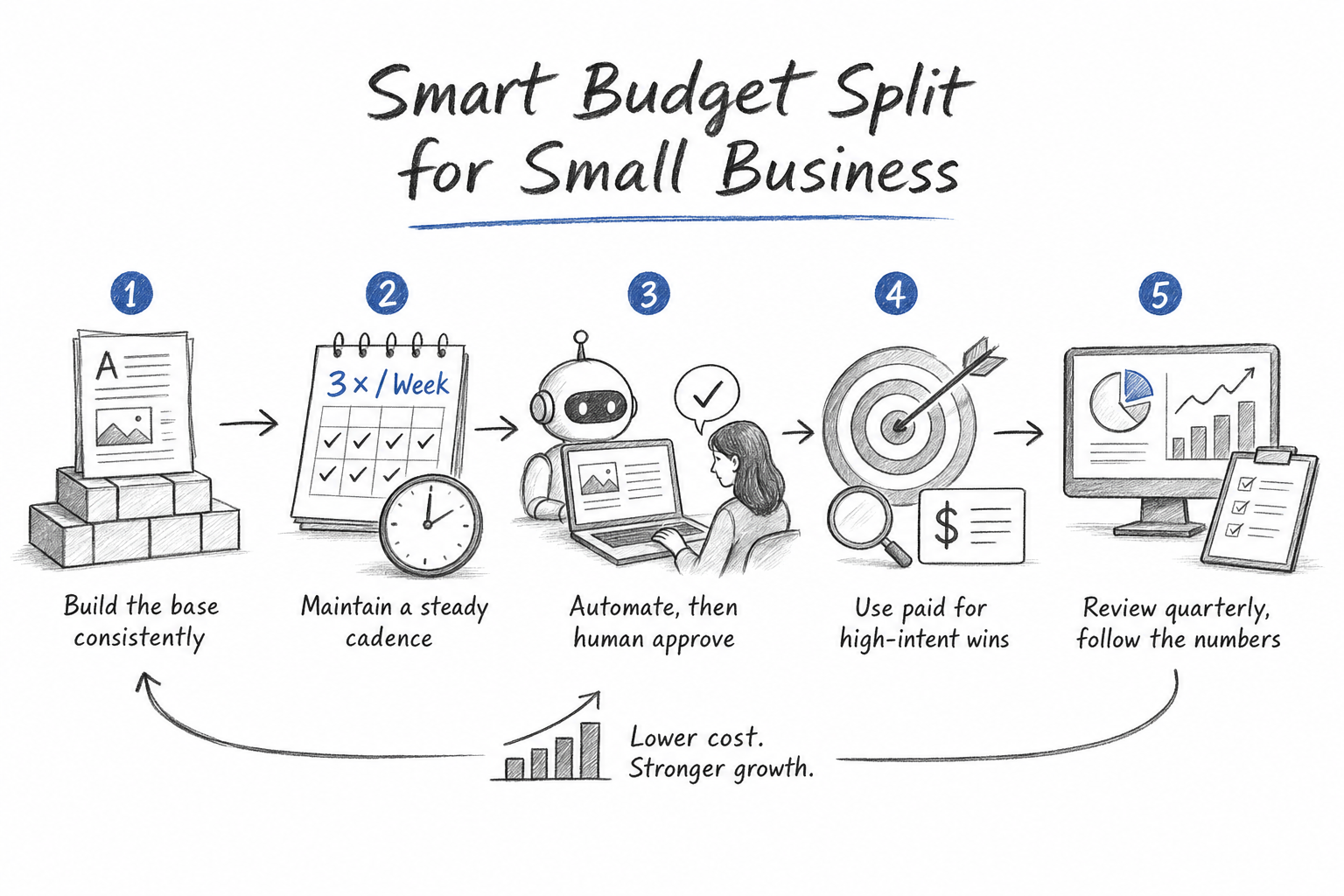
Organic is the base layer because it is the only one that accumulates. The condition is cadence. Three articles a week is the floor for a blog that intends to own a topic — on broad topics, closer to one a day. Below that, coverage builds too slowly to matter against competitors who are publishing properly, and the archive never reaches the size where the stack effect kicks in.
Three a week is 150 or so articles in a year. At the internal-time cost calculated earlier, that is well beyond what most small businesses can write by hand, which is why the realistic route is an automated system that drafts, illustrates and publishes on schedule with a human approving each piece before it goes live. That is the normal way to run a company blog now, and it is also what makes the organic cost per visit land at the low end of the range instead of the high end.
Use paid as the accelerant, on queries where waiting costs you money
Keep a paid budget aimed narrowly at the searches that are ready to convert, plus any short window where timing matters — a launch, a season, a local event. Resist the pull to use paid for awareness-level queries while your content programme is still ramping; that is where ad budgets quietly consume the money that was supposed to build the archive.
Review the split on evidence, not on habit
Every quarter, look at the two denominators: cost per visit and cost per qualified enquiry from each source. When the organic archive starts producing enquiries at a lower cost per lead than paid, shift the marginal euro toward content and keep paid where it still wins. The deeper argument about how this compounds into a falling customer acquisition cost is developed in the piece on how inbound content lowers CAC, and the measurement side — attribution, defending the budget internally — is covered in the guide on measuring content marketing ROI.
Practical takeaway: budget organic as a fixed monthly production cost you do not cut, and paid as a variable you tune. Reversing those two is the most common way small businesses stay dependent on ads.
Frequently asked questions
Is organic website traffic really free?
No. Organic traffic is unpaid per click, but every article carries a real production cost in time or fees, plus the cost of keeping the archive current. The difference is that the cost is fixed per asset rather than charged on every visit, so the cost per visit falls as the article keeps performing over months.
How long before a blog produces meaningful website traffic?
Expect little in the first weeks and a gradual build after that, driven more by how many pages you publish than by how good any single one is. The ramp is slow by nature: pages need to be indexed, gather impressions and earn position. Plan the budget so the business does not depend on content revenue during that period.
Should I pause ads once organic traffic starts working?
Pause the parts of the ad account that overlap with queries your content now ranks for, and keep the ones targeting immediate-need searches where organic rarely wins the click. Cutting paid entirely the moment organic improves usually costs you bottom-funnel volume you were not actually replacing.
What publishing frequency does a small business blog need?
At least three articles a week, sustained without gaps. Lower cadences build topical coverage too slowly to compete, and bursts followed by silence signal an abandoned site to both search engines and AI answer systems. Consistency over a year beats any launch spike.
Can paid ads improve organic rankings?
Not directly. Ad spend does not give a page a ranking advantage. What paid can do is bring early readers to new content, which helps you learn which topics and angles resonate before you invest more writing time in them. Treat it as research spend, not as an SEO lever.
How do I compare the two channels fairly in a spreadsheet?
Use the same denominator for both: cost per visit and cost per qualified enquiry. For paid, that is spend divided by clicks and by leads. For organic, take the production cost of each article and divide it by the visits that article has produced to date, then recalculate quarterly as the number grows.
Does AI-generated content still have to be declared?
Yes. Content produced with the help of artificial intelligence should state it in plain text and in structured data. Transparency is an advantage: it satisfies AI Act obligations, keeps the publishing record auditable, and costs nothing in search performance when the content is genuinely useful.
The decision in one line
Paid ads let you rent attention at a market price that someone else sets; organic content lets you own an asset whose cost per visit falls every month it keeps working. A small business that funds only the rental never stops paying full price for the same visitor, and a business that funds only the asset has to survive the ramp — which is why the archive is the base layer and the ad account is the accelerant on top of it.
If the obstacle is the cost of producing enough articles to make the base layer real, the production side is where the economics are decided: see how the plans are priced and work out what three articles a week would actually cost you compared with a month of ad spend.
This article was produced and published automatically with the help of artificial intelligence.
Start today
A blog like this, on your site
This article was written and published by RankGrove, with the method you read about on the site. Try it free on your WordPress: the first article lands in your drafts within ten minutes.
Start free trial