Content ROI & B2B Lead Generation
B2B Lead Generation: How Inbound Content Lowers CAC

Paid acquisition buys traffic for exactly as long as the card is charged; an indexed article keeps working after the invoice is paid. That difference turns a blog into an asset with a falling marginal cost per lead — but only if publishing stays continuous, because a stale blog stops compounding and starts decaying.
Most finance-minded founders look at b2b lead generation the way they look at any other line item: spend in, pipeline out, divide one by the other. Under that lens paid channels win early. They are measurable on day one, they scale with budget, and the attribution is clean enough to put in a board deck. Content looks worse on every short-horizon metric, which is why it gets cut first when the quarter tightens.
The problem with that comparison is the time window. A click bought through an ad auction is consumed at the moment of purchase. An article that ranks is a produced asset that keeps delivering visits, and now also keeps feeding the answers that AI assistants generate for your buyers. The cost was incurred once; the returns arrive over months. Comparing the two inside a single month is like comparing rent to a mortgage payment and concluding the rent is cheaper because the first cheque is smaller.
This piece explains the mechanism, in economic terms, by which consistent inbound content lowers customer acquisition cost over time — and the specific failure that destroys the advantage. It sits underneath a broader discussion of how a company blog turns into traffic, leads and revenue, which covers the full revenue chain. Here we stay on one question: why does the cost per acquired customer fall, and under what conditions does it stop falling?
Contents
- Why CAC behaves differently for paid and organic channels
- How inbound content compounds instead of accumulating
- What makes a blog stop compounding
- How to model the economics before you commit budget
- Where automation changes the arithmetic
- Frequently asked questions
- The decision this actually comes down to
Why CAC behaves differently for paid and organic channels
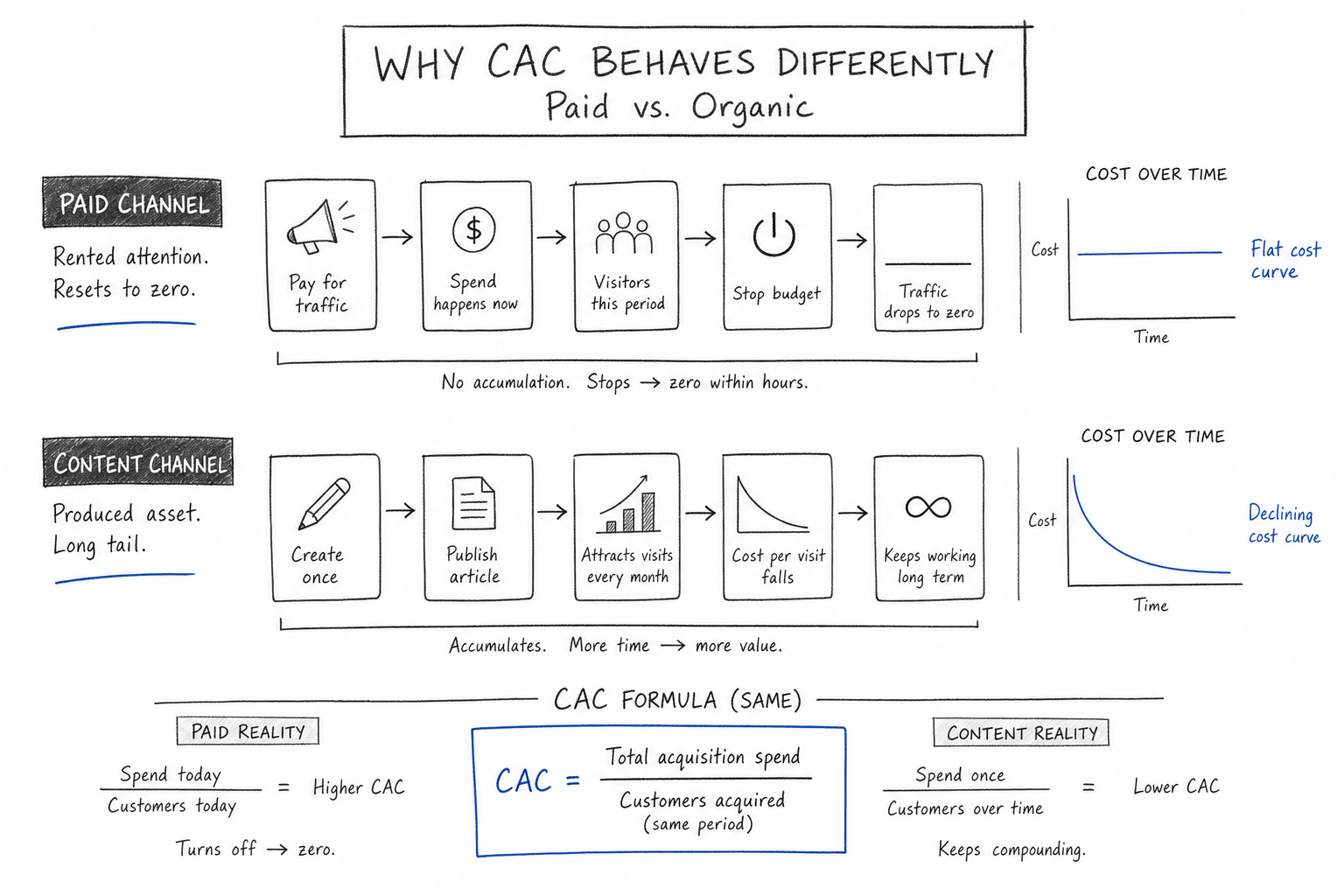
Customer acquisition cost is total acquisition spend divided by customers acquired in the same period. The formula hides something important: it assumes the spend and the result belong to the same window. For paid media that assumption holds almost perfectly. For content it is simply wrong, and the error is what makes content look expensive.
Paid spend is linear and resets to zero
A paid channel has a flat cost curve. Each additional click costs roughly what the last one cost, sometimes more as you push past the cheapest inventory into broader targeting. There is no accumulation: the thousandth click does not make the thousand-and-first cheaper. And when the budget stops, traffic goes to zero within hours. Nothing you paid for last quarter is still working for you this quarter.
That is not a criticism of paid — it is an accurate description of what you are buying. You are renting attention, at auction, against competitors who want the same attention. The price floor is set by whoever in your category has the highest tolerance for a bad payback period. In crowded B2B categories, that competitor usually has venture money and a mandate to grow.
Published content is a produced asset with a long tail
An article has a different cost shape. You pay to produce it once. If it ranks, it attracts visits every month after that, with no additional marginal spend. The cost per visit falls every month the article stays live, because the numerator is fixed and the denominator keeps growing.
Show the arithmetic to yourself with your own assumptions. Suppose producing and publishing one article costs you 150 euros of internal time — five hours of someone whose fully loaded annual cost is around 40.000 euros. If that article brings 40 visits a month, after one month the cost per visit is 3,75 euros. After twelve months it is around 0,31 euros. After two years, under 0,16. No ad auction moves in that direction; auctions move the other way.
The takeaway for a finance reader: treat published content as capex with a depreciation schedule, not as opex consumed in-period. Until you do, every comparison you run will be biased against it.
How inbound content compounds instead of accumulating
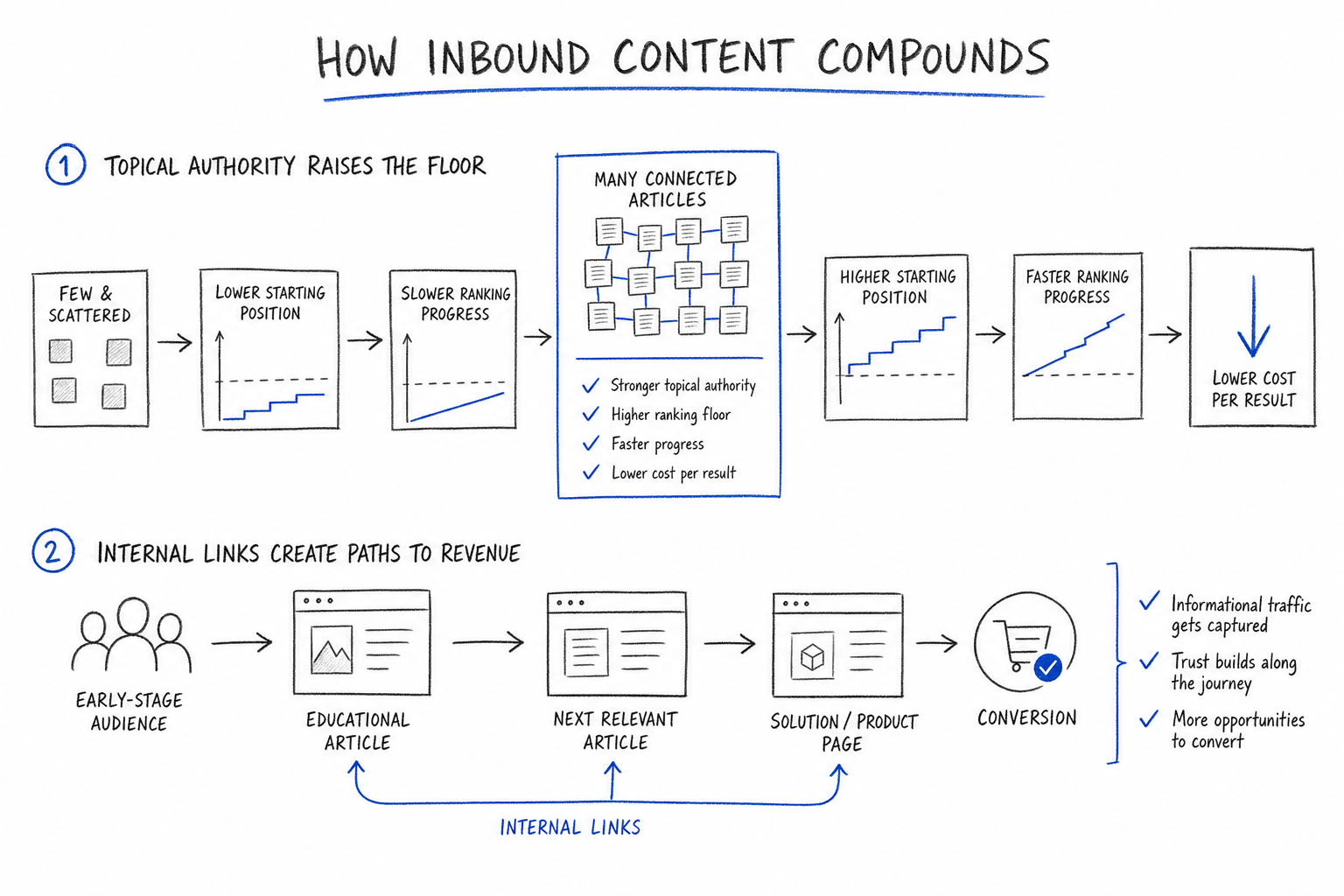
Compounding and accumulating are different. A pile of articles accumulates. A structured body of content compounds, because each new piece makes the existing ones more valuable. Three mechanisms drive this, and they are the reason b2b lead generation through content gets cheaper per unit as volume grows.
Topical authority raises the ranking floor for everything you publish next
Search systems — and the retrieval layers behind AI assistants — assess whether a site is a credible source on a subject, not just whether a single page matches a query. A site with forty connected articles on one subject starts new articles from a higher position than a site with four scattered posts. The fortieth article ranks faster than the fourth did, for roughly the same production cost. That is compounding in its purest form: unit cost falls while unit output rises.
This is also why random publishing underperforms so reliably. A post about pricing, then one about company culture, then one about an industry event, builds authority on nothing. The structural reasons behind this are worth understanding in detail if you have ever wondered why random blog posts rarely rank.
Internal links move traffic from cheap queries to commercial pages
An article that answers an early-stage question attracts people who are not ready to buy. On its own that visit has little value. Connected to the right next article, and from there to a page that sells, it has a path. Internal links are the plumbing that converts informational traffic into commercial traffic without paying a second time for the same person.
Paid channels require you to re-buy the visitor at each stage, or to run retargeting, which is itself a rented audience. Internal linking is free and permanent. Every new article you publish adds link paths into your existing ones, which is a second compounding loop layered on the first. The detailed mechanics of turning that reader into a qualified opportunity are covered separately in the discussion of moving from blog reader to demo request — we will not repeat the funnel steps here.
Long-tail commercial queries are abundant and poorly served by ads
Head terms in B2B are expensive because everyone bids on them. Underneath them sit thousands of specific, low-volume queries with high commercial intent: comparisons, integration questions, compliance questions, pricing-model questions, “does X work for a company like mine” questions. Individually they are too small to justify a campaign. Collectively they are where a large share of serious buyers actually start.
Content can serve these queries economically because the cost of one more article is fixed and small, while the cost of one more ad group is operational overhead forever. A topic tree captures demand that the auction never prices efficiently, and it does so with the same production process you already run. For readers who want the side-by-side monetary comparison of organic and paid at channel level, that analysis belongs in a dedicated piece — this one stays on the mechanism.
What makes a blog stop compounding
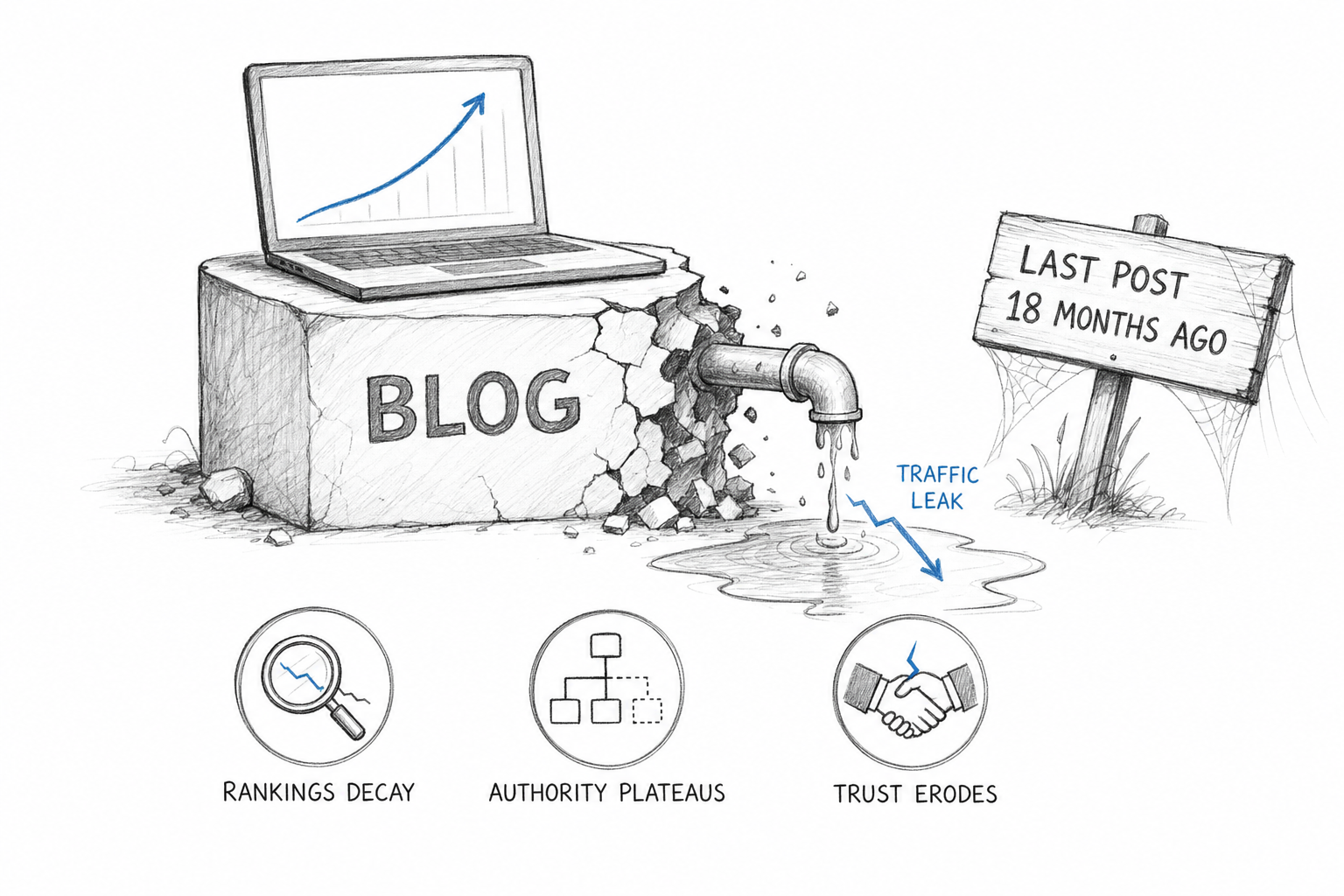
Here is the part that most CAC arguments skip. The compounding effect is conditional. It is not a property of having published; it is a property of continuing to publish. When publishing stops, three things happen in sequence, and the asset starts losing value.
Rankings decay because freshness and competition both move
Nothing holds position by default. Competitors publish newer material on the same queries. Products change, regulations change, the questions buyers ask change. An article written two years ago that has never been revisited slowly slides down, and the slide accelerates once a site shows no publishing activity at all. The traffic curve that was supposed to be flat-and-rising turns into a slow leak.
The topic tree stays incomplete, so authority plateaus
A blog that publishes for three months and then stops has covered maybe a quarter of its subject. The queries it never answered are answered by someone else, and that someone else now owns the topical authority you were building toward. You paid the expensive part of the curve — the early articles that rank slowly — and abandoned the cheap part, where unit economics finally turn in your favour. Stopping early means you absorbed all the cost and collected none of the compounding.
A visibly abandoned blog damages trust
A reader who lands on a post dated eighteen months ago, on a blog whose newest item is also eighteen months old, draws a conclusion about the company. So does an evaluation committee checking whether you are still active in your space. The page is still indexed, still receiving visits, and now working against you.
The practical implication is uncomfortable but clear: cadence is the input variable that determines whether content behaves as an asset or as a sunk cost. A blog that intends to own a subject publishes at least three articles a week, up to one a day on the widest subjects. One a week is a starting posture, not a competitive one — at that rate a topic tree of a hundred articles takes two years, and your market will not wait. Consistency matters more than intensity: three a week sustained for a year beats fifteen in a launch month followed by silence.
How to model the economics before you commit budget
A founder or CFO deciding between channels does not need faith in content marketing. They need a model with explicit assumptions, run over a realistic horizon.
Choose a 24-month window, not a quarter
Pick the horizon first, because it determines the answer. Over one quarter, paid wins almost always. Over twenty-four months, you are comparing a cost that recurs every month against a cost that was incurred once and keeps returning value. If your business genuinely cannot survive twenty-four months, buy traffic — that is the correct decision for your situation, and no content strategy fixes a cash problem.
Put a production cost on your cadence, then hold it fixed
Decide the cadence, price it, and treat it as a fixed monthly line. Three articles a week is roughly thirteen a month. At the 150-euro internal cost used earlier, that is about 1.950 euros of time per month if produced in-house — assuming the time actually exists, which in most small teams it does not. Published listed pricing for an automated system that writes, illustrates and publishes on a schedule is visible and comparable; the point of the exercise is that your cadence has a price either way, and an unpriced cadence is the one that quietly stops.
Measure cumulative leads per euro, not monthly CAC
Monthly CAC is the wrong instrument for an asset with a long tail. Track cumulative organic leads divided by cumulative content spend, plotted month by month. The curve should fall. If it is flat after a year, something structural is wrong: usually the topic tree is scattered, or the articles answer questions nobody with buying intent asks. If it falls steadily, you are watching compounding happen, and you can forecast the crossover point against your paid CAC with reasonable confidence.
| Signal | What it tells you | Action |
|---|---|---|
| Cumulative cost per lead falling | Compounding is working | Hold cadence, extend the tree |
| Cumulative cost per lead flat | Tree is scattered or off-intent | Rebuild the topic map |
| Traffic rising, leads flat | Wrong query intent | Shift toward commercial questions |
| Gaps in the publishing calendar | Asset is starting to decay | Fix the cadence before adding topics |
| Old articles never revisited | Slow ranking slide | Schedule systematic updates |
Read that table as a diagnostic, not a scorecard. Each row points at a different fix, and only one of them — the first — means you should keep doing exactly what you are doing.
Where automation changes the arithmetic
The economic argument for content has always been sound. What broke it in practice was execution: producing three structured, internally linked, technically clean articles a week is more work than most teams sustain past month four. The historical failure of company blogs is operational, not strategic.
What changed is that the production step can now run on a schedule with a person approving, rather than depending on someone finding five free hours in a week that has none. A system that plans the topic tree, writes, builds the internal links and publishes to the site turns cadence from a willpower problem into a configuration. The human stays where judgement matters: approving, correcting positioning, deciding what the company will and will not claim.
Two things make this viable for a company that takes compliance seriously. First, the connection to the site has to be safe and reversible, which is worth checking before you grant any external tool publishing rights — the considerations around letting a tool auto-publish to WordPress are specific and checkable. Second, articles produced with AI assistance should say so, in plain text and in structured data. AI Act transparency obligations apply to published content, and marking it properly is straightforward when it is built into the workflow. Treating disclosure as an advantage rather than a liability is also better positioning: buyers in 2026 are far more suspicious of content that hides its origin than of content that states it.
Automated publishing with human review is the normal way to run a company blog now. The compounding economics described above only materialise for teams that actually publish; the method that gets you there matters less than the fact that the calendar never goes empty.
Frequently asked questions
How long before content marketing lowers our CAC?
Expect the first indexed articles to take a few months to gain position, and the unit economics to turn meaningfully only once a topic tree is substantially complete. At three articles a week, that is typically a matter of several months rather than weeks. The curve to watch is cumulative cost per lead, which should decline steadily rather than jump.
Should we stop paid ads once organic traffic grows?
Rarely. Paid covers the head terms and gives you control over timing; organic covers the long tail and lowers blended cost. The sensible move is to let organic absorb the queries where you now rank well, and reallocate that paid budget to terms organic cannot reach quickly. Reducing paid spend is a consequence, not a goal.
What happens to our rankings if we pause publishing for a quarter?
Existing articles keep ranking for a while, then slide as competitors publish newer material. The larger loss is opportunity: the queries you had not yet covered get answered by someone else, and your topical authority plateaus. A quarter of silence usually costs more than the quarter of production you saved.
Is three articles a week really necessary for b2b lead generation?
If you want to own a subject, yes. A competitive topic tree runs to dozens or hundreds of articles. At one a week you are adding roughly fifty a year, which is too slow against anyone publishing at triple that rate. Three a week, held consistently without gaps, builds coverage fast enough to compete.
How do we account for content costs — capex or opex?
Accounting rules will say opex. Your internal model should treat it as an asset with a depreciation profile, because that is how it behaves. Track spend cumulatively against cumulative leads rather than matching monthly spend to monthly results, otherwise every comparison against paid media will be structurally misleading.
Do AI-generated articles still rank and get cited?
Ranking depends on whether the content answers a real query usefully and sits in a coherent structure, not on how it was drafted. What matters operationally is editorial review, accurate claims, clean technical markup and clear AI disclosure. Content that is thin or duplicated performs badly regardless of whether a human or a model wrote it.
How do we disclose AI-assisted content without undermining trust?
State it plainly on the article and mark it in machine-readable form alongside the publication data. Pair the notice with a visible human approval step so readers know someone is accountable for the claims. Companies that disclose clearly tend to read as more trustworthy than those whose authorship is ambiguous.
The decision this actually comes down to
Content lowers acquisition cost through one mechanism: a fixed production cost spread across a growing, continuing stream of visits, amplified by topical authority that makes each subsequent article cheaper to rank. Paid media has no equivalent mechanism, which is why its CAC is stable at best. The entire advantage, though, is contingent on a calendar that never goes empty — a blog that stalls keeps the costs and loses the compounding.
If you want that cadence to survive contact with a busy quarter, price it and systematise it rather than relying on good intentions. You can see the plans and what each cadence costs and run the comparison against your current paid CAC with your own numbers.
This article was produced and published automatically with the help of artificial intelligence.
Start today
A blog like this, on your site
This article was written and published by RankGrove, with the method you read about on the site. Try it free on your WordPress: the first article lands in your drafts within ten minutes.
Start free trial