Content ROI & B2B Lead Generation
B2B Lead Generation: From Blog Reader to Demo Request

A blog produces demo requests when every article has a defined exit: a contextual CTA matched to the reader’s intent and an internal link that moves them one step closer to a commercial page. The mechanics are placement, wording and link architecture — not traffic volume. This guide walks the whole path, from the first anonymous visit to the form submission.
Most blogs that fail at b2b lead generation fail at the same point: the article ends. The reader finishes a useful piece about a problem they genuinely have, reaches the last paragraph, and finds either nothing or a generic “contact us” box that fits every article on the site equally badly. They close the tab. The content did its job; the path didn’t exist.
You already know a company blog can produce pipeline — the broader argument about whether content earns its keep is covered in our guide to content marketing ROI for a company blog. This article is the playbook underneath it: the specific moves that turn an anonymous reader into someone who fills in a demo form.
What follows is operational. You will set up the prerequisites that make attribution possible, map reader intent to article types, place and word CTAs so they match where the reader actually is, build an internal link structure that routes traffic toward commercial-intent pages rather than in circles, and decide what to gate and what to leave open. At the end you will find the common mistakes that quietly cost conversions, and a realistic picture of what to expect once the structure is in place.
Contents
- What has to be in place before a blog can generate leads
- How to match article intent to the right conversion ask
- Where to place CTAs inside an article, and how to word them
- How internal links route readers toward commercial pages
- Gated and ungated content: deciding what sits behind a form
- The mistakes that quietly cost demo requests
- Frequently asked questions
- What changes once the path exists
What has to be in place before a blog can generate leads
Three things must exist before any CTA tactic matters, and skipping them is why teams conclude “blogging doesn’t convert” when the real problem is instrumentation.
A destination that answers commercial questions
Your blog needs somewhere to send people. That means at least two pages that handle commercial intent: one that explains how the product actually works — mechanism, inputs, outputs, what the buyer has to do — and one that handles price and plan selection. If a reader arrives from a problem-aware article and the only commercial page is a homepage full of positioning language, the journey breaks there. Audit those pages first. A blog can only be as good as what it links to.
Tracking that survives the gap between visit and form
B2B readers rarely convert on the first visit. They read, leave, come back through a branded search three weeks later, and then request a demo. If your analytics only credits the last click, every article looks worthless and the paid channel looks heroic. Set up attribution that retains the first content touch, tag internal CTA links so you can see which article sent the click, and record the landing page of the first session on the lead record in your CRM. Without this, you are optimising blind.
Enough coverage that a reader can land anywhere useful
One article is a lottery ticket. The odds that a stranger’s query matches your single piece of content are low, and the odds that the piece they land on happens to be the one adjacent to a buying decision are lower still. Coverage is what fixes this: a cluster of articles around the same problem, published continuously, so that whichever phrasing the reader types, something of yours is there. In practice that means at least three articles a week on an active topic — a weekly post builds coverage too slowly to compete with anyone serious about the same keywords.
Get these three right and the rest of this guide becomes tactical work. Get them wrong and no amount of CTA copywriting will rescue the funnel.
How to match article intent to the right conversion ask
The single biggest cause of flat conversion rates is asking for the same thing everywhere. A reader researching whether a problem is worth solving and a reader comparing two vendors are in different mental states, and the same button cannot serve both.
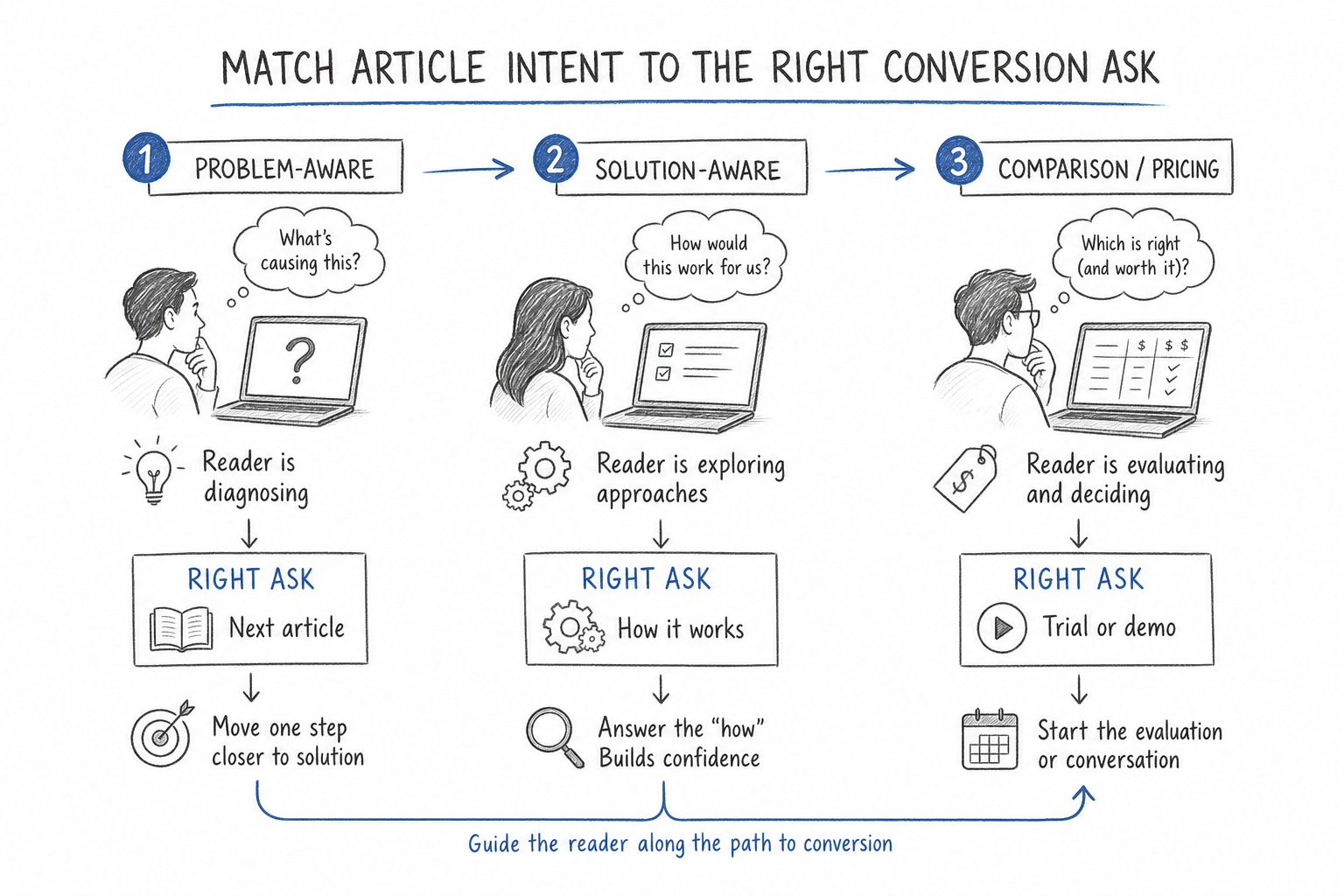
Problem-aware articles: ask for the next read
Someone searching “why does our blog traffic keep dropping” is diagnosing. They do not want a demo; they want to understand what is happening. Asking for a sales conversation here gets ignored and trains the reader to skip your CTAs for the rest of the session. The right ask is another article that deepens the diagnosis — specifically one that sits closer to a solution. You are not giving up the conversion; you are moving the reader one node along the path.
Solution-aware articles: ask for the mechanism
Once the reader accepts the problem and is scanning approaches — in-house team, agency, software, some mix — the useful ask is an explanation of how your approach works in practice. This is where a link to a how-it-works page outperforms a pricing link, because the reader’s open question is “what would this actually look like for us”, not “what does it cost”. Wording follows the question: “see how the publishing cycle runs end to end” converts better than “book a demo” because it promises the information they were already hunting for.
Comparison and pricing articles: ask for the trial or the demo
Articles about selecting a tool, evaluating providers, or what something should cost are read by people with budget in mind. Here the direct ask is correct, and softening it wastes the moment. Put the commercial CTA high — within the first screen — not only at the end, because readers at this stage scan rather than read. Our piece on SEO software selection criteria is the kind of article where an early, explicit CTA belongs.
The takeaway: write the CTA after you have decided which of the three states the article serves, and never reuse one template across all three.
Where to place CTAs inside an article, and how to word them
Placement is a function of reading behaviour, not of page length. B2B readers scan the first screen, drop into the section that matches their question, and leave. A single CTA at the bottom reaches only the minority who read linearly to the end.
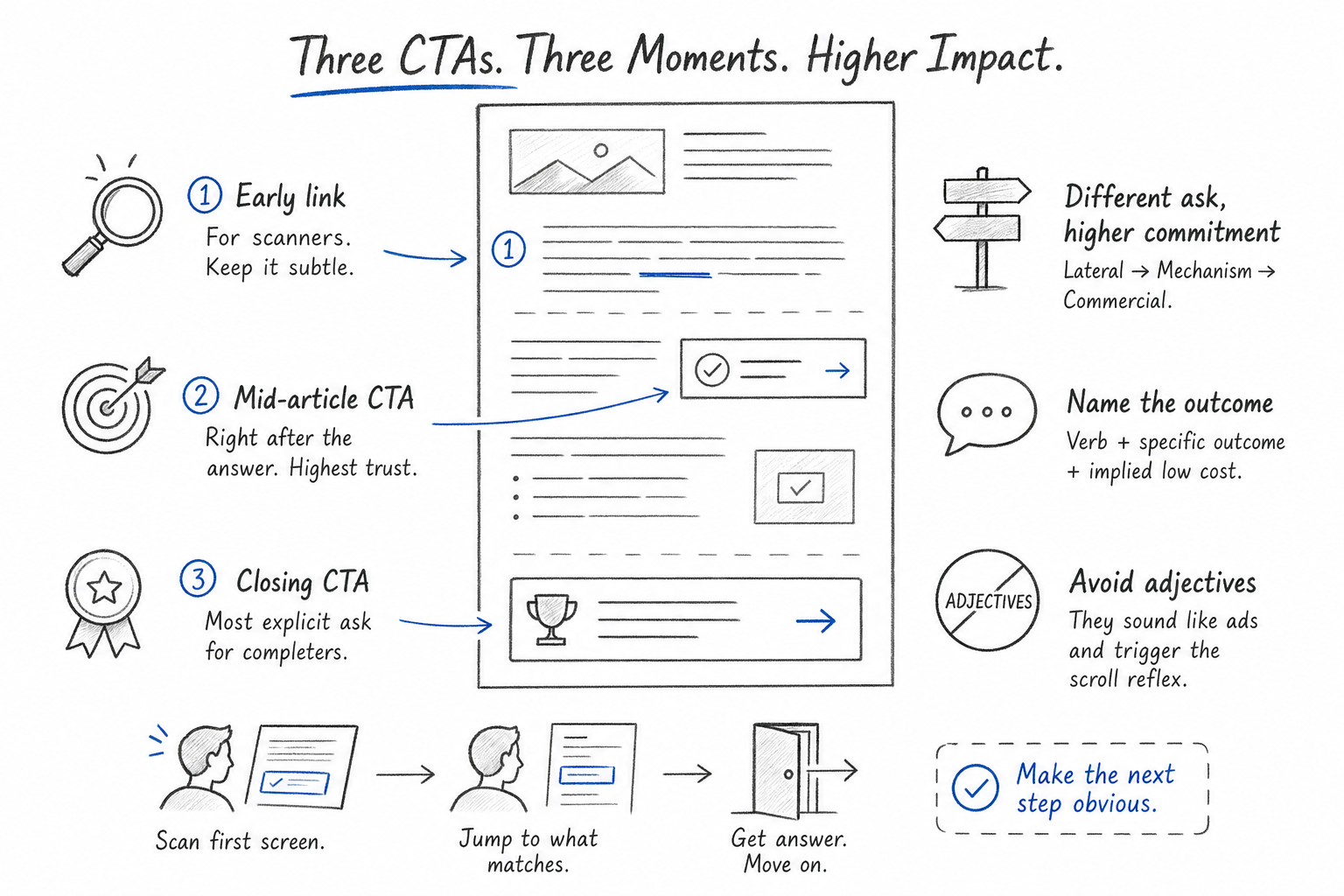
The three positions that carry weight
The early contextual link, inside the second or third paragraph, catches the scanner who has already decided this article confirms what they suspected. Keep it inline and understated: a linked phrase in running text, not a box. The mid-article CTA, placed immediately after the section that solves the reader’s main question, catches people at the moment of highest trust — they just got value, and the ask feels earned. The closing CTA catches the completers and should be the most explicit of the three, because anyone still reading has invested real attention.
Three positions, three different asks, escalating in commitment. The early link is usually lateral (another article), the mid one points at mechanism, the closing one makes the commercial request.
Wording logic: name the outcome, not the action
“Request a demo” describes work the reader has to do. “See what three articles a week looks like on your own site” describes something they get. The pattern that holds up is: verb + specific outcome + implied low cost. Avoid adjectives entirely — “powerful platform”, “comprehensive solution” and similar words measurably weaken a CTA because they read as advertising and trigger the scroll reflex.
Match the vocabulary of the CTA to the vocabulary of the article. If the piece talks about publishing cadence, the CTA should talk about publishing cadence. A reader who has spent six minutes in one semantic field and then meets a CTA written in generic marketing language experiences a tonal break, and the break costs clicks.
Form length and the friction trade-off
Every field you add filters out some real buyers along with the tyre-kickers. For a demo request from a blog reader, ask for work email and company — anything beyond that should earn its place by changing what happens next. If your sales process genuinely routes by company size, ask for company size. If it does not, deleting the field is a free conversion gain.
Set up these three positions as a standard in your article template, then vary the ask by intent rather than reinventing placement each time.
How internal links route readers toward commercial pages
This is the part most teams treat as an afterthought, and it is where the compounding happens. Internal linking is not a ranking trick bolted on at the end; it is the road network that decides whether readers wander or arrive.
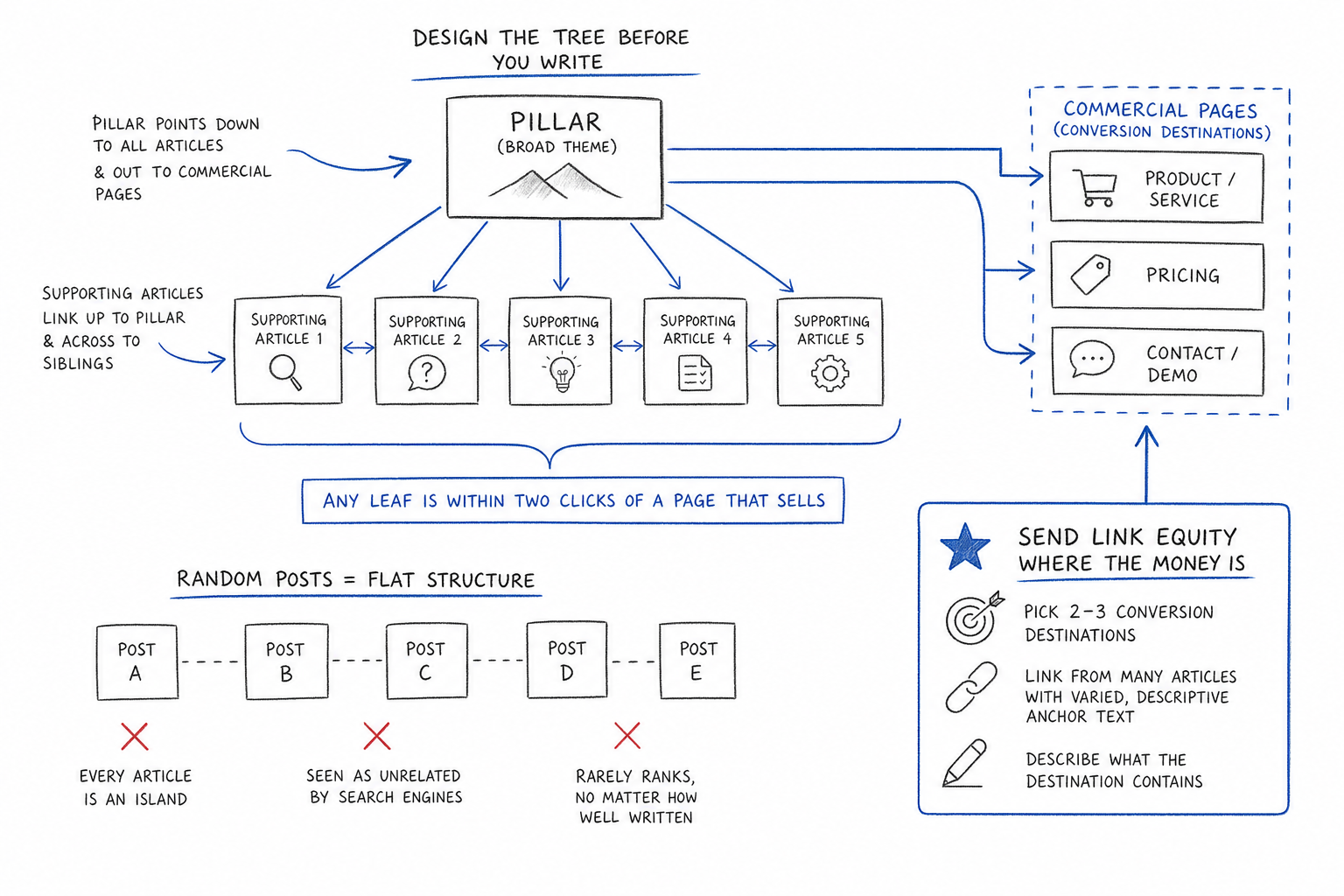
Design the tree before you write the articles
A topic tree has a pillar article that owns the broad theme, supporting articles that each answer one specific question inside it, and links that flow in a deliberate direction: supporting articles point up to the pillar and across to their closest siblings, while the pillar points down to all of them and out to the commercial pages. The result is that a reader entering through any leaf — however narrow their original query — is always within two clicks of a page that sells.
Random posts produce a flat structure where every article is an island. Search engines read that structure as a set of unrelated pages rather than evidence of depth on a subject, which is a large part of why scattered blog posts rarely rank no matter how well each one is written.
Send link equity where the money is
Commercial pages usually have few external links pointing at them, because nobody cites a pricing page. Internal links are how those pages accumulate authority. Decide which two or three pages are your conversion destinations, then make sure a meaningful share of your articles link to them with varied, descriptive anchor text that describes what the page contains. Repeating the identical anchor across fifty articles looks manipulated; describing the destination differently each time looks like editing.
Use the sibling link as a conversion step
The lateral link between two supporting articles is underrated. A reader on a diagnostic article who clicks through to a comparison article has moved themselves down the funnel without any sales pressure, and the comparison article is where your explicit CTA lives. Measured that way, the sibling link is a conversion event, even though no form was filled. Instrument it: if you cannot see which internal links readers actually follow, you cannot improve the routes.
Map your existing articles into pillar, supporting and orphan buckets this week. The orphans are your fastest win — each one needs an upward link and a sibling link, and that is thirty minutes of work per article.
Gated and ungated content: deciding what sits behind a form
The gating question gets argued ideologically and should be decided mechanically. A gate converts attention into a contact record at the cost of reach, and whether that trade is good depends on what the asset is for.
Leave ungated anything that needs to be found, cited or linked. Articles that answer search queries, explanations that you want AI assistants to quote, comparisons that shape how buyers frame the category — these earn nothing behind a form, because the traffic never arrives in the first place. Gate assets whose value is self-evident before opening: a template, a calculator, an assessment, a structured document that saves the reader hours of assembly. The test is simple: can the reader judge the value from the title alone? If yes, a gate is viable. If they need to read it to know whether it helped, the gate kills it.
There is a middle path worth more than either extreme. Publish the full article openly and offer a related working asset — a checklist version, a fillable template — in exchange for an email, inside the article. The reader who wanted information gets it and may link to it; the reader who wants to act identifies themselves. You capture intent rather than curiosity.
| Asset type | Open or gated | Why |
|---|---|---|
| Problem-diagnosis article | Open | Needs to rank and be cited |
| Comparison or selection guide | Open | Buying-stage traffic you cannot afford to block |
| Template or calculator | Gated | Value is clear from the title |
| Audit or assessment | Gated | High intent, qualifies naturally |
| Companion checklist inside an open article | Gated | Captures action intent, not curiosity |
One warning about demo forms specifically: treat them as a separate category from gated content. A demo request is not an exchange of data for a file, it is a request for a conversation, and the page should read that way — what happens after submission, who gets in touch, how long it takes. Vagueness at that final step costs more conversions than any form field.
Decide your gating policy once, write it down, and apply it by asset category rather than debating it per piece.
The mistakes that quietly cost demo requests
Some errors are visible in the data; these are the ones that are not.
Publishing in bursts. A month of intensive output followed by silence leaves a half-built tree: pillars without enough supporting articles, articles without siblings, and a visible last-updated date that tells a careful buyer the company lost interest. Three articles a week sustained for a year produces a structure that routes traffic; fifteen in a launch month produces a graveyard.
Linking only upward. Many teams add pillar links dutifully and never add lateral ones, which means every reader journey ends at the same overview page. The pillar is a hub, not a terminus, and it must push readers back down and out to commercial pages.
One CTA template sitewide. A single reusable block is operationally convenient and conversionally weak, for the reasons covered above. If you must standardise, standardise three blocks — one per intent stage — and pick per article.
Hiding the AI disclosure. If articles are produced with AI assistance, say so plainly in the text and in structured data. Under the transparency requirements now applying to AI-generated content in Europe, this is a legal expectation, and burying it in a footer is both risky and unnecessary. Buyers respond well to a stated process, and a visible note that a person reviewed and approved each article reads as quality control rather than apology. The question of who should review AI articles before publishing is worth settling before you scale output.
Measuring conversion per article instead of per path. A diagnostic article that generates zero direct demo requests but feeds the comparison article that generates them all is the most valuable asset you have. Judge it by assisted conversions or you will delete the engine and keep the exhaust pipe.
Audit for these five every quarter; they reappear as soon as attention moves elsewhere.
Frequently asked questions
How long before a company blog starts producing demo requests?
Expect the first qualified requests once a cluster has enough coverage to catch varied queries and enough internal structure to route readers toward commercial pages. That generally means several months of uninterrupted publishing rather than weeks. Articles targeting comparison and pricing queries convert soonest, because the reader arrives with budget already in mind, so prioritise those inside each cluster.
How many CTAs should one article contain?
Three, placed at different depths and with escalating commitment: an inline contextual link early, a mechanism-oriented CTA after the section that solves the reader’s main question, and an explicit commercial ask at the end. More than three starts reading as advertising. Fewer than three reaches only the minority of readers who finish the article linearly.
Should blog articles link directly to the pricing page?
Yes, from articles that serve buying-stage intent — comparisons, selection criteria, cost questions. Avoid it on early diagnostic articles, where the reader has not yet accepted the problem and a price link reads as premature. Those articles should link laterally to the next article in the path instead, which does the qualifying work for you.
Does gating content hurt SEO?
Gating removes the asset from search entirely, since there is nothing crawlable behind the form. The practical approach is to publish the explanatory article openly so it can rank and be cited, then offer a working companion asset — template, checklist, calculator — behind a form inside that article. You keep the visibility and still capture contact details from readers ready to act.
How do I know which article generated a lead?
Record the landing page of the first session on the lead record in your CRM, tag internal CTA links so clicks are attributable to a source article, and report on assisted conversions rather than last click. Without first-touch retention, diagnostic articles appear worthless even when they start every journey that ends in a demo request.
What publishing frequency does lead generation actually require?
At least three articles a week on an active topic, up to one a day on broad themes, held without gaps. Coverage is what determines how often a reader’s query matches something of yours, and how complete the internal link network becomes. A weekly post builds that network too slowly to compete, and sporadic bursts leave clusters half-built.
Do we have to disclose that articles were written with AI?
Yes. European transparency rules require AI-generated published content to be marked, and the practical implementation is plain-text disclosure plus machine-readable structured data, alongside a record of who reviewed and approved each piece. Stated openly, with human review documented, this reads as editorial process rather than a weakness, and it removes compliance risk entirely.
What changes once the path exists
The shift is from thinking about articles as individual assets to thinking about them as a routing system with defined entrances and exits. Traffic volume stops being the headline number; what matters is how many entrances exist, how reliably each one leads somewhere commercial, and whether the ask at each stage matches the reader’s actual question. Articles that generate no direct conversions earn their place by feeding the ones that do.
That system only compounds if it keeps being built — a tree with three branches routes almost nobody, and a tree that stopped growing in March tells every careful buyer exactly what they need to know. If you want the structure, the cadence and the compliance handled as one process rather than five separate jobs, see the plans and start a trial and get the first cluster live.
This article was produced and published automatically with the help of artificial intelligence.
Start today
A blog like this, on your site
This article was written and published by RankGrove, with the method you read about on the site. Try it free on your WordPress: the first article lands in your drafts within ten minutes.
Start free trial