AI Act Compliance & Content Governance
Does a US AI Writing Tool Create AI Act Compliance Risk?
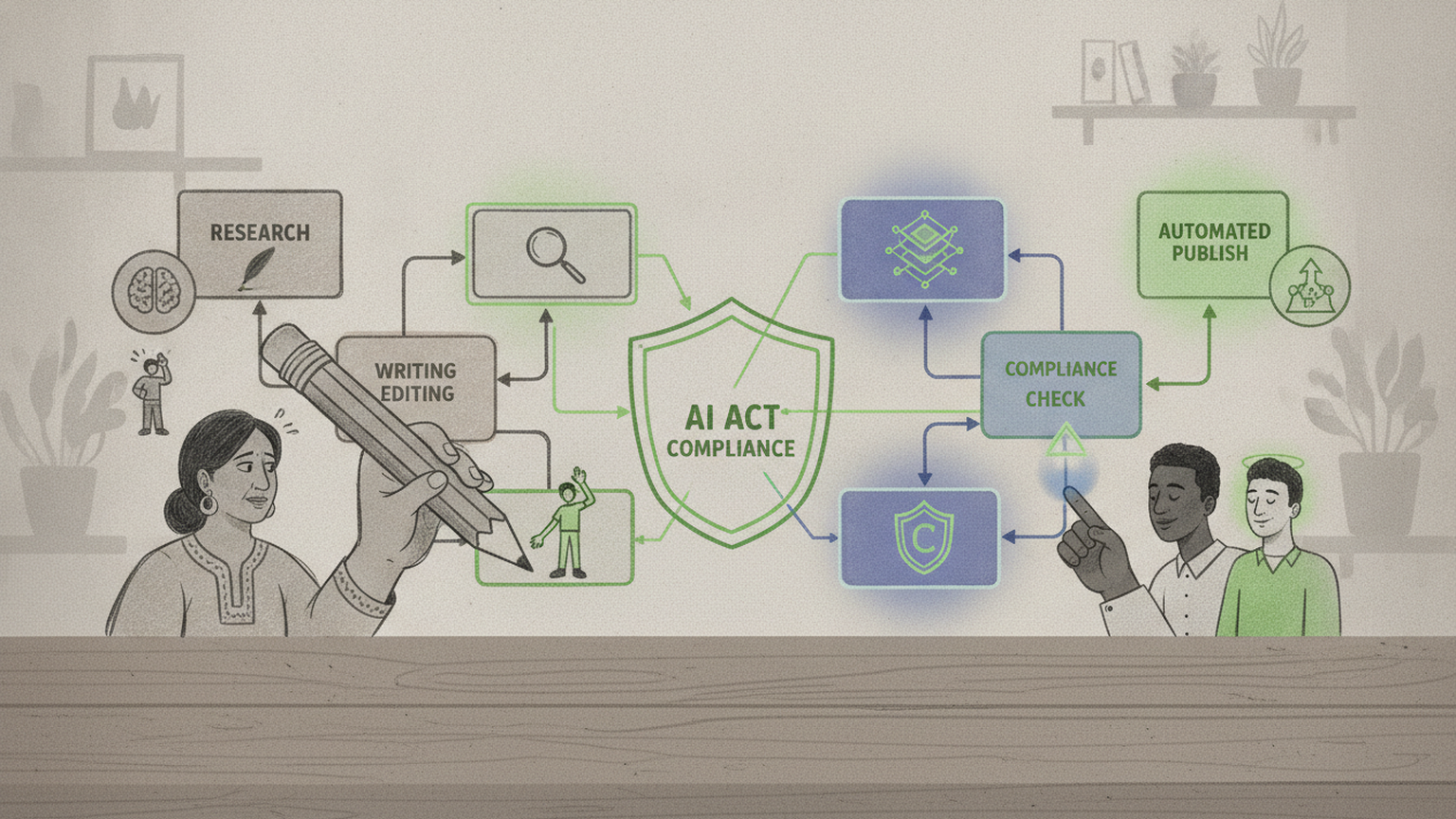
Buying an AI writing tool from a US vendor does not transfer your transparency duties to that vendor: under EU rules you remain the party that publishes, and the disclosure obligation sits with you. What changes with a foreign generic tool is that none of the compliance work — marking content as AI-assisted, logging who approved it, producing a transparency note — is done for you. The practical decision is between doing that work by hand, forever, or running a workflow where it happens automatically at publish time.
A marketing manager asked a question that deserves a straight answer: “our AI writing tool is American, does that alone put us at risk under the AI Act?” The short version is no, and yes — for different reasons than most people assume.
The nationality of your vendor is not what creates exposure. What creates exposure is publishing AI-assisted content on your own domain, under your own brand, without the disclosure and the paper trail that European rules expect from the party doing the publishing. That party is you. If the tool is built in Ohio or in Bologna changes nothing about who carries the duty. It changes a great deal about how much manual work you have to do to satisfy it, and about how easily you can prove you did.
This article is a comparison, not a legal lecture. The general scope of the regulation — who counts as a provider, who counts as a deployer, which obligations attach to which role — is covered in the pillar on what businesses publishing with AI must do under the EU AI Act. Here we stay on one narrow question: how a generic US-built AI writer compares with a tool designed around European obligations, when the thing you are comparing is who does the compliance work.
You will get three things: what genuinely changes legally when the vendor sits outside the EU, the questions to put to any AI writing vendor before you sign, and a side-by-side view of a compliance-aware workflow versus a plain text generator.
Contents
- What actually changes legally when your AI writing tool is US-based
- The criteria that actually separate one tool from another
- Scenario one: a generic AI writer with no EU compliance features
- Scenario two: a tool where compliance is part of the publishing step
- Comparing the two workflows side by side
- Frequently asked questions
- The decision in one line
What actually changes legally when your AI writing tool is US-based
Two separate issues get collapsed into one worry, and separating them dissolves most of the confusion.
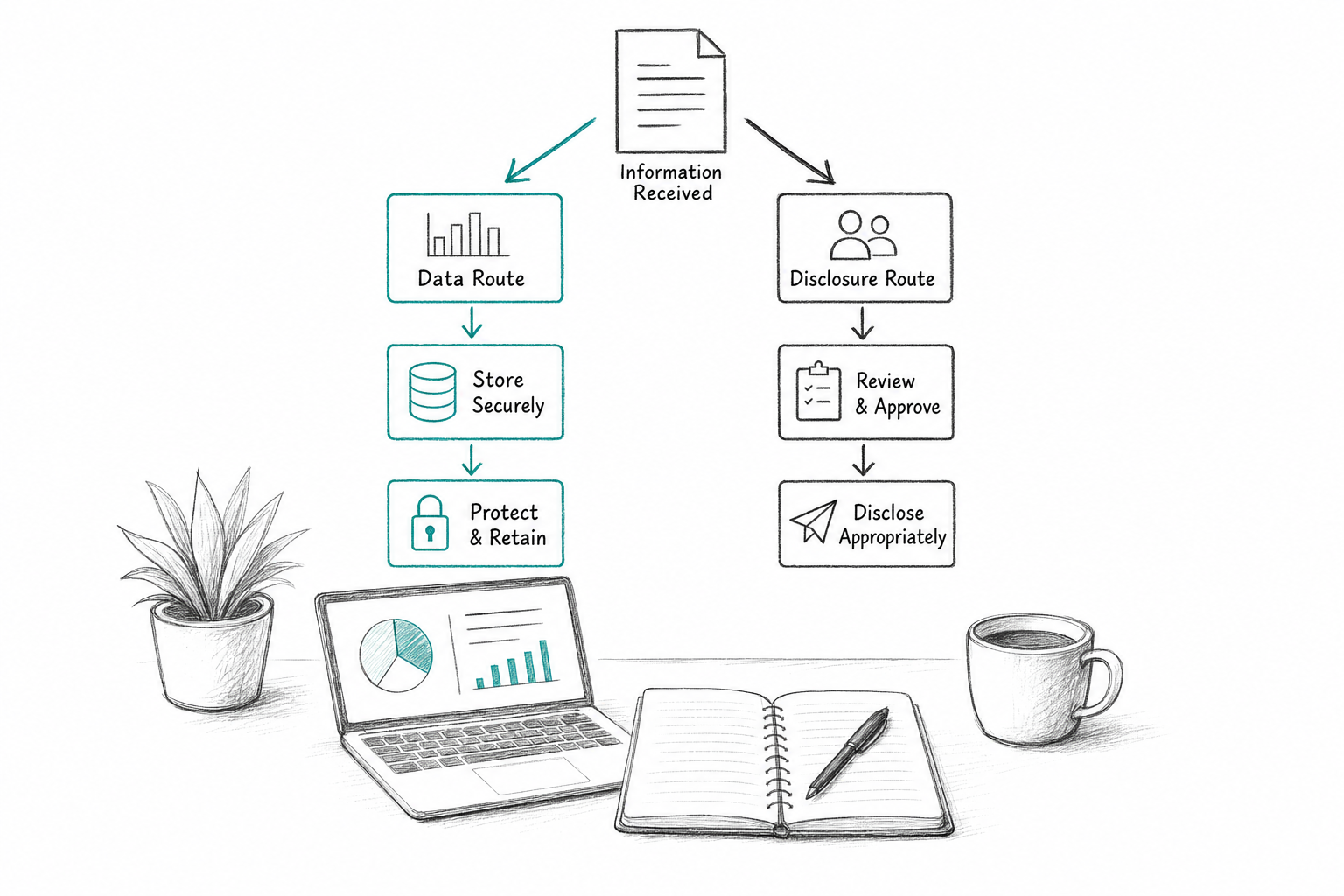
Data residency is a different problem from AI Act compliance
Where your prompts and drafts are processed is a data protection question. It concerns personal data, transfer mechanisms, and your privacy documentation. It is a real question and it deserves an answer from your vendor, but it is not the same question as whether your published articles satisfy AI transparency rules.
You can have a perfectly clean data transfer arrangement and still publish a hundred AI-assisted articles with no disclosure anywhere on them. Conversely, you can process everything inside the EU and still be exposed, because nothing on the page tells a reader — or a machine — that the text was generated with AI assistance. Solving one does not solve the other. Treat them as two lines on your checklist, not one.
The publishing business is the deployer, and the duty follows the deployer
European rules on artificial intelligence distinguish between the organisation that builds and supplies a system and the organisation that puts it to use in its own activity. When you use a writing tool to produce articles for your company blog, you are in the second category. The vendor’s location, incorporation, or choice of jurisdiction does not move you out of it.
This is the single most important thing to internalise: you cannot outsource your own transparency obligation by buying software abroad. A US vendor has its own set of duties as a provider of a general-purpose AI system, and those duties are theirs. Yours — telling readers and machines that the content was produced with AI assistance — remain yours regardless. There is no contract clause that transfers them, and any vendor implying otherwise is selling comfort rather than compliance.
What foreign vendors typically leave undone
Most mainstream AI content tools were designed in a market where no equivalent disclosure requirement exists. They are honest products built for a different regulatory environment. The consequence is predictable: they optimise for draft quality and speed, and they have no reason to ship a marking mechanism, an approval log, or a transparency page, because their primary buyers were never asked for them.
That is not a legal defect in the tool. It is a gap in your workflow that you inherit the moment you publish. The takeaway: assume that with a generic foreign tool, one hundred percent of the compliance work sits on your side of the table.
The criteria that actually separate one tool from another
If vendor nationality is the wrong criterion, what are the right ones? Four, in order of how much manual labour they save you.
Does it mark content as AI-assisted, in text and in structured data
A disclosure that only a human can see is half a disclosure. The visible note tells your reader; machine-readable marking in the page’s structured data tells crawlers, aggregators and AI systems that consume your content. Both matter, and they are not interchangeable.
Ask the vendor a direct question: when this article lands on my WordPress site, does it arrive with an AI-assistance note in the body and a corresponding field in the structured data? If the answer is “you can add that yourself”, you now know who is doing the work. Multiply that by three articles a week for a year and the cost of “you can add that yourself” becomes visible.
Does it log who approved what, and when
Transparency is what the reader sees. Governance is what you can prove afterwards. If someone asks in eighteen months which articles were AI-assisted, who reviewed them and on what date, a folder of Google Docs will not answer.
An approval log is boring infrastructure and it is the part nobody thinks about until they need it. The useful question is whether the tool records a human approval event tied to each published piece, with a timestamp and an identity, or whether approval happens in a chat message that will be unsearchable by the time it matters.
Does it produce a transparency note you can actually publish
Marking individual articles is one layer. A page explaining how your organisation uses AI in content production — which parts are automated, where the human review sits, how readers can reach you about it — is the other. It is short, it is written once, and it does more for trust than any disclaimer at the bottom of a post.
Generic writers do not produce this because it is not a content deliverable, it is a governance artefact. If you are building the workflow yourself, put it on your list.
Does it publish, or does it hand you a draft
This one sounds like a productivity question and it is really a compliance question. Tools that stop at the draft leave the final step — the step where marking, disclosure and approval actually attach to a live URL — to a human doing copy-paste. Manual steps are where consistency dies. The article published on a Friday afternoon by whoever was available is the one missing the note.
A workflow that carries the marking through to the published page removes an entire class of human error. If you want to see how that plumbing should behave, the piece on WordPress auto-publishing and what to look for walks through the mechanics.
Scenario one: a generic AI writer with no EU compliance features
Picture the realistic version of this setup, because it is the one most EU businesses are running right now.
You have a subscription to a capable text generator. You brief it, it produces solid drafts, someone on the team edits and pastes into WordPress. Output volume is good. Quality is acceptable. Nobody is being reckless.
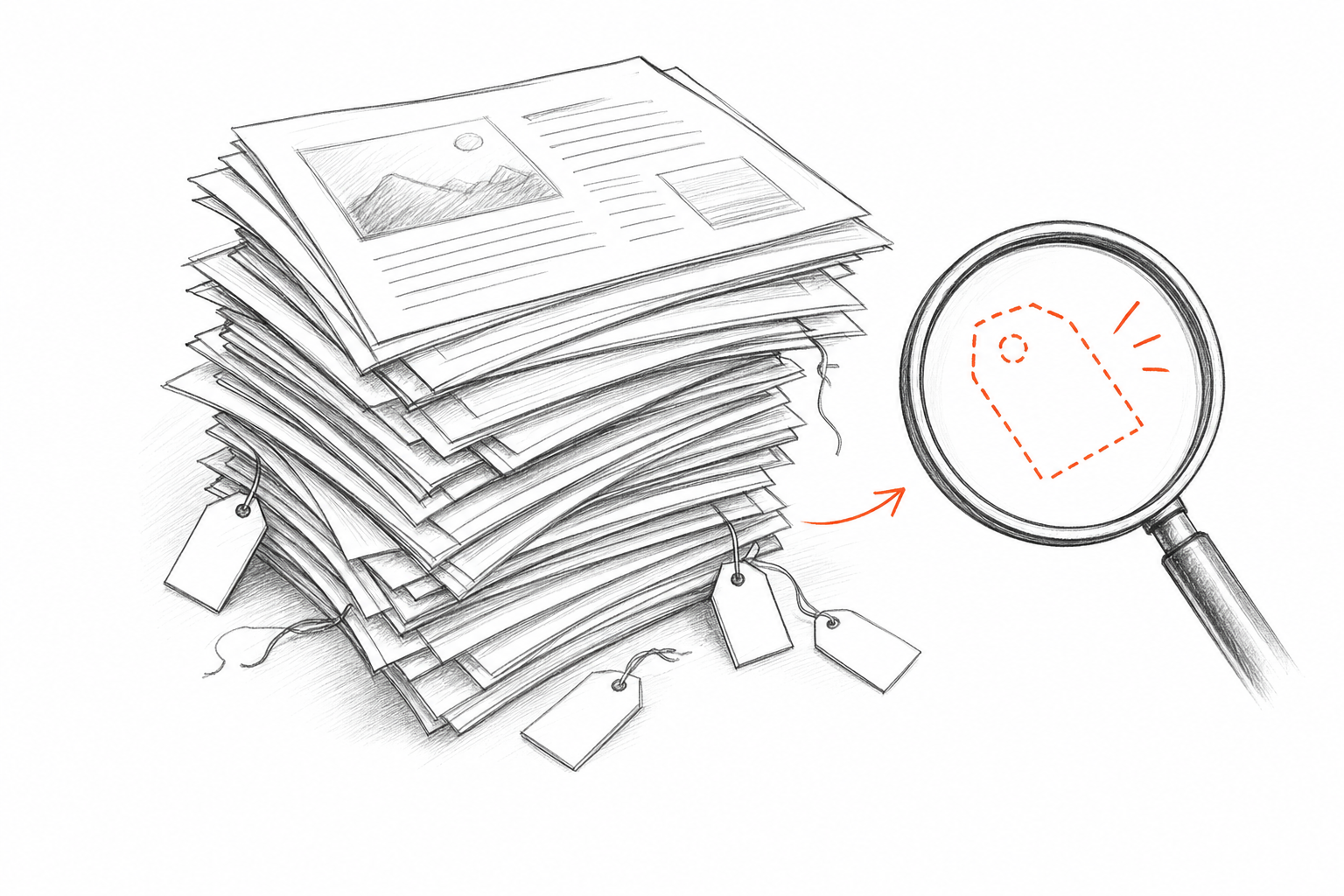
Now trace the compliance path. The AI-assistance note gets added if the editor remembers. Structured data marking is almost certainly absent, because adding a custom field manually to every post is the kind of task that survives two weeks. Approvals exist as Slack messages. There is no transparency page. And crucially, there is no single person who can tell you which of your last ninety articles were AI-assisted, because nothing recorded it.
None of this makes the tool illegal, and none of it makes the vendor a bad actor. It makes your blog an undocumented archive. The risk is not a dramatic enforcement scene; it is the mundane problem of being asked a simple factual question about your own published content and not having the answer.
When this scenario is still the right choice
Honesty requires saying it: if you publish occasionally, in a single language, and a named person reviews every piece and adds the note by hand, a generic writer plus discipline works. The manual overhead per article is small when the article count is small.
The arrangement breaks at volume. A blog that intends to own a topic publishes at least three articles a week, and on broad topics closer to one a day — because topic coverage builds in weeks, not in quarters. At that cadence, manual compliance steps stop being a habit and become a queue that nobody clears. If you are unsure what cadence your situation demands, the analysis of how many blog posts a small business actually needs sets the baseline.
Scenario two: a tool where compliance is part of the publishing step
The alternative is not “a European vendor” as a marketing badge. It is a tool where the compliance artefacts are produced by the same action that produces the article.
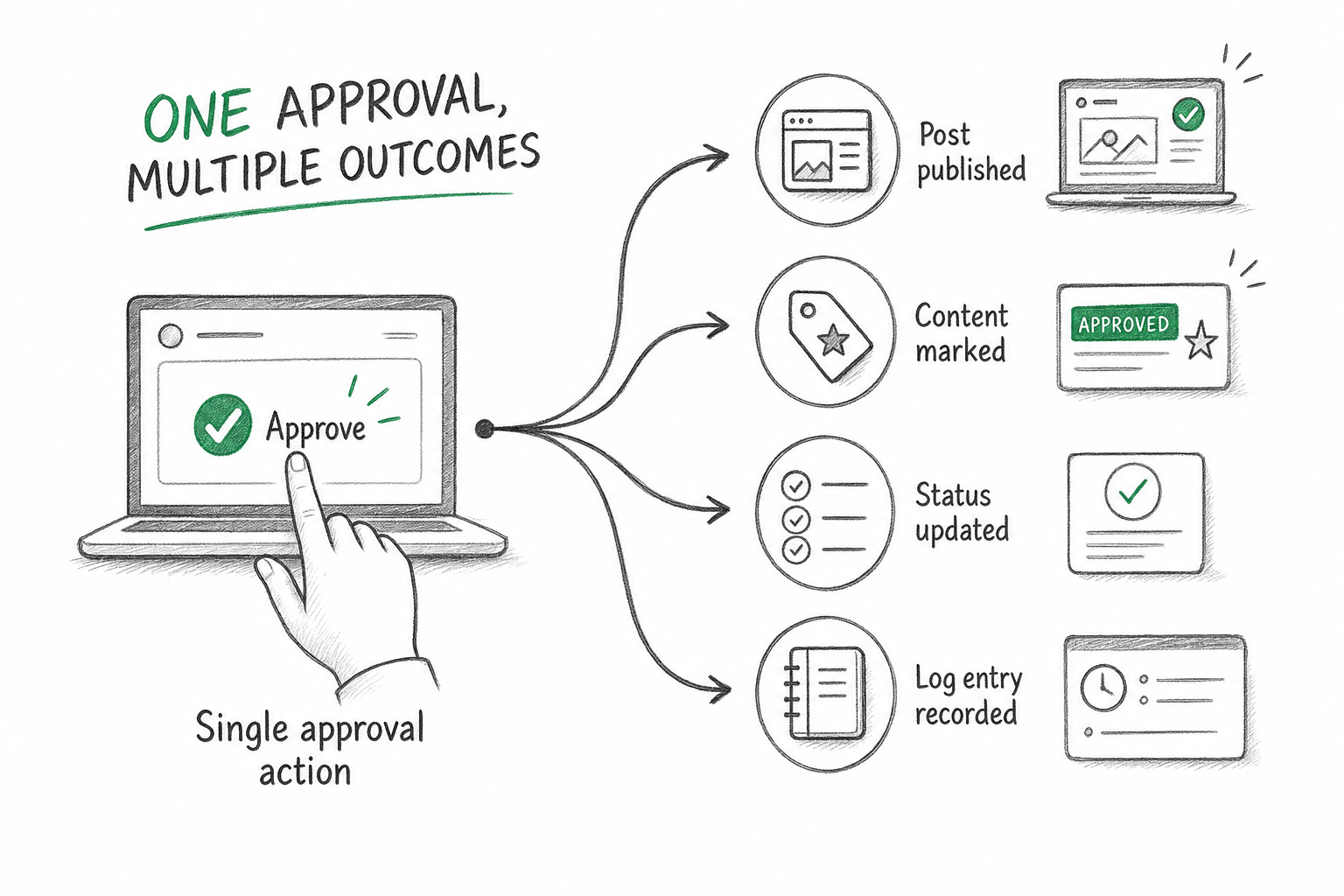
Concretely: the article is generated, a human opens it and approves it, and the act of approval writes three things at once — the published post, the AI-assistance disclosure in plain text and in structured data, and the log entry recording who approved it and when. Nobody had to remember anything. The transparency note lives as a page on the site and stays accurate because it describes a process that is actually running.
The difference in outcome is not subtle. In the first scenario you have articles and hope. In the second you have articles and an answerable record.
Why “designed in Italy” is a functional fact, not a flag
RankGrove was designed and built in Italy, which matters only because the obligations were in the room when the product was specified. Machine-readable AI marking, tracked approvals and transparency notes are not add-ons bolted on after a customer complained; they are how publishing works. A product built for a market with no disclosure requirement has no reason to make those decisions, and retrofitting them onto a draft-only tool means rebuilding the publishing step.
The practical consequence for an EU business: the compliance work is either done by the system or done by your team, and there is no third option.
Comparing the two workflows side by side
You have now seen both scenarios described. Here is the same comparison compressed, so you can check your current setup against it.
| Element | Compliance-aware workflow | Generic AI writer |
|---|---|---|
| Visible AI disclosure | Written into every published post | Added manually, if remembered |
| Machine-readable marking | In structured data at publish time | Usually absent |
| Approval record | Timestamped, tied to each article | Chat messages or nothing |
| Transparency note | Produced and kept current | Your job to write |
| Publishing step | Automated, human approves | Copy-paste by a person |
| Who carries the burden | Shared with the system | Entirely your team |
Read the last row first. Every difference above resolves into it. The question you are really answering when you choose a tool is not whether the vendor is European — it is how many manual compliance steps you are willing to perform, every week, indefinitely, without one of them being skipped.
If your honest answer is “we will skip some”, choose the workflow that does not ask you to.
Frequently asked questions
Does using a US-based AI writing tool break the EU AI Act?
No. Using a foreign tool is not itself a breach. What matters is whether the content you publish carries the required transparency for AI-assisted material, and whether you can document your review process. Those duties sit with your business as the party publishing, regardless of where the tool was built or where its servers are.
Can my vendor take on my AI Act compliance obligations by contract?
Not the ones that belong to you as the publishing organisation. A vendor has its own obligations as a supplier of an AI system; your transparency duty toward your readers stays with you. A contract can commit a vendor to provide features that make compliance easier, which is useful, but it cannot relocate the duty itself.
Is data residency the same as AI Act compliance?
No, and conflating them causes real mistakes. Data residency concerns where personal data is processed and under which transfer mechanism — a data protection question. AI transparency concerns whether published content is marked as AI-assisted and whether approvals are recorded. You need answers to both, on separate lines of your checklist.
What should I ask an AI writing vendor before signing?
Four questions. Does published content arrive with a visible AI-assistance note? Is that marking also present in structured data? Does the system log who approved each article and when? Does it produce a transparency note I can publish? If the answer to any is “you can add that yourself”, you have measured your own workload.
Do I need to disclose AI assistance if a human edited the article heavily?
Disclose anyway. Heavy editing improves quality; it does not change the fact that the draft was produced with AI assistance. A short, plain note stating that the article was written with AI support and reviewed by a person is accurate, costs nothing in credibility, and is far safer than deciding case by case how much editing counts as enough.
Does marking content as AI-generated hurt search rankings?
There is no evidence that an honest disclosure damages visibility. Search and AI systems assess whether content is useful, accurate and well structured. A transparency note is a trust signal, and being explicit about your process tends to help citation in AI answers rather than hinder it.
We already published dozens of AI-assisted articles with no disclosure. What now?
Start with an inventory: list what was AI-assisted, as far as you can reconstruct it. Add the disclosure to those posts, publish a transparency page describing your process, and move future publishing into a workflow that marks and logs automatically. Fixing the archive is finite work; fixing the process prevents it recurring.
The decision in one line
Your vendor’s passport is not the variable that matters — the variable is whether marking, approval logging and disclosure happen automatically at publish time or depend on someone remembering. At any serious publishing cadence, “depends on someone remembering” is the same as “will not happen consistently”, and an undocumented archive is a problem you discover late.
If you want to see how a publishing workflow with transparency built into the publish step is put together, see why RankGrove is designed this way — and if you have already decided to move, the plans and pricing show what running a compliant blog at real cadence costs.
This article was produced and published automatically with the help of artificial intelligence.
Start today
A blog like this, on your site
This article was written and published by RankGrove, with the method you read about on the site. Try it free on your WordPress: the first article lands in your drafts within ten minutes.
Start free trial